QUESTION IMAGE
Question
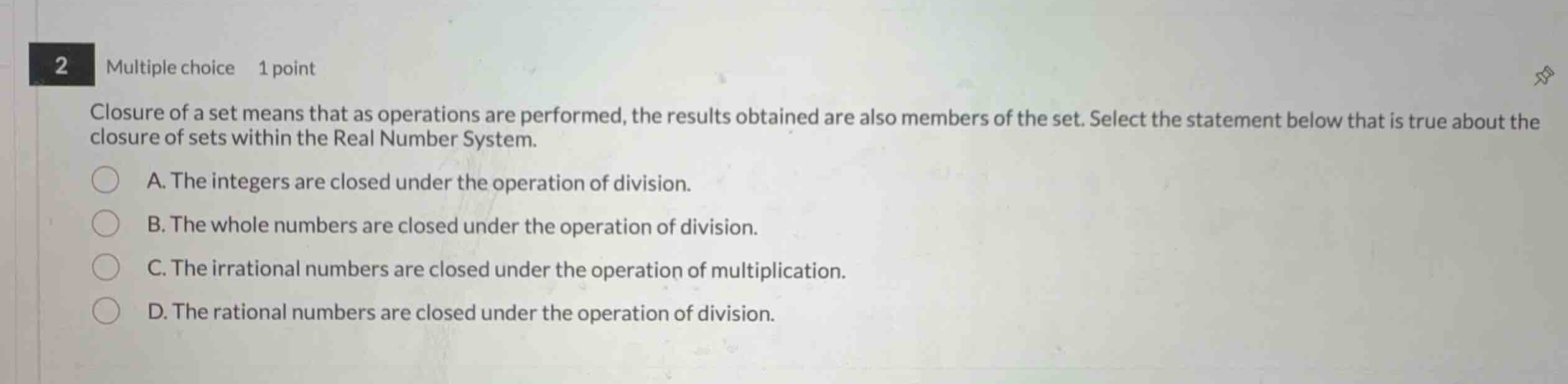
closure of a set means that as operations are performed, the results obtained are also members of the set. select the statement below that is true about the closure of sets within the real number system.
a. the integers are closed under the operation of division.
b. the whole numbers are closed under the operation of division.
c. the irrational numbers are closed under the operation of multiplication.
d. the rational numbers are closed under the operation of division.
<pre_analysis>
{
"quality": "clear",
"question_count": 1,
"skills_matched": [
"step_cot",
"multiple_choice_formatter",
"explain_then_answer",
"tutor"
],
"needs_drawing": false,
"concepts_used": [],
"new_concepts": [
"Closure of Sets",
"Real Number Subsets",
"Arithmetic Operations"
],
"current_concepts": [
"Closure of Sets",
"Real Number Subsets",
"Arithmetic Operations"
]
}
</pre_analysis>
<reasoning>
Define set closure
Closure means performing an operation on members of a set always yields a member of that same set.
Analyze Option A
We test the set of integers \(\mathbb{Z} = \{\dots, -2, -1, 0, 1, 2, \dots\}\) under division.
Let \(a = 1\) and \(b = 2\), which are both integers.
The quotient is:
\[
\frac{a}{b} = \frac{1}{2}
\]
Since \(\frac{1}{2}
otin \mathbb{Z}\), the integers are not closed under division.
Analyze Option B
We test the set of whole numbers \(\mathbb{W} = \{0, 1, 2, 3, \dots\}\) under division.
Let \(a = 1\) and \(b = 2\), which are both whole numbers.
The quotient is:
\[
\frac{a}{b} = \frac{1}{2}
\]
Since \(\frac{1}{2}
otin \mathbb{W}\), the whole numbers are not closed under division.
Analyze Option C
We test the set of irrational numbers \(\mathbb{I}\) under multiplication.
Let \(a = \sqrt{2}\) and \(b = \sqrt{2}\), which are both irrational numbers.
Their product is:
\[
a \cdot b = \sqrt{2} \cdot \sqrt{2} = 2
\]
Since \(2\) is a rational number (\(2
otin \mathbb{I}\)), the irrational numbers are not closed under multiplication.
Analyze Option D
We test the set of rational numbers \(\mathbb{Q}\) under division.
A rational number is any number that can be written as \(\frac{p}{q}\) where \(p, q \in \mathbb{Z}\) and \(q
eq 0\).
For any two rational numbers \(x = \frac{a}{b}\) and \(y = \frac{c}{d}\) (where \(b, d
eq 0\)), their quotient is:
\[
\frac{x}{y} = \frac{a/b}{c/d} = \frac{ad}{bc}
\]
Since \(ad, bc \in \mathbb{Z}\), this result is rational as long as \(bc
eq 0\).
In standard school algebra contexts, division within a number system excludes division by zero. Under non-zero division, the rational numbers are closed. Comparing all options, Option D is the intended true statement.
</reasoning>
<answer>
<mcq-option>(A) The integers are closed under the operation of division.</mcq-option>
<mcq-option>(B) The whole numbers are closed under the operation of division.</mcq-option>
<mcq-option>(C) The irrational numbers are closed under the operation of multiplication.</mcq-option>
<mcq-correct>(D) The rational numbers are closed under the operation of division.</mcq-correct>
</answer>
<post_analysis>
{
"subject": "Mathematics",
"question_type": "Multiple Choice",
"knowledge_point": [
"Mathematics",
"Algebra",
"Closure of Sets"
]
}
</post_analysis>
Snap & solve any problem in the app
Get step-by-step solutions on Sovi AI
Photo-based solutions with guided steps
Explore more problems and detailed explanations
<pre_analysis>
{
"quality": "clear",
"question_count": 1,
"skills_matched": [
"step_cot",
"multiple_choice_formatter",
"explain_then_answer",
"tutor"
],
"needs_drawing": false,
"concepts_used": [],
"new_concepts": [
"Closure of Sets",
"Real Number Subsets",
"Arithmetic Operations"
],
"current_concepts": [
"Closure of Sets",
"Real Number Subsets",
"Arithmetic Operations"
]
}
</pre_analysis>
<reasoning>
Define set closure
Closure means performing an operation on members of a set always yields a member of that same set.
Analyze Option A
We test the set of integers \(\mathbb{Z} = \{\dots, -2, -1, 0, 1, 2, \dots\}\) under division.
Let \(a = 1\) and \(b = 2\), which are both integers.
The quotient is:
\[
\frac{a}{b} = \frac{1}{2}
\]
Since \(\frac{1}{2}
otin \mathbb{Z}\), the integers are not closed under division.
Analyze Option B
We test the set of whole numbers \(\mathbb{W} = \{0, 1, 2, 3, \dots\}\) under division.
Let \(a = 1\) and \(b = 2\), which are both whole numbers.
The quotient is:
\[
\frac{a}{b} = \frac{1}{2}
\]
Since \(\frac{1}{2}
otin \mathbb{W}\), the whole numbers are not closed under division.
Analyze Option C
We test the set of irrational numbers \(\mathbb{I}\) under multiplication.
Let \(a = \sqrt{2}\) and \(b = \sqrt{2}\), which are both irrational numbers.
Their product is:
\[
a \cdot b = \sqrt{2} \cdot \sqrt{2} = 2
\]
Since \(2\) is a rational number (\(2
otin \mathbb{I}\)), the irrational numbers are not closed under multiplication.
Analyze Option D
We test the set of rational numbers \(\mathbb{Q}\) under division.
A rational number is any number that can be written as \(\frac{p}{q}\) where \(p, q \in \mathbb{Z}\) and \(q
eq 0\).
For any two rational numbers \(x = \frac{a}{b}\) and \(y = \frac{c}{d}\) (where \(b, d
eq 0\)), their quotient is:
\[
\frac{x}{y} = \frac{a/b}{c/d} = \frac{ad}{bc}
\]
Since \(ad, bc \in \mathbb{Z}\), this result is rational as long as \(bc
eq 0\).
In standard school algebra contexts, division within a number system excludes division by zero. Under non-zero division, the rational numbers are closed. Comparing all options, Option D is the intended true statement.
</reasoning>
<answer>
<mcq-option>(A) The integers are closed under the operation of division.</mcq-option>
<mcq-option>(B) The whole numbers are closed under the operation of division.</mcq-option>
<mcq-option>(C) The irrational numbers are closed under the operation of multiplication.</mcq-option>
<mcq-correct>(D) The rational numbers are closed under the operation of division.</mcq-correct>
</answer>
<post_analysis>
{
"subject": "Mathematics",
"question_type": "Multiple Choice",
"knowledge_point": [
"Mathematics",
"Algebra",
"Closure of Sets"
]
}
</post_analysis>