QUESTION IMAGE
Question
chapter 4 - uniform circular motion & gravity
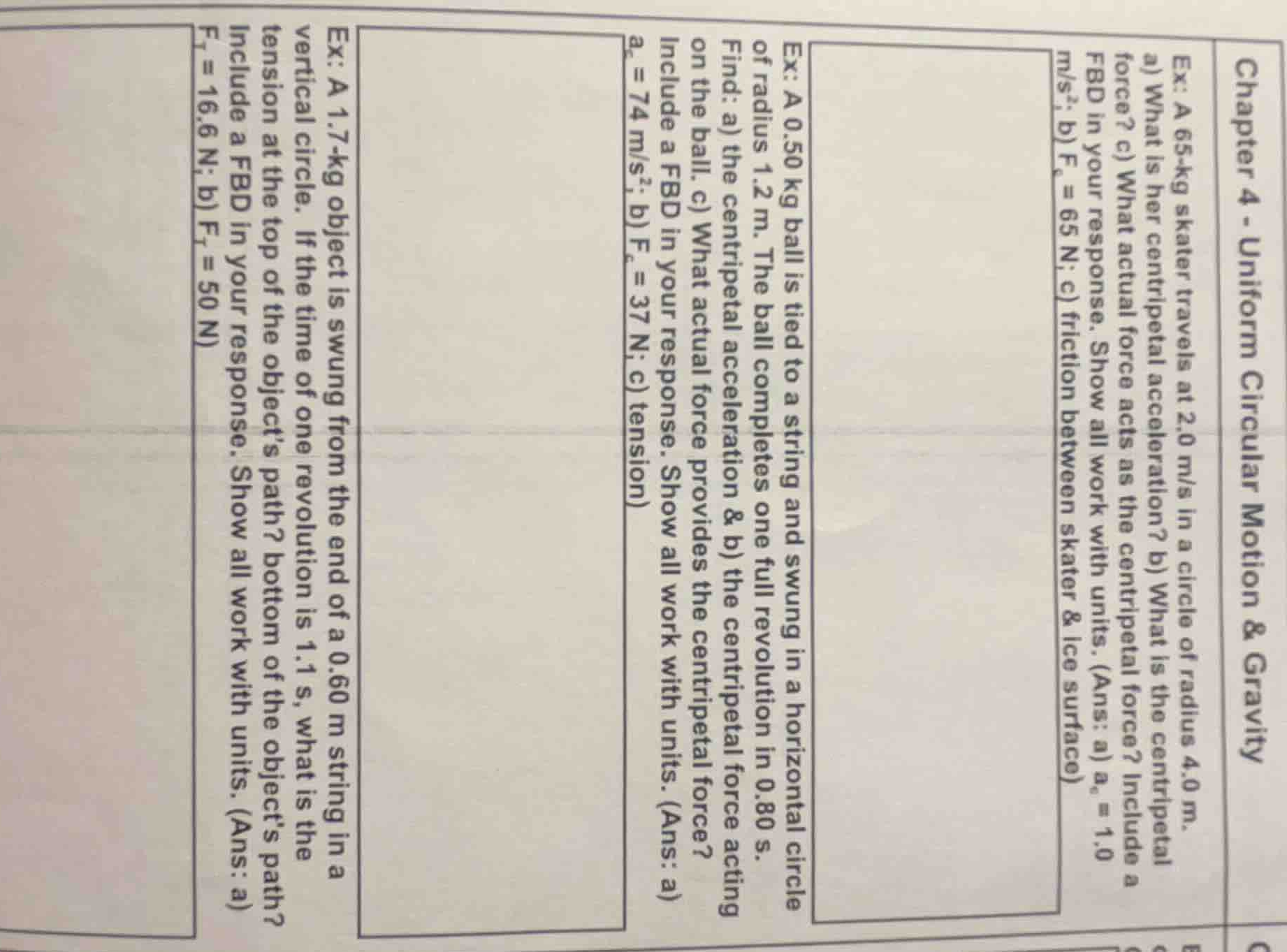
ex: a 65-kg skater travels at 2.0 m/s in a circle of radius 4.0 m.
a) what is her centripetal acceleration? b) what is the centripetal force? c) what actual force acts as the centripetal force? include a fbd in your response. show all work with units. (ans: a) \\(a_c = 1.0\text{ m/s}^2\\); b) \\(f_c = 65\text{ n}\\); c) friction between skater & ice surface)
ex: a 0.50 kg ball is tied to a string and swung in a horizontal circle of radius 1.2 m. the ball completes one full revolution in 0.80 s.
find: a) the centripetal acceleration & b) the centripetal force acting on the ball. c) what actual force provides the centripetal force? include a fbd in your response. show all work with units. (ans: a) \\(a_c = 74\text{ m/s}^2\\); b) \\(f_c = 37\text{ n}\\); c) tension)
ex: a 1.7-kg object is swung from the end of a 0.60 m string in a vertical circle. if the time of one revolution is 1.1 s, what is the tension at the top of the objects path? bottom of the objects path? include a fbd in your response. show all work with units. (ans: a) \\(f_t = 16.6\text{ n}\\); b) \\(f_t = 50\text{ n}\\))
Analyze the first example (Skater)
We are given:
- Mass of the skater, \(m = 65\text{ kg}\)
- Speed, \(v = 2.0\text{ m/s}\)
- Radius of the circular path, \(r = 4.0\text{ m}\)
We need to find:
- a) Centripetal acceleration, \(a_c\)
- b) Centripetal force, \(F_c\)
- c) The actual force acting as the centripetal force.
Let's calculate:
- a) Centripetal acceleration formula:
- b) Centripetal force formula:
- c) The physical force that keeps the skater in a circular path on ice is the static friction force between the skater's blades and the ice surface.
Analyze the second example (Ball on a string in horizontal circle)
We are given:
- Mass of the ball, \(m = 0.50\text{ kg}\)
- Radius of the circle, \(r = 1.2\text{ m}\)
- Period of one full revolution, \(T = 0.80\text{ s}\)
We need to find:
- a) Centripetal acceleration, \(a_c\)
- b) Centripetal force, \(F_c\)
- c) The actual force providing the centripetal force.
Let's calculate:
- Speed \(v\) in terms of period \(T\):
- a) Centripetal acceleration:
- b) Centripetal force:
- c) The actual force pulling the ball inward along the horizontal circle is the tension in the string.
Analyze the third example (Object in vertical circle)
We are given:
- Mass of the object, \(m = 1.7\text{ kg}\)
- Radius of the vertical circle, \(r = 0.60\text{ m}\)
- Period of one revolution, \(T = 1.1\text{ s}\)
We need to find:
- a) Tension at the top of the path, \(F_{T,\text{top}}\)
- b) Tension at the bottom of the path, \(F_{T,\text{bottom}}\)
Let's calculate:
- Centripetal acceleration:
- Gravity force acting on the object:
- a) At the top of the path, both gravity and tension point downward towards the center:
- b) At the bottom of the path, tension points upward (towards the center) and gravity points downward (away from the center):

Snap & solve any problem in the app
Get step-by-step solutions on Sovi AI
Photo-based solutions with guided steps
Explore more problems and detailed explanations
Question 1
Ex: A 65-kg skater travels at 2.0 m/s in a circle of radius 4.0 m.
- a) What is her centripetal acceleration?
- b) What is the centripetal force?
- c) What actual force acts as the centripetal force?
The static friction force between the skater's blades and the ice surface.
---
Question 2
Ex: A 0.50 kg ball is tied to a string and swung in a horizontal circle of radius 1.2 m. The ball completes one full revolution in 0.80 s.
- a) Find the centripetal acceleration:
- b) Find the centripetal force acting on the ball:
- c) What actual force provides the centripetal force?
The tension force in the string.
---
Question 3
Ex: A 1.7-kg object is swung from the end of a 0.60 m string in a vertical circle. If the time of one revolution is 1.1 s, what is the tension at the top of the object's path? bottom of the object's path?
- a) Tension at the top of the path:
- b) Tension at the bottom of the path: