QUESTION IMAGE
Question
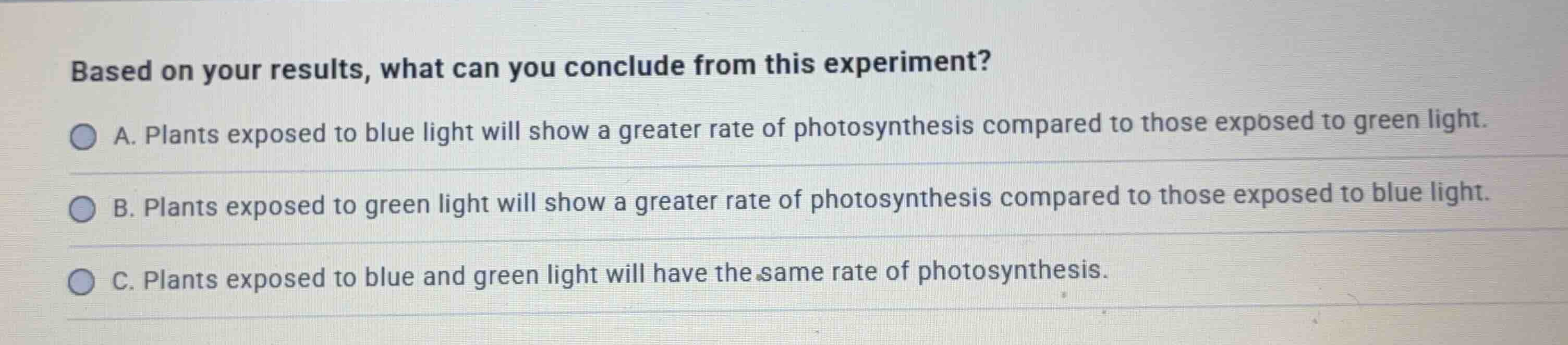
based on your results, what can you conclude from this experiment?
a. plants exposed to blue light will show a greater rate of photosynthesis compared to those exposed to green light.
b. plants exposed to green light will show a greater rate of photosynthesis compared to those exposed to blue light.
c. plants exposed to blue and green light will have the same rate of photosynthesis.
Analyze photosynthetic pigments
Using the Light Absorption and Reflection knowledge point
- Chlorophylls \(a\) and \(b\) are the primary pigments driving photosynthesis.
- These pigments absorb light strongly in the blue (\(\sim 430\text{–}450\text{ nm}\)) and red (\(\sim 640\text{–}660\text{ nm}\)) regions of the spectrum.
- Green light (\(\sim 500\text{–}550\text{ nm}\)) is mostly reflected or transmitted rather than absorbed, which is why most plant leaves appear green.
Relate absorption to photosynthetic rate
Using the Action Spectrum of Photosynthesis knowledge point
- The action spectrum of photosynthesis closely matches the absorption spectrum of chlorophyll.
- High light absorption in the blue region translates directly to a high rate of photosynthesis.
- Low light absorption in the green region results in a significantly lower rate of photosynthesis.
- Therefore, plants exposed to blue light will show a greater rate of photosynthesis compared to those exposed to green light.

Snap & solve any problem in the app
Get step-by-step solutions on Sovi AI
Photo-based solutions with guided steps
Explore more problems and detailed explanations
- A. Plants exposed to blue light will show a greater rate of photosynthesis compared to those exposed to green light. (Correct answer)
- B. Plants exposed to green light will show a greater rate of photosynthesis compared to those exposed to blue light.
- C. Plants exposed to blue and green light will have the same rate of photosynthesis.