QUESTION IMAGE
Question
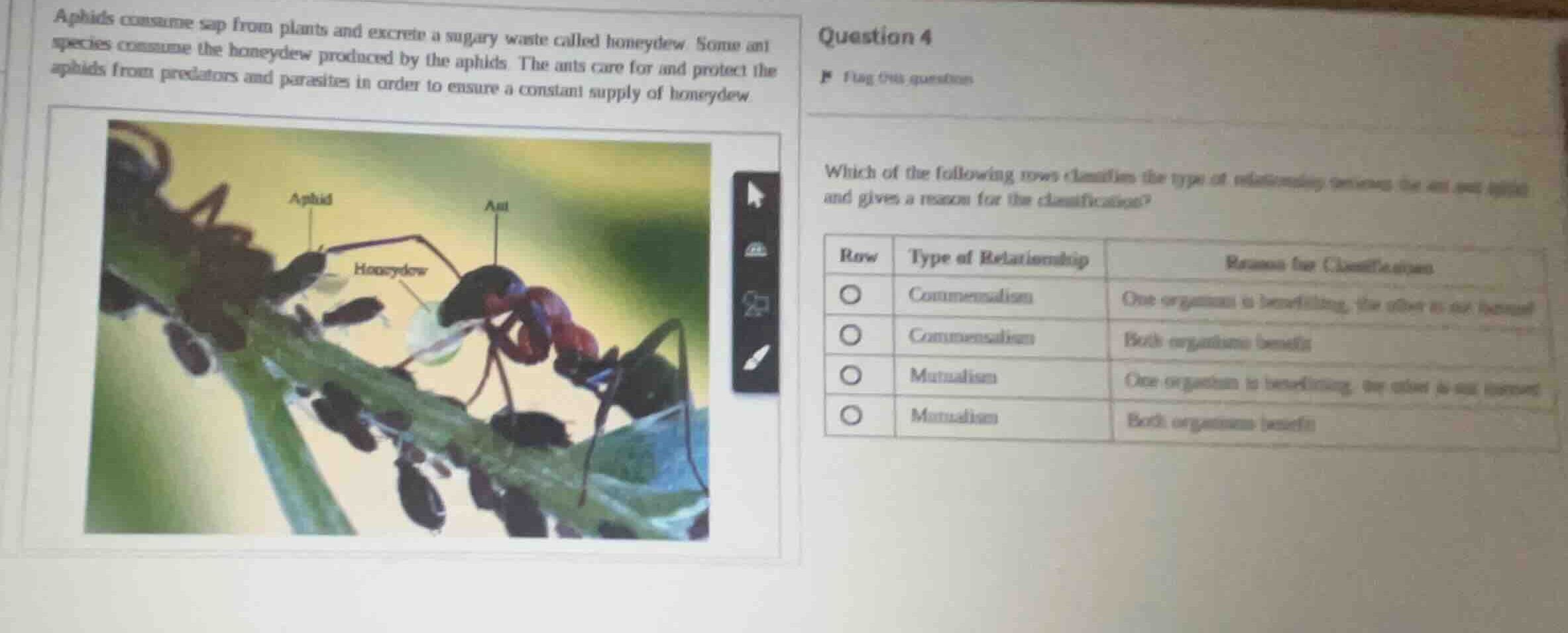
aphids consume sap from plants and excrete a sugary waste called honeydew. some ant species consume the honeydew produced by the aphids. the ants care for and protect the aphids from predators and parasites in order to ensure a constant supply of honeydew.
question 4
which of the following rows classifies the type of relationship between the ant and aphid and gives a reason for the classification?
\
<pre_analysis>
{
"quality": "clear",
"question_count": 1,
"skills_matched": [
"direct_cot",
"multiple_choice_formatter",
"explain_then_answer",
"tutor"
],
"needs_drawing": false,
"concepts_used": [
"Ecological Niche",
"Ecosystem Roles"
],
"new_concepts": [
"Symbiotic Relationships",
"Mutualism",
"Commensalism"
],
"current_concepts": [
"Ecological Niche",
"Ecosystem Roles",
"Symbiotic Relationships",
"Mutualism",
"Commensalism"
]
}
</pre_analysis>
<reasoning>
Analyze the interaction
The text states that ants consume honeydew produced by aphids, which benefits the ants. It also states that ants care for and protect the aphids from predators and parasites, which benefits the aphids. Since both organisms benefit, this is a mutualistic relationship.
Evaluate the options
We need to find the row where the relationship is classified as "Mutualism" and the reason is "Both organisms benefit".
- Row 1: Commensalism / One organism is benefiting, the other is not harmed (Incorrect)
- Row 2: Commensalism / Both organisms benefit (Incorrect classification)
- Row 3: Mutualism / One organism is benefiting, the other is not harmed (Incorrect reason)
- Row 4: Mutualism / Both organisms benefit (Correct)
</reasoning>
<answer>
<mcq-option>Row 1: Commensalism | One organism is benefiting, the other is not harmed</mcq-option>
<mcq-option>Row 2: Commensalism | Both organisms benefit</mcq-option>
<mcq-option>Row 3: Mutualism | One organism is benefiting, the other is not harmed</mcq-option>
<mcq-correct>Row 4: Mutualism | Both organisms benefit</mcq-correct>
</answer>
<post_analysis>
{
"subject": "Natural Science",
"question_type": "Multiple Choice",
"knowledge_point": [
"Natural Science",
"Biology",
"Symbiotic Relationships"
]
}
</post_analysis>
Snap & solve any problem in the app
Get step-by-step solutions on Sovi AI
Photo-based solutions with guided steps
Explore more problems and detailed explanations
<pre_analysis>
{
"quality": "clear",
"question_count": 1,
"skills_matched": [
"direct_cot",
"multiple_choice_formatter",
"explain_then_answer",
"tutor"
],
"needs_drawing": false,
"concepts_used": [
"Ecological Niche",
"Ecosystem Roles"
],
"new_concepts": [
"Symbiotic Relationships",
"Mutualism",
"Commensalism"
],
"current_concepts": [
"Ecological Niche",
"Ecosystem Roles",
"Symbiotic Relationships",
"Mutualism",
"Commensalism"
]
}
</pre_analysis>
<reasoning>
Analyze the interaction
The text states that ants consume honeydew produced by aphids, which benefits the ants. It also states that ants care for and protect the aphids from predators and parasites, which benefits the aphids. Since both organisms benefit, this is a mutualistic relationship.
Evaluate the options
We need to find the row where the relationship is classified as "Mutualism" and the reason is "Both organisms benefit".
- Row 1: Commensalism / One organism is benefiting, the other is not harmed (Incorrect)
- Row 2: Commensalism / Both organisms benefit (Incorrect classification)
- Row 3: Mutualism / One organism is benefiting, the other is not harmed (Incorrect reason)
- Row 4: Mutualism / Both organisms benefit (Correct)
</reasoning>
<answer>
<mcq-option>Row 1: Commensalism | One organism is benefiting, the other is not harmed</mcq-option>
<mcq-option>Row 2: Commensalism | Both organisms benefit</mcq-option>
<mcq-option>Row 3: Mutualism | One organism is benefiting, the other is not harmed</mcq-option>
<mcq-correct>Row 4: Mutualism | Both organisms benefit</mcq-correct>
</answer>
<post_analysis>
{
"subject": "Natural Science",
"question_type": "Multiple Choice",
"knowledge_point": [
"Natural Science",
"Biology",
"Symbiotic Relationships"
]
}
</post_analysis>