QUESTION IMAGE
Question
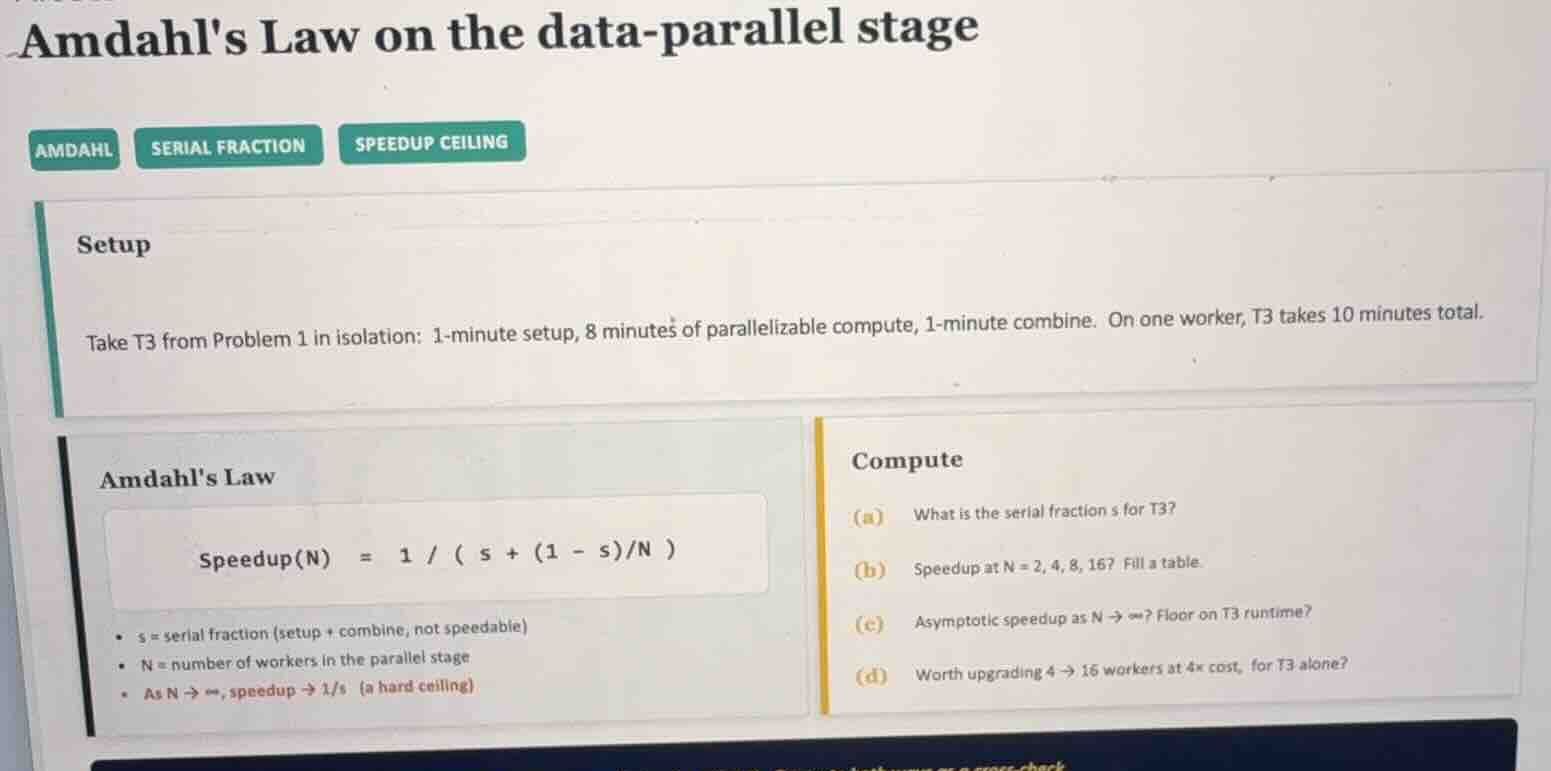
amdahls law on the data-parallel stage
setup
take t3 from problem 1 in isolation: 1-minute setup, 8 minutes of parallelizable compute, 1-minute combine. on one worker, t3 takes 10 minutes total.
amdahls law
\\(\text{speedup}(n) = 1 / (s + (1 - s)/n)\\)
- \\(s =\\) serial fraction (setup + combine, not speedable)
- \\(n =\\) number of workers in the parallel stage
- as \\(n \to \infty\\), \\(\text{speedup} \to 1/s\\) (a hard ceiling)
compute
(a) what is the serial fraction \\(s\\) for t3?
(b) speedup at \\(n = 2, 4, 8, 16\\)? fill a table.
(c) asymptotic speedup as \\(n \to \infty\\)? floor on t3 runtime?
(d) worth upgrading \\(4 \to 16\\) workers at \\(4\times\\) cost, for t3 alone?
Identify given parameters
We analyze the setup parameters.
The total sequential runtime is:
The non-parallelizable (serial) parts are:
- Setup: \(1\text{ minute}\)
- Combine: \(1\text{ minute}\)
The parallelizable compute part is:
- Compute: \(8\text{ minutes}\)
Calculate serial fraction
We find the serial fraction \(s\).
The serial portion is:
The serial fraction \(s\) is:
Compute speedup values
We apply Amdahl's Law:
We calculate for each \(N\):
- For \(N = 2\):
- For \(N = 4\):
- For \(N = 8\):
- For \(N = 16\):
Determine asymptotic limits
We find the limits as \(N \to \infty\).
The asymptotic speedup limit is:
The minimum possible runtime (floor) is:
Evaluate upgrade cost-benefit
We analyze upgrading from \(4 \to 16\) workers.
- At \(N = 4\), speedup is \(2.5\).
- At \(N = 16\), speedup is \(4.0\).
- The speedup improvement factor is:
- The cost increases by \(4\times\) (\(16\) workers vs \(4\) workers).
Since a \(4\times\) cost increase yields only a \(1.6\times\) speedup, this upgrade is highly inefficient and not worth it for T3 alone.

Snap & solve any problem in the app
Get step-by-step solutions on Sovi AI
Photo-based solutions with guided steps
Explore more problems and detailed explanations
(a) The serial fraction \(s\) is:
(b) Speedup table:
| Number of Workers (\(N\)) | Speedup |
|---|---|
| 4 | \(2.50\) |
| 8 | \(3.33\) |
| 16 | \(4.00\) |
(c) Asymptotic limits:
- Asymptotic speedup as \(N \to \infty\): \(5\)
- Floor on T3 runtime: \(2\text{ minutes}\)
(d) Upgrade evaluation:
- No, it is not worth upgrading. Increasing workers from \(4 \to 16\) increases the resource cost by \(4\times\) but only improves performance by \(1.6\times\) (\(2.5 \to 4.0\) speedup), which is highly cost-inefficient.