QUESTION IMAGE
Question
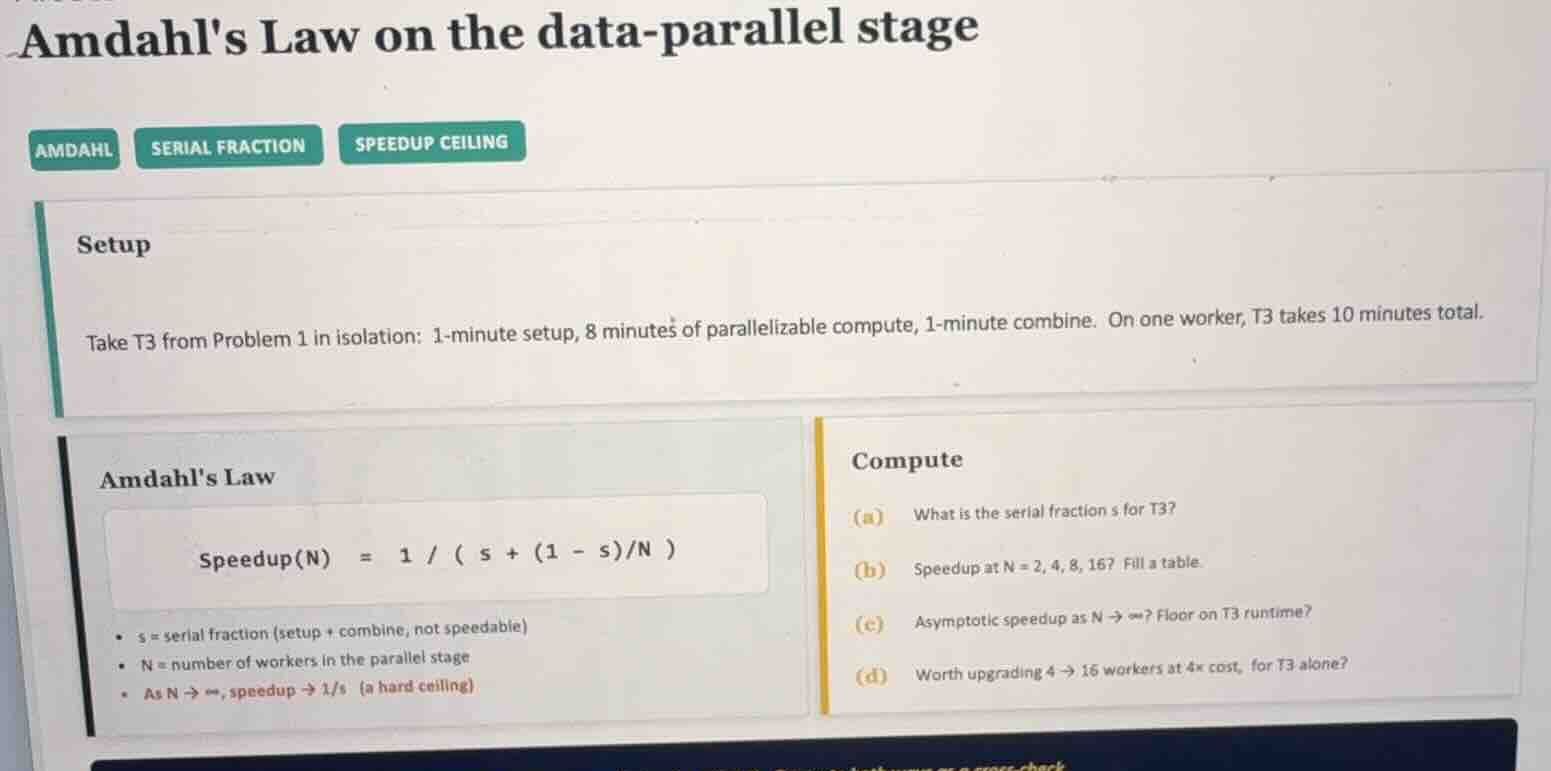
amdahls law on the data-parallel stage
setup
take t3 from problem 1 in isolation: 1-minute setup, 8 minutes of parallelizable compute, 1-minute combine. on one worker, t3 takes 10 minutes total.
amdahls law
\\(\text{speedup}(n) = 1 / (s + (1 - s)/n)\\)
- \\(s =\\) serial fraction (setup + combine, not speedable)
- \\(n =\\) number of workers in the parallel stage
- as \\(n \to \infty\\), \\(\text{speedup} \to 1/s\\) (a hard ceiling)
compute
(a) what is the serial fraction \\(s\\) for t3?
(b) speedup at \\(n = 2, 4, 8, 16\\)? fill a table.
(c) asymptotic speedup as \\(n \to \infty\\)? floor on t3 runtime?
(d) worth upgrading \\(4 \to 16\\) workers at \\(4\times\\) cost, for t3 alone?
<pre_analysis>
{
"quality": "clear",
"question_count": 1,
"skills_matched": [
"step_cot",
"explain_then_answer",
"tutor"
],
"needs_drawing": false,
"concepts_used": [],
"new_concepts": [
"Amdahl's Law",
"Serial Fraction",
"Parallel Speedup"
],
"current_concepts": [
"Amdahl's Law",
"Serial Fraction",
"Parallel Speedup"
]
}
</pre_analysis>
<reasoning>
Identify given parameters
We analyze the setup parameters.
The total sequential runtime is:
\[
T_{\text{total}} = 10\text{ minutes}
\]
The non-parallelizable (serial) parts are:
- Setup: \(1\text{ minute}\)
- Combine: \(1\text{ minute}\)
The parallelizable compute part is:
- Compute: \(8\text{ minutes}\)
Calculate serial fraction
We find the serial fraction \(s\).
The serial portion is:
\[
T_{\text{serial}} = 1 + 1 = 2\text{ minutes}
\]
The serial fraction \(s\) is:
\[
s = \frac{T_{\text{serial}}}{T_{\text{total}}} = \frac{2}{10} = 0.2
\]
Compute speedup values
We apply Amdahl's Law:
\[
\text{Speedup}(N) = \frac{1}{s + \frac{1 - s}{N}} = \frac{1}{0.2 + \frac{0.8}{N}}
\]
We calculate for each \(N\):
- For \(N = 2\):
\[
\text{Speedup}(2) = \frac{1}{0.2 + \frac{0.8}{2}} = \frac{1}{0.2 + 0.4} = \frac{1}{0.6} \approx 1.67
\]
- For \(N = 4\):
\[
\text{Speedup}(4) = \frac{1}{0.2 + \frac{0.8}{4}} = \frac{1}{0.2 + 0.2} = \frac{1}{0.4} = 2.50
\]
- For \(N = 8\):
\[
\text{Speedup}(8) = \frac{1}{0.2 + \frac{0.8}{8}} = \frac{1}{0.2 + 0.1} = \frac{1}{0.3} \approx 3.33
\]
- For \(N = 16\):
\[
\text{Speedup}(16) = \frac{1}{0.2 + \frac{0.8}{16}} = \frac{1}{0.2 + 0.05} = \frac{1}{0.25} = 4.00
\]
Determine asymptotic limits
We find the limits as \(N \to \infty\).
The asymptotic speedup limit is:
\[
\lim_{N \to \infty} \text{Speedup}(N) = \frac{1}{s} = \frac{1}{0.2} = 5
\]
The minimum possible runtime (floor) is:
\[
T_{\text{floor}} = T_{\text{serial}} = 2\text{ minutes}
\]
Evaluate upgrade cost-benefit
We analyze upgrading from \(4 \to 16\) workers.
- At \(N = 4\), speedup is \(2.5\).
- At \(N = 16\), speedup is \(4.0\).
- The speedup improvement factor is:
\[
\frac{4.0}{2.5} = 1.6\times
\]
- The cost increases by \(4\times\) (\(16\) workers vs \(4\) workers).
Since a \(4\times\) cost increase yields only a \(1.6\times\) speedup, this upgrade is highly inefficient and not worth it for T3 alone.
</reasoning>
<answer>
(a) The serial fraction \(s\) is:
\[
s = 0.2 \quad (20\%)
\]
(b) Speedup table:
| Number of Workers (\(N\)) | Speedup |
|---|---|
| 4 | \(2.50\) |
| 8 | \(3.33\) |
| 16 | \(4.00\) |
(c) Asymptotic limits:
- Asymptotic speedup as \(N \to \infty\): \(5\)
- Floor on T3 runtime: \(2\text{ minutes}\)
(d) Upgrade evaluation:
- No, it is not worth upgrading. Increasing workers from \(4 \to 16\) increases the resource cost by \(4\times\) but only improves performance by \(1.6\times\) (\(2.5 \to 4.0\) speedup), which is highly cost-inefficient.
</answer>
<post_analysis>
{
"subject": "Mathematics",
"question_type": "Multi-part",
"knowledge_point": [
"Mathematics",
"Algebra",
"Amdahl's Law"
]
}
</post_analysis>
Snap & solve any problem in the app
Get step-by-step solutions on Sovi AI
Photo-based solutions with guided steps
Explore more problems and detailed explanations
<pre_analysis>
{
"quality": "clear",
"question_count": 1,
"skills_matched": [
"step_cot",
"explain_then_answer",
"tutor"
],
"needs_drawing": false,
"concepts_used": [],
"new_concepts": [
"Amdahl's Law",
"Serial Fraction",
"Parallel Speedup"
],
"current_concepts": [
"Amdahl's Law",
"Serial Fraction",
"Parallel Speedup"
]
}
</pre_analysis>
<reasoning>
Identify given parameters
We analyze the setup parameters.
The total sequential runtime is:
\[
T_{\text{total}} = 10\text{ minutes}
\]
The non-parallelizable (serial) parts are:
- Setup: \(1\text{ minute}\)
- Combine: \(1\text{ minute}\)
The parallelizable compute part is:
- Compute: \(8\text{ minutes}\)
Calculate serial fraction
We find the serial fraction \(s\).
The serial portion is:
\[
T_{\text{serial}} = 1 + 1 = 2\text{ minutes}
\]
The serial fraction \(s\) is:
\[
s = \frac{T_{\text{serial}}}{T_{\text{total}}} = \frac{2}{10} = 0.2
\]
Compute speedup values
We apply Amdahl's Law:
\[
\text{Speedup}(N) = \frac{1}{s + \frac{1 - s}{N}} = \frac{1}{0.2 + \frac{0.8}{N}}
\]
We calculate for each \(N\):
- For \(N = 2\):
\[
\text{Speedup}(2) = \frac{1}{0.2 + \frac{0.8}{2}} = \frac{1}{0.2 + 0.4} = \frac{1}{0.6} \approx 1.67
\]
- For \(N = 4\):
\[
\text{Speedup}(4) = \frac{1}{0.2 + \frac{0.8}{4}} = \frac{1}{0.2 + 0.2} = \frac{1}{0.4} = 2.50
\]
- For \(N = 8\):
\[
\text{Speedup}(8) = \frac{1}{0.2 + \frac{0.8}{8}} = \frac{1}{0.2 + 0.1} = \frac{1}{0.3} \approx 3.33
\]
- For \(N = 16\):
\[
\text{Speedup}(16) = \frac{1}{0.2 + \frac{0.8}{16}} = \frac{1}{0.2 + 0.05} = \frac{1}{0.25} = 4.00
\]
Determine asymptotic limits
We find the limits as \(N \to \infty\).
The asymptotic speedup limit is:
\[
\lim_{N \to \infty} \text{Speedup}(N) = \frac{1}{s} = \frac{1}{0.2} = 5
\]
The minimum possible runtime (floor) is:
\[
T_{\text{floor}} = T_{\text{serial}} = 2\text{ minutes}
\]
Evaluate upgrade cost-benefit
We analyze upgrading from \(4 \to 16\) workers.
- At \(N = 4\), speedup is \(2.5\).
- At \(N = 16\), speedup is \(4.0\).
- The speedup improvement factor is:
\[
\frac{4.0}{2.5} = 1.6\times
\]
- The cost increases by \(4\times\) (\(16\) workers vs \(4\) workers).
Since a \(4\times\) cost increase yields only a \(1.6\times\) speedup, this upgrade is highly inefficient and not worth it for T3 alone.
</reasoning>
<answer>
(a) The serial fraction \(s\) is:
\[
s = 0.2 \quad (20\%)
\]
(b) Speedup table:
| Number of Workers (\(N\)) | Speedup |
|---|---|
| 4 | \(2.50\) |
| 8 | \(3.33\) |
| 16 | \(4.00\) |
(c) Asymptotic limits:
- Asymptotic speedup as \(N \to \infty\): \(5\)
- Floor on T3 runtime: \(2\text{ minutes}\)
(d) Upgrade evaluation:
- No, it is not worth upgrading. Increasing workers from \(4 \to 16\) increases the resource cost by \(4\times\) but only improves performance by \(1.6\times\) (\(2.5 \to 4.0\) speedup), which is highly cost-inefficient.
</answer>
<post_analysis>
{
"subject": "Mathematics",
"question_type": "Multi-part",
"knowledge_point": [
"Mathematics",
"Algebra",
"Amdahl's Law"
]
}
</post_analysis>