QUESTION IMAGE
Question
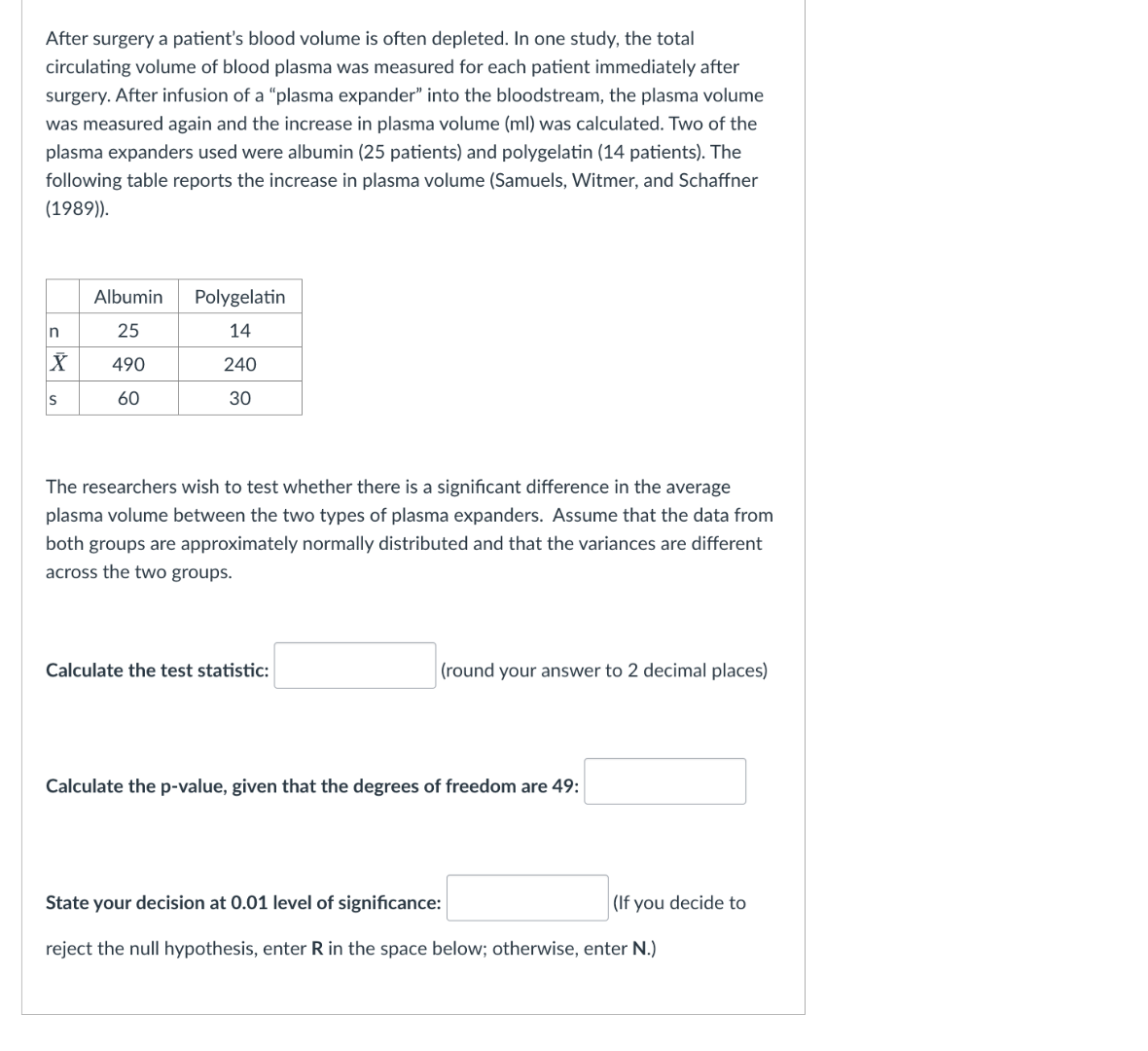
after surgery a patients blood volume is often depleted. in one study, the total circulating volume of blood plasma was measured for each patient immediately after surgery. after infusion of a \plasma expander\ into the bloodstream, the plasma volume was measured again and the increase in plasma volume (ml) was calculated. two of the plasma expanders used were albumin (25 patients) and polygelatin (14 patients). the following table reports the increase in plasma volume (samuels, witmer, and schaffner (1989)).
\
the researchers wish to test whether there is a significant difference in the average plasma volume between the two types of plasma expanders. assume that the data from both groups are approximately normally distributed and that the variances are different across the two groups.
calculate the test statistic: (round your answer to 2 decimal places)
calculate the p-value, given that the degrees of freedom are 49:
state your decision at 0.01 level of significance: (if you decide to reject the null hypothesis, enter r in the space below; otherwise, enter n.)
⚡ Using what you learned: Hypothesis Testing
Step 1: Calculate the test statistic
We are comparing the means of two independent groups (Albumin and Polygelatin) with unequal variances (Welch's t-test).
The formula for the two-sample t-statistic is:
Given data:
- Group 1 (Albumin): \( n_1 = 25 \), \( \bar{X}_1 = 490 \), \( s_1 = 60 \)
- Group 2 (Polygelatin): \( n_2 = 14 \), \( \bar{X}_2 = 240 \), \( s_2 = 30 \)
Substitute the values:
Rounding to 2 decimal places:
Step 2: Calculate the p-value
The alternative hypothesis is two-tailed because we want to test "whether there is a significant difference":
- \( H_0: \mu_1 - \mu_2 = 0 \)
- \( H_a: \mu_1 - \mu_2
eq 0 \)
Using the t-distribution with \( \text{df} = 49 \) and \( t = 17.32 \):
Since \( t = 17.32 \) is extremely large, the probability of obtaining a value this extreme or more extreme under the null hypothesis is virtually zero.
Step 3: State the decision
Compare the p-value to the significance level \( \alpha = 0.01 \):
Since the p-value is less than \( \alpha \), we reject the null hypothesis (\( H_0 \)).

Snap & solve any problem in the app
Get step-by-step solutions on Sovi AI
Photo-based solutions with guided steps
Explore more problems and detailed explanations
- Calculate the test statistic: 17.32
- Calculate the p-value, given that the degrees of freedom are 49: 0.0000 (or <0.0001)
- State your decision at 0.01 level of significance: R