QUESTION IMAGE
Question
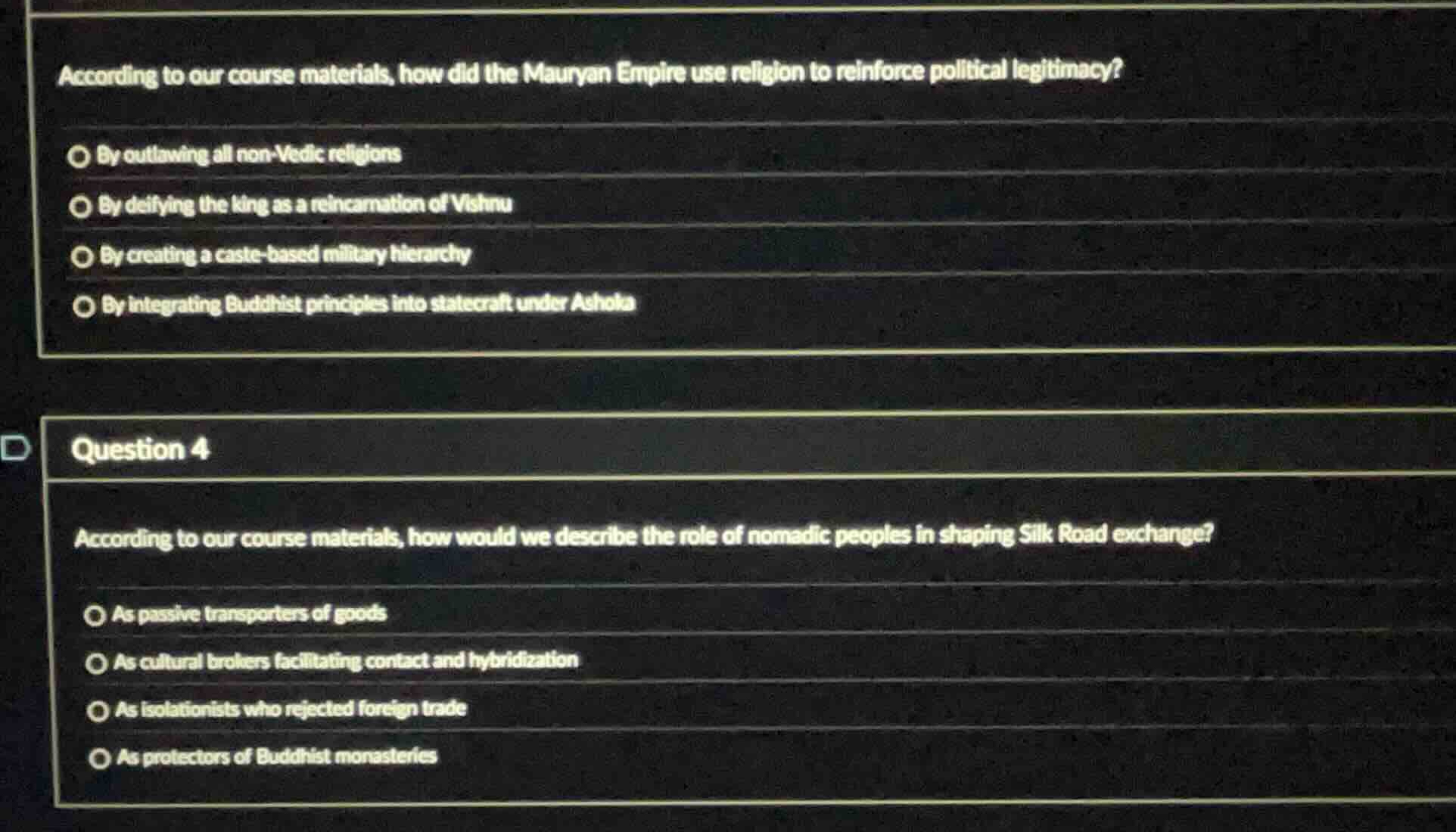
according to our course materials, how did the mauryan empire use religion to reinforce political legitimacy?
- by outlawing all non-vedic religions
- by deifying the king as a reincarnation of vishnu
- by creating a caste-based military hierarchy
- by integrating buddhist principles into statecraft under ashoka
question 4
according to our course materials, how would we describe the role of nomadic peoples in shaping silk road exchange?
- as passive transporters of goods
- as cultural brokers facilitating contact and hybridization
- as isolationists who rejected foreign trade
- as protectors of buddhist monasteries
Analyze Mauryan Empire political legitimacy
The Mauryan Empire, particularly under Emperor Ashoka, famously integrated Buddhist principles (Dhamma) into its governance, law, and statecraft to unite a diverse empire and reinforce political legitimacy, rather than outlawing other religions or deifying the king as Vishnu.
Analyze nomadic role in Silk Road exchange
Nomadic peoples acted as active cultural brokers, facilitators, and intermediaries who connected different sedentary civilizations, spreading technologies, ideas, and goods, which led to cultural hybridization, rather than being passive transporters or isolationists.

Snap & solve any problem in the app
Get step-by-step solutions on Sovi AI
Photo-based solutions with guided steps
Explore more problems and detailed explanations
Question 1
- By outlawing all non-Vedic religions
- By deifying the king as a reincarnation of Vishnu
- By creating a caste-based military hierarchy
- By integrating Buddhist principles into statecraft under Ashoka (Correct answer)
Question 2
- As passive transporters of goods
- As cultural brokers facilitating contact and hybridization (Correct answer)
- As isolationists who rejected foreign trade
- As protectors of Buddhist monasteries