QUESTION IMAGE
Question
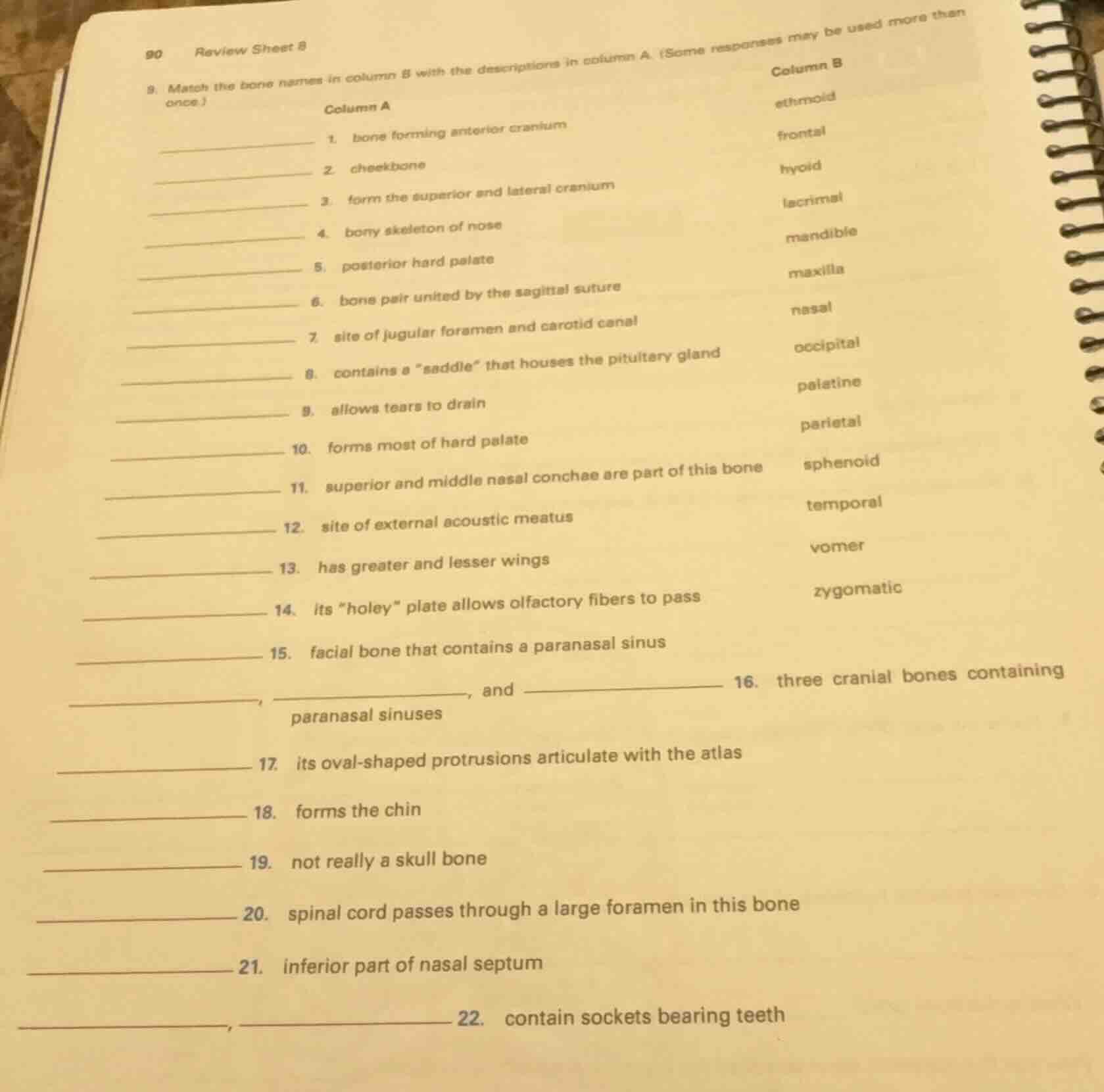
90 review sheet 8
- match the bone names in column b with the descriptions in column a. (some responses may be used more than once.)
column a
- bone forming anterior cranium
- cheekbone
- form the superior and lateral cranium
- bony skeleton of nose
- posterior hard palate
- bone pair united by the sagittal suture
- site of jugular foramen and carotid canal
- contains a \saddle\ that houses the pituitary gland
- allows tears to drain
- forms most of hard palate
- superior and middle nasal conchae are part of this bone
- site of external acoustic meatus
- has greater and lesser wings
- its \holey\ plate allows olfactory fibers to pass
- facial bone that contains a paranasal sinus
- three cranial bones containing paranasal sinuses
- its oval-shaped protrusions articulate with the atlas
- forms the chin
- not really a skull bone
- spinal cord passes through a large foramen in this bone
- inferior part of nasal septum
- contain sockets bearing teeth
column b
ethmoid
frontal
hyoid
lacrimal
mandible
maxilla
nasal
occipital
palatine
parietal
sphenoid
temporal
vomer
zygomatic
Identify anterior cranium and cheekbone
Using the Skeletal Anatomy knowledge point, we match the first two descriptions. The bone forming the anterior cranium is the frontal bone. The cheekbone is the zygomatic bone.
Identify cranial vault and nasal structures
Using the Skeletal Anatomy knowledge point, the parietal bones form the superior and lateral cranium. The nasal bones form the bony bridge/skeleton of the nose. The palatine bones form the posterior portion of the hard palate. The sagittal suture unites the pair of parietal bones.
Identify cranial base landmarks and sinuses
Using the Skeletal Anatomy knowledge point, the temporal bone contains the jugular foramen, carotid canal, and external acoustic meatus. The sphenoid bone contains the sella turcica ("saddle" for the pituitary gland) and has greater and lesser wings. The lacrimal bone contains the lacrimal fossa allowing tears to drain. The maxilla forms most of the hard palate. The ethmoid bone contains the superior and middle nasal conchae, as well as the cribriform ("holey") plate for olfactory fibers.
Identify sinuses, articulations, and lower jaw
Using the Skeletal Anatomy knowledge point, the facial bones containing paranasal sinuses are the maxillae. The three cranial bones containing paranasal sinuses are the frontal, ethmoid, and sphenoid bones. The occipital bone has oval-shaped condyles that articulate with the atlas, and contains the foramen magnum for the spinal cord. The mandible forms the chin. The hyoid bone is suspended in the neck and not considered a skull bone.
Identify nasal septum and tooth sockets
Using the Skeletal Anatomy knowledge point, the vomer forms the inferior part of the nasal septum. The mandible and maxilla contain alveolar processes (sockets) bearing teeth.

Snap & solve any problem in the app
Get step-by-step solutions on Sovi AI
Photo-based solutions with guided steps
Explore more problems and detailed explanations
Question 1
frontal
Question 2
zygomatic
Question 3
parietal
Question 4
nasal
Question 5
palatine
Question 6
parietal
Question 7
temporal
Question 8
sphenoid
Question 9
lacrimal
Question 10
maxilla
Question 11
ethmoid
Question 12
temporal
Question 13
sphenoid
Question 14
ethmoid
Question 15
maxilla
Question 16
frontal, ethmoid, sphenoid
Question 17
occipital
Question 18
mandible
Question 19
hyoid
Question 20
occipital
Question 21
vomer
Question 22
mandible, maxilla