QUESTION IMAGE
Question
- valid sudoku
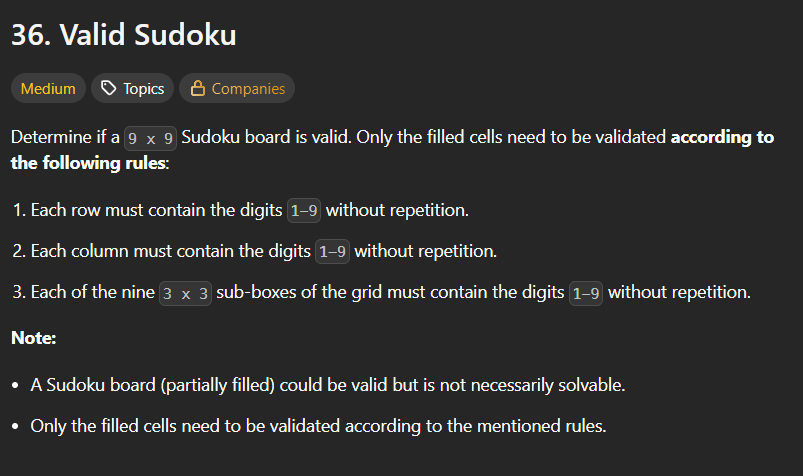
determine if a (9 \times 9) sudoku board is valid. only the filled cells need to be validated according to the following rules:
- each row must contain the digits (1-9) without repetition.
- each column must contain the digits (1-9) without repetition.
- each of the nine (3 \times 3) sub-boxes of the grid must contain the digits (1-9) without repetition.
note:
- a sudoku board (partially filled) could be valid but is not necessarily solvable.
- only the filled cells need to be validated according to the mentioned rules.
🆕 New Concept Discovered: Hash Set Lookup
Using unique keys to track duplicates in groups.
Step 1: Understand the constraints
To determine if a \(9 \times 9\) Sudoku board is valid, we must verify three conditions for the filled cells (non-empty cells containing digits '1' through '9'):
- No duplicate digits in any row.
- No duplicate digits in any column.
- No duplicate digits in any of the nine \(3 \times 3\) sub-boxes.
We do not need to solve the Sudoku; we only need to check if the current state violates any of these three rules.
Step 2: Design a tracking mechanism
To check for duplicates efficiently, we can use hash sets. A hash set allows us to store elements and check if an element has been seen before in \(O(1)\) time.
We can represent the presence of a digit in three ways:
- Rows: Track seen digits using a unique identifier for each row, such as
"row " + r + " has " + val. - Columns: Track seen digits using a unique identifier for each column, such as
"col " + c + " has " + val. - Sub-boxes: The board has nine \(3 \times 3\) sub-boxes. We can map any cell coordinate \((r, c)\) to a sub-box index using integer division:
This gives us a unique coordinate pair \((\text{box\_row}, \text{box\_col})\) for each of the nine boxes. We can represent this as "box " + (r/3) + "-" + (c/3) + " has " + val.
Step 3: Algorithm implementation
We iterate through every cell \((r, c)\) on the \(9 \times 9\) board:
- If the cell is empty (usually represented by
'.'), we skip it. - If the cell contains a digit
val, we generate its three corresponding string keys:
row_key = f"row {r} {val}"col_key = f"col {c} {val}"box_key = f"box {r//3}-{c//3} {val}"
- We check if any of these keys already exist in our global hash set:
- If any key is already present, it means we have found a duplicate in that row, column, or box. We immediately return
False. - If none of the keys are present, we add all three keys to our set and continue.
- If we finish checking the entire board without finding any duplicates, we return
True.
Python Code Example
class Solution:
    def isValidSudoku(self, board: list[list[str]]) -> bool:
        seen = set()
        for r in range(9):
            for c in range(9):
                val = board[r][c]
                if val != '.':
                    row_key = f"row {r} {val}"
                    col_key = f"col {c} {val}"
                    box_key = f"box {r//3}-{c//3} {val}"

                    if row_key in seen or col_key in seen or box_key in seen:
                        return False

                    seen.add(row_key)
                    seen.add(col_key)
                    seen.add(box_key)
        return True
Snap & solve any problem in the app
Get step-by-step solutions on Sovi AI
Photo-based solutions with guided steps
Explore more problems and detailed explanations
To determine if a \(9 \times 9\) Sudoku board is valid, iterate through each cell and use a hash set to track seen numbers across rows, columns, and \(3 \times 3\) sub-boxes.
For any filled cell at row \(r\) and column \(c\) containing digit \(v\):
- Check if \(v\) already exists in row \(r\).
- Check if \(v\) already exists in column \(c\).
- Check if \(v\) already exists in the sub-box indexed by \((\lfloor r/3
floor, \lfloor c/3
floor)\).
If any duplicate is detected, the board is invalid (False). If the entire board is scanned without duplicates, the board is valid (True).