QUESTION IMAGE
Question
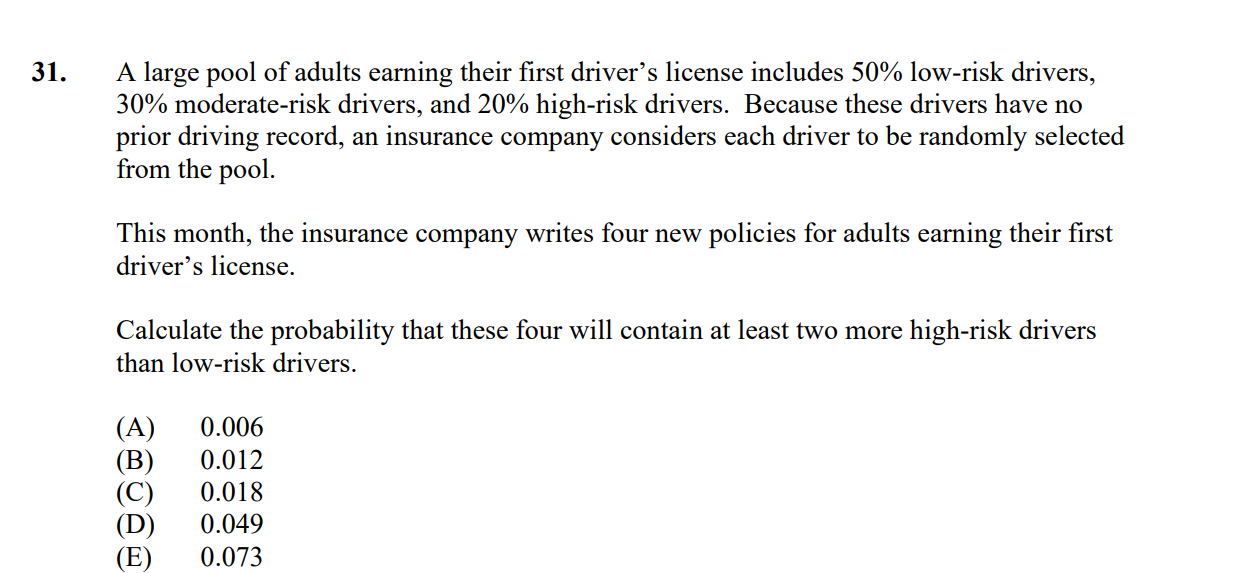
- a large pool of adults earning their first drivers license includes 50% low-risk drivers, 30% moderate-risk drivers, and 20% high-risk drivers. because these drivers have no prior driving record, an insurance company considers each driver to be randomly selected from the pool.
this month, the insurance company writes four new policies for adults earning their first drivers license.
calculate the probability that these four will contain at least two more high-risk drivers than low-risk drivers.
(a) 0.006
(b) 0.012
(c) 0.018
(d) 0.049
(e) 0.073
🆕 New Concept Discovered: Multinomial Probability
Finding probabilities when outcomes have more than two categories
Step 1: Define variables and probabilities
Let \( L \), \( M \), and \( H \) represent the number of low-risk, moderate-risk, and high-risk drivers selected among the four new policies, respectively.
The total number of drivers is:
The probabilities for selecting a single driver from each category are:
Step 2: Identify the condition
We need to find the probability that there are at least two more high-risk drivers than low-risk drivers. Mathematically, this condition is:
Since the total number of drivers is 4 (\( L + M + H = 4 \)), we can find all non-negative integer combinations of \((L, M, H)\) that satisfy both \( L + M + H = 4 \) and \( H \ge L + 2 \).
Let's test possible values for \( H \):
- If \( H = 4 \):
Since \( H = 4 \), we must have \( L = 0 \) and \( M = 0 \). This satisfies the condition.
- Scenario 1: \((L, M, H) = (0, 0, 4)\)
- If \( H = 3 \):
Since \( H = 3 \), the remaining \( 4 - 3 = 1 \) driver can be either low-risk (\( L \)) or moderate-risk (\( M \)).
- If \( L = 1 \), then \( M = 0 \). This satisfies \( L \le 1 \).
- Scenario 2: \((L, M, H) = (1, 0, 3)\)
- If \( L = 0 \), then \( M = 1 \). This satisfies \( L \le 1 \).
- Scenario 3: \((L, M, H) = (0, 1, 3)\)
- If \( H = 2 \):
Since \( H = 2 \) and \( L = 0 \), we must have \( M = 4 - 2 - 0 = 2 \).
- Scenario 4: \((L, M, H) = (0, 2, 2)\)
- If \( H < 2 \):
It is impossible to satisfy \( H \ge L + 2 \) because \( L \) cannot be negative.
Thus, the favorable scenarios for \((L, M, H)\) are:
- \((0, 0, 4)\)
- \((1, 0, 3)\)
- \((0, 1, 3)\)
- \((0, 2, 2)\)
Step 3: Calculate the probability of each scenario
We use the multinomial probability formula:
- Scenario 1: \((0, 0, 4)\)
- Scenario 2: \((1, 0, 3)\)
- Scenario 3: \((0, 1, 3)\)
- Scenario 4: \((0, 2, 2)\)
Step 4: Sum the probabilities
Sum the probabilities of all mutually exclusive favorable scenarios:
Rounding to three decimal places gives \( 0.049 \).

Snap & solve any problem in the app
Get step-by-step solutions on Sovi AI
Photo-based solutions with guided steps
Explore more problems and detailed explanations
(D) 0.049