QUESTION IMAGE
Question
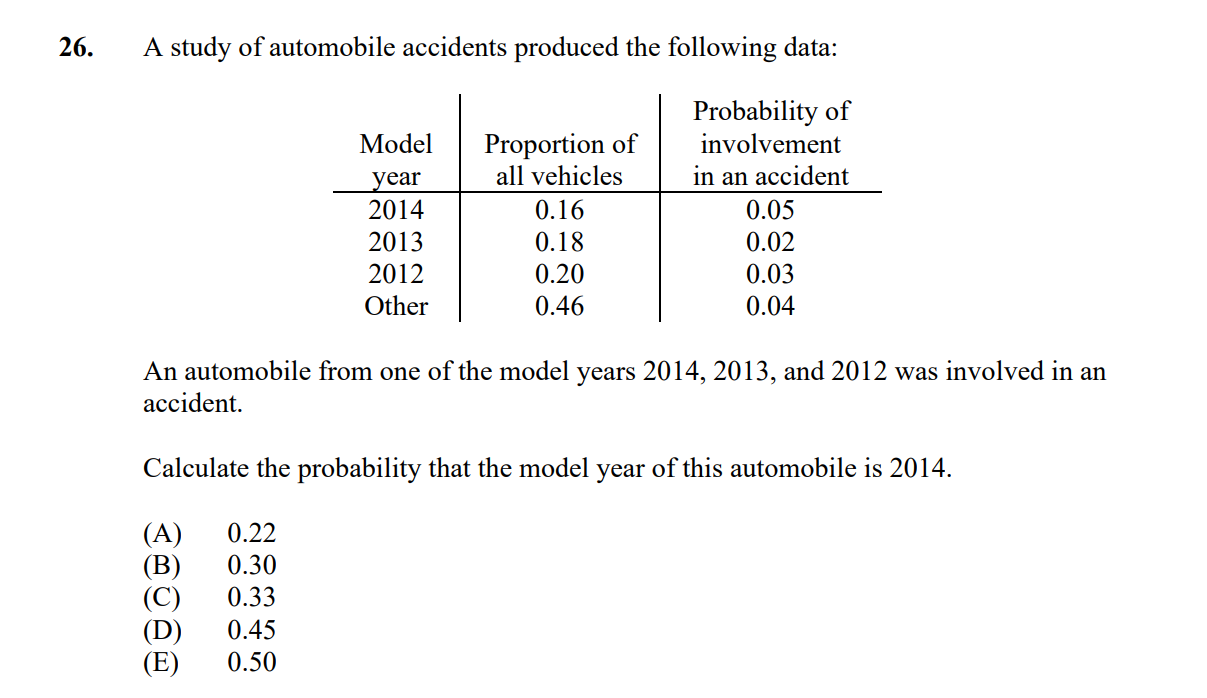
- a study of automobile accidents produced the following data:
\
an automobile from one of the model years 2014, 2013, and 2012 was involved in an accident.
calculate the probability that the model year of this automobile is 2014.
(a) 0.22
(b) 0.30
(c) 0.33
(d) 0.45
(e) 0.50
⚡ Using what you learned: Conditional Probability · 🆕 New: Bayes' Theorem
Updating your belief given new evidence
Step 1: Define the events and identify given probabilities
Let \( Y \) be the model year of a randomly selected vehicle, and let \( A \) be the event that a vehicle is involved in an accident.
From the table, we have the prior probabilities of selecting a vehicle from each category:
We also have the conditional probabilities of being involved in an accident given the model year:
Step 2: Understand the condition
We are given that an automobile from one of the model years 2014, 2013, and 2012 was involved in an accident.
Let this condition be event \( C \). Event \( C \) means the vehicle is from the set \( \{2014, 2013, 2012\} \) AND it was involved in an accident \( A \).
Since the model years are mutually exclusive, the probability of this conditioning event occurring is:
Using the multiplication rule \( P(A \cap Y) = P(Y) \cdot P(A \mid Y) \), we calculate each term:
Now, sum these values to find the total probability of the conditioning event:
Step 3: Calculate the conditional probability
We want to find the probability that the model year is 2014, given that the vehicle meets condition \( C \):
Since a vehicle from 2014 involved in an accident is automatically part of condition \( C \), the numerator is simply the probability of a 2014 vehicle being in an accident:
Now, divide to find the final probability:
Comparing this to the given options, the closest value is \( 0.45 \).

Snap & solve any problem in the app
Get step-by-step solutions on Sovi AI
Photo-based solutions with guided steps
Explore more problems and detailed explanations
(D) 0.45