Sovi.AI - AI Math Tutor

Scan to solve math questions

QUESTION IMAGE

18. which set of health complications is most strongly associated with …

Question

  1. which set of health complications is most strongly associated with the digestive system?

a. vomit and heartburn
b. dry cough and lung cancer
c. irritability and mood swings
d. high blood pressure and heart disease

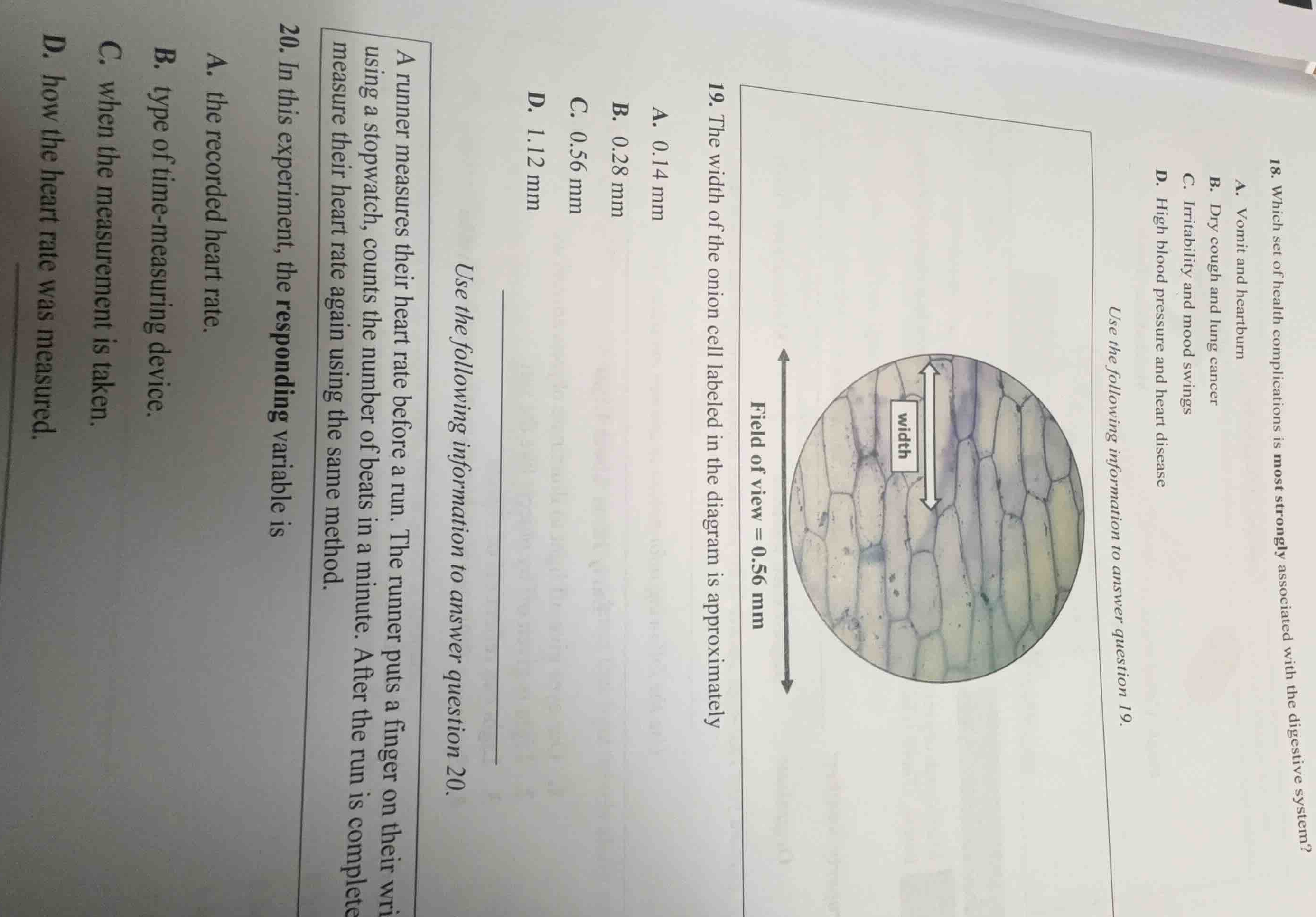
use the following information to answer question 19.

field of view = 0.56 mm

  1. the width of the onion cell labeled in the diagram is approximately

a. 0.14 mm
b. 0.28 mm
c. 0.56 mm
d. 1.12 mm

use the following information to answer question 20.

a runner measures their heart rate before a run. the runner puts a finger on their wrist and, using a stopwatch, counts the number of beats in a minute. after the run is completed, they measure their heart rate again using the same method.

  1. in this experiment, the responding variable is

a. the recorded heart rate.
b. type of time-measuring device.
c. when the measurement is taken.
d. how the heart rate was measured.

Explanation:

Response

<pre_analysis>
{
"quality": "clear",
"question_count": 3,
"skills_matched": [
"step_cot",
"multiple_choice_formatter",
"explain_then_answer",
"tutor"
],
"needs_drawing": false,
"concepts_used": [
"Plant and Animal Cells"
],
"new_concepts": [
"Microscope Field of View",
"Experimental Variables"
],
"current_concepts": [
"Plant and Animal Cells",
"Microscope Field of View",
"Experimental Variables"
]
}
</pre_analysis>

<reasoning>

Identify digestive system complications

The digestive system is responsible for breaking down food, absorbing nutrients, and eliminating waste. Complications directly associated with this system include conditions affecting the stomach and esophagus. Vomit (emesis) and heartburn (acid reflux) are classic symptoms of digestive tract irritation or dysfunction. Other options like dry cough/lung cancer (respiratory), irritability/mood swings (nervous/endocrine), and high blood pressure/heart disease (circulatory) belong to different systems.

Estimate onion cell width

Using the Plant and Animal Cells concept, we observe the cells under a microscope. The total field of view is given as \(0.56\text{ mm}\). Looking at the circular field of view, approximately 4 cells of similar width can fit side-by-side across the entire diameter. The cell labeled "width" spans roughly one-quarter (\(\frac{1}{4}\)) of the total field of view diameter.
\[
\text{Cell Width} \approx \frac{\text{Field of View}}{4} = \frac{0.56\text{ mm}}{4} = 0.14\text{ mm}
\]

Determine the responding variable

In an experiment, the responding (dependent) variable is the factor that is measured or observed to see how it changes in response to the independent variable. Here, the runner measures their heart rate before and after a run to see how physical activity affects it. Therefore, the variable that responds to the exercise is the recorded heart rate.
</reasoning>

<answer>

Question 18

<mcq-correct>(A) Vomit and heartburn</mcq-correct>
<mcq-option>(B) Dry cough and lung cancer</mcq-option>
<mcq-option>(C) Irritability and mood swings</mcq-option>
<mcq-option>(D) High blood pressure and heart disease</mcq-option>

Question 19

<mcq-correct>(A) 0.14 mm</mcq-correct>
<mcq-option>(B) 0.28 mm</mcq-option>
<mcq-option>(C) 0.56 mm</mcq-option>
<mcq-option>(D) 1.12 mm</mcq-option>

Question 20

<mcq-correct>(A) the recorded heart rate.</mcq-correct>
<mcq-option>(B) type of time-measuring device.</mcq-option>
<mcq-option>(C) when the measurement is taken.</mcq-option>
<mcq-option>(D) how the heart rate was measured.</mcq-option>
</answer>

<post_analysis>
{
"subject": "Natural Science",
"question_type": "Multiple Choice",
"knowledge_point": [
"Natural Science",
"Biology",
"Cell Biology and Experimental Design"
]
}
</post_analysis>

Answer:

<pre_analysis>
{
"quality": "clear",
"question_count": 3,
"skills_matched": [
"step_cot",
"multiple_choice_formatter",
"explain_then_answer",
"tutor"
],
"needs_drawing": false,
"concepts_used": [
"Plant and Animal Cells"
],
"new_concepts": [
"Microscope Field of View",
"Experimental Variables"
],
"current_concepts": [
"Plant and Animal Cells",
"Microscope Field of View",
"Experimental Variables"
]
}
</pre_analysis>

<reasoning>

Identify digestive system complications

The digestive system is responsible for breaking down food, absorbing nutrients, and eliminating waste. Complications directly associated with this system include conditions affecting the stomach and esophagus. Vomit (emesis) and heartburn (acid reflux) are classic symptoms of digestive tract irritation or dysfunction. Other options like dry cough/lung cancer (respiratory), irritability/mood swings (nervous/endocrine), and high blood pressure/heart disease (circulatory) belong to different systems.

Estimate onion cell width

Using the Plant and Animal Cells concept, we observe the cells under a microscope. The total field of view is given as \(0.56\text{ mm}\). Looking at the circular field of view, approximately 4 cells of similar width can fit side-by-side across the entire diameter. The cell labeled "width" spans roughly one-quarter (\(\frac{1}{4}\)) of the total field of view diameter.
\[
\text{Cell Width} \approx \frac{\text{Field of View}}{4} = \frac{0.56\text{ mm}}{4} = 0.14\text{ mm}
\]

Determine the responding variable

In an experiment, the responding (dependent) variable is the factor that is measured or observed to see how it changes in response to the independent variable. Here, the runner measures their heart rate before and after a run to see how physical activity affects it. Therefore, the variable that responds to the exercise is the recorded heart rate.
</reasoning>

<answer>

Question 18

<mcq-correct>(A) Vomit and heartburn</mcq-correct>
<mcq-option>(B) Dry cough and lung cancer</mcq-option>
<mcq-option>(C) Irritability and mood swings</mcq-option>
<mcq-option>(D) High blood pressure and heart disease</mcq-option>

Question 19

<mcq-correct>(A) 0.14 mm</mcq-correct>
<mcq-option>(B) 0.28 mm</mcq-option>
<mcq-option>(C) 0.56 mm</mcq-option>
<mcq-option>(D) 1.12 mm</mcq-option>

Question 20

<mcq-correct>(A) the recorded heart rate.</mcq-correct>
<mcq-option>(B) type of time-measuring device.</mcq-option>
<mcq-option>(C) when the measurement is taken.</mcq-option>
<mcq-option>(D) how the heart rate was measured.</mcq-option>
</answer>

<post_analysis>
{
"subject": "Natural Science",
"question_type": "Multiple Choice",
"knowledge_point": [
"Natural Science",
"Biology",
"Cell Biology and Experimental Design"
]
}
</post_analysis>