QUESTION IMAGE
Question
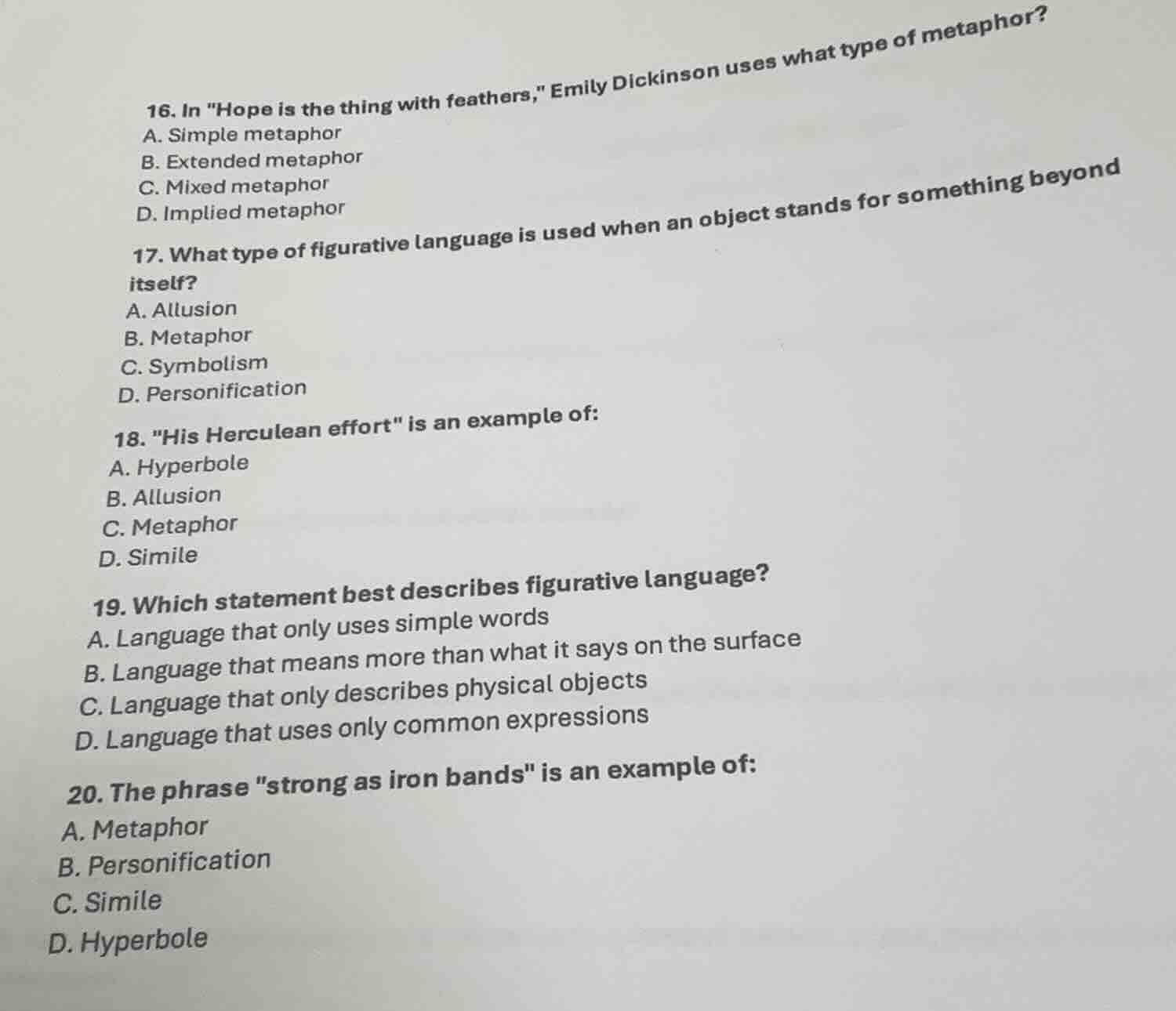
- in \hope is the thing with feathers,\ emily dickinson uses what type of metaphor?
a. simple metaphor
b. extended metaphor
c. mixed metaphor
d. implied metaphor
- what type of figurative language is used when an object stands for something beyond itself?
a. allusion
b. metaphor
c. symbolism
d. personification
- \his herculean effort\ is an example of:
a. hyperbole
b. allusion
c. metaphor
d. simile
- which statement best describes figurative language?
a. language that only uses simple words
b. language that means more than what it says on the surface
c. language that only describes physical objects
d. language that uses only common expressions
- the phrase \strong as iron bands\ is an example of:
a. metaphor
b. personification
c. simile
d. hyperbole
Analyze Question 16
In "Hope is the thing with feathers," Emily Dickinson compares hope to a bird throughout the entire poem. This is a classic example of an Extended Metaphor, which is a metaphor developed over several lines or the entire work.
Analyze Question 17
When an object stands for something beyond its literal meaning, it represents a deeper concept. This literary device is known as Symbolism. While Metaphor compares two things directly, symbolism uses a concrete object to represent an abstract idea.
Analyze Question 18
The phrase "Herculean effort" refers directly to Hercules, a famous hero from Greek mythology. Referencing a well-known historical, mythological, or literary figure is an Allusion.
Analyze Question 19
Figurative Language is defined as language that goes beyond the literal, surface-level meaning of words to create a fresh, vivid image or comparison. Therefore, it means more than what it says on the surface.
Analyze Question 20
The phrase "strong as iron bands" uses the comparative word "as" to make a direct comparison between two unlike things. This is the defining characteristic of a Simile.

Snap & solve any problem in the app
Get step-by-step solutions on Sovi AI
Photo-based solutions with guided steps
Explore more problems and detailed explanations
Question 16
- A. Simple metaphor
- B. Extended metaphor (Correct answer)
- C. Mixed metaphor
- D. Implied metaphor
Question 17
- A. Allusion
- B. Metaphor
- C. Symbolism (Correct answer)
- D. Personification
Question 18
- A. Hyperbole
- B. Allusion (Correct answer)
- C. Metaphor
- D. Simile
Question 19
- A. Language that only uses simple words
- B. Language that means more than what it says on the surface (Correct answer)
- C. Language that only describes physical objects
- D. Language that uses only common expressions
Question 20
- A. Metaphor
- B. Personification
- C. Simile (Correct answer)
- D. Hyperbole