QUESTION IMAGE
Question
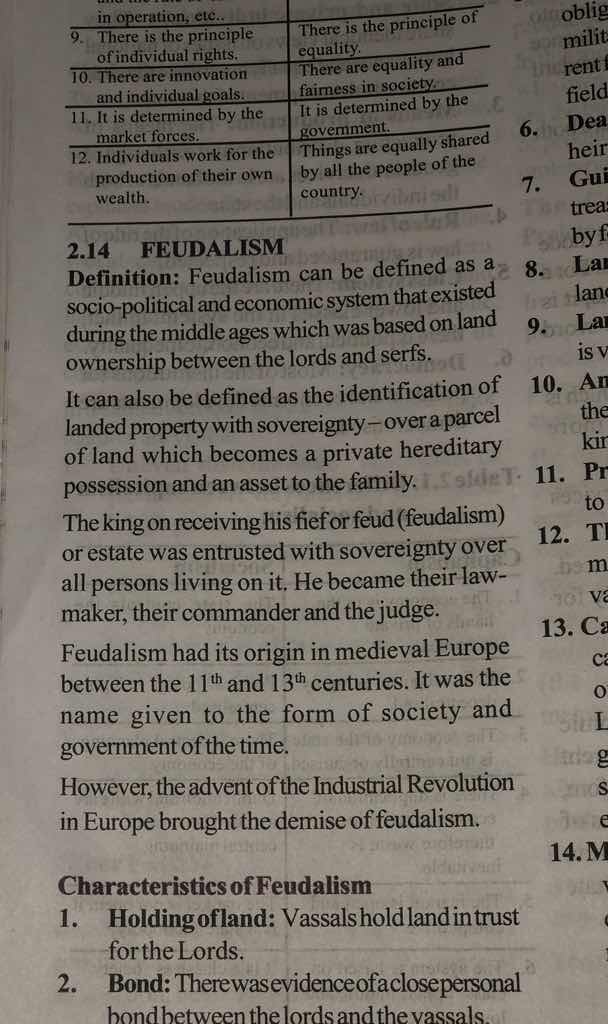
2.14 feudalism
definition: feudalism can be defined as a socio-political and economic system that existed during the middle ages which was based on land ownership between the lords and serfs.
it can also be defined as the identification of landed property with sovereignty - over a parcel of land which becomes a private hereditary possession and an asset to the family.
the king on receiving his fief or feud (feudalism) or estate was entrusted with sovereignty over all persons living on it. he became their law-maker, their commander and the judge.
feudalism had its origin in medieval europe between the 11th and 13th centuries. it was the name given to the form of society and government of the time.
however, the advent of the industrial revolution in europe brought the demise of feudalism.
characteristics of feudalism
- holding of land: vassals hold land in trust for the lords.
- bond: there was evidence of a close personal bond between the lords and the vassals.
Define feudalism from text
The text defines feudalism as a socio-political and economic system of the Middle Ages based on land ownership between lords and serfs.
Identify key characteristics
It involves identifying landed property with sovereignty, where land becomes a private hereditary possession and family asset.
Describe the ruler's role
The king received a fief or estate, granting him sovereignty over all residents as lawmaker, commander, and judge.
Outline historical timeline
Feudalism originated in medieval Europe between the 11th and 13th centuries, defining the society and government of that era.
Explain its decline
The text notes that the advent of the Industrial Revolution in Europe eventually brought about the demise of feudalism.

Snap & solve any problem in the app
Get step-by-step solutions on Sovi AI
Photo-based solutions with guided steps
Explore more problems and detailed explanations
Based on the provided text, Feudalism is defined and characterized as follows:
- Definition: A socio-political and economic system of the Middle Ages based on land ownership between lords and serfs. It is also defined by the identification of landed property with sovereignty, where a parcel of land becomes a private hereditary possession and a family asset.
- Role of the King: Upon receiving his fief (estate), the king was entrusted with absolute sovereignty over all people living on it, acting as their lawmaker, commander, and judge.
- Historical Timeline: It originated in medieval Europe between the 11th and 13th centuries.
- Demise: The system eventually came to an end with the advent of the Industrial Revolution in Europe.
- Key Characteristics:
- Holding of land: Vassals hold land in trust for the Lords.
- Bond: There was a close personal bond between the lords and the vassals.