QUESTION IMAGE
Question
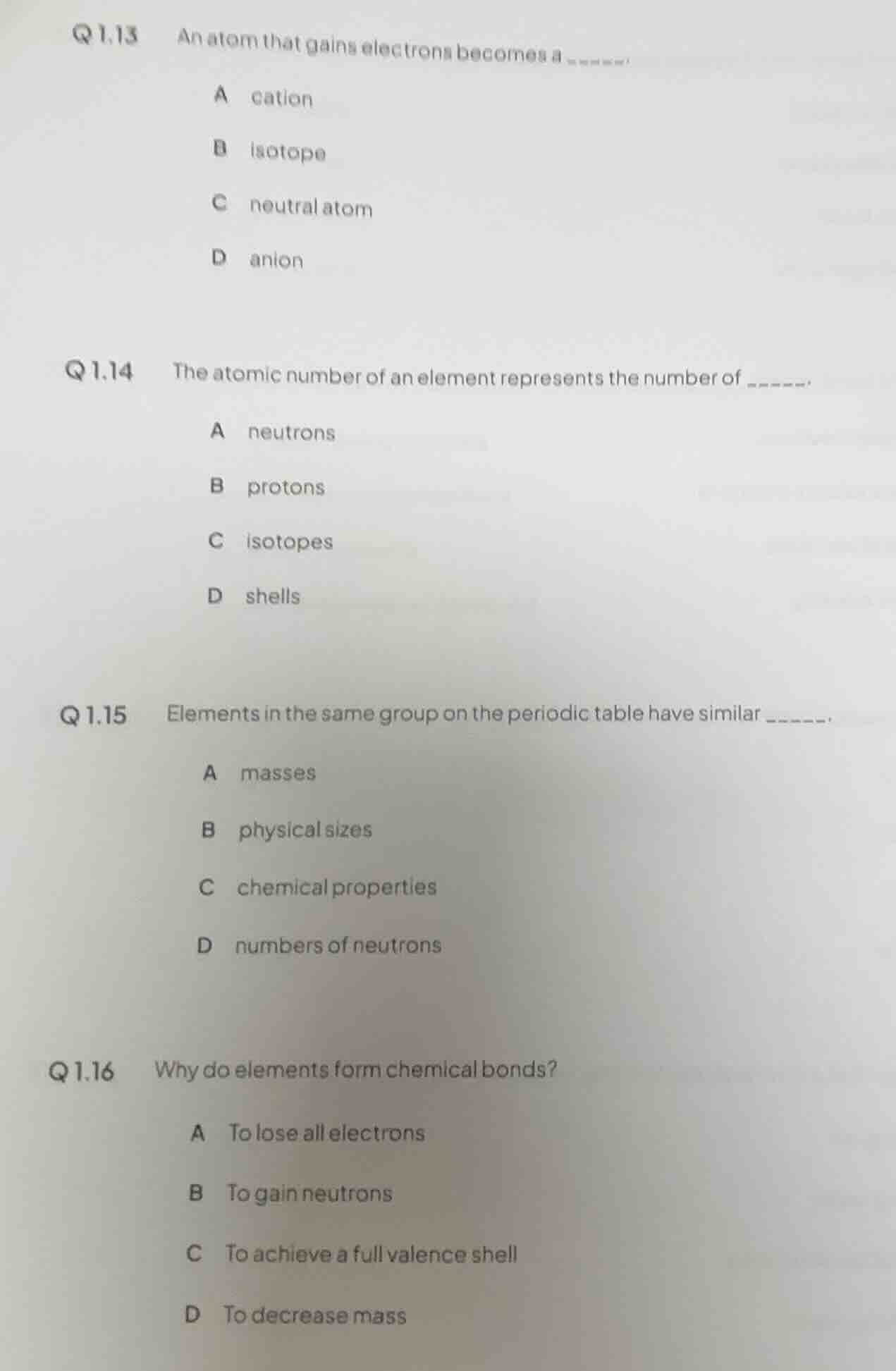
q 1.13 an atom that gains electrons becomes a _____.
a cation
b isotope
c neutral atom
d anion
q 1.14 the atomic number of an element represents the number of _____.
a neutrons
b protons
c isotopes
d shells
q 1.15 elements in the same group on the periodic table have similar _____.
a masses
b physical sizes
c chemical properties
d numbers of neutrons
q 1.16 why do elements form chemical bonds?
a to lose all electrons
b to gain neutrons
c to achieve a full valence shell
d to decrease mass
Analyze Q1.13 regarding gained electrons
An atom is neutral when its protons and electrons are equal. Electrons carry a negative charge. When an atom gains electrons, it acquires a net negative charge, forming a negative ion known as an anion.
Analyze Q1.14 regarding atomic number
Using the Atomic Structure concept, we know that the atomic number of an element is defined by the number of protons in its nucleus, which uniquely identifies the element.
Analyze Q1.15 regarding periodic table groups
Elements in the same vertical column (group) of the periodic table have the same number of valence electrons, which gives them highly similar chemical properties.
Analyze Q1.16 regarding chemical bonding
Atoms form chemical bonds to achieve a more stable electron configuration, which typically means obtaining a full outer valence shell (the octet rule).

Snap & solve any problem in the app
Get step-by-step solutions on Sovi AI
Photo-based solutions with guided steps
Explore more problems and detailed explanations
Question 1.13
- A cation
- B isotope
- C neutral atom</mcq-correct>
- D anion (Correct answer)
Question 1.14
<mcq-option>A neutrons
- B protons (Correct answer)
- C isotopes
- D shells
Question 1.15
- A masses
- B physical sizes
- C chemical properties (Correct answer)
- D numbers of neutrons
Question 1.16
- A To lose all electrons
- B To gain neutrons
- C To achieve a full valence shell (Correct answer)
- D To decrease mass