QUESTION IMAGE
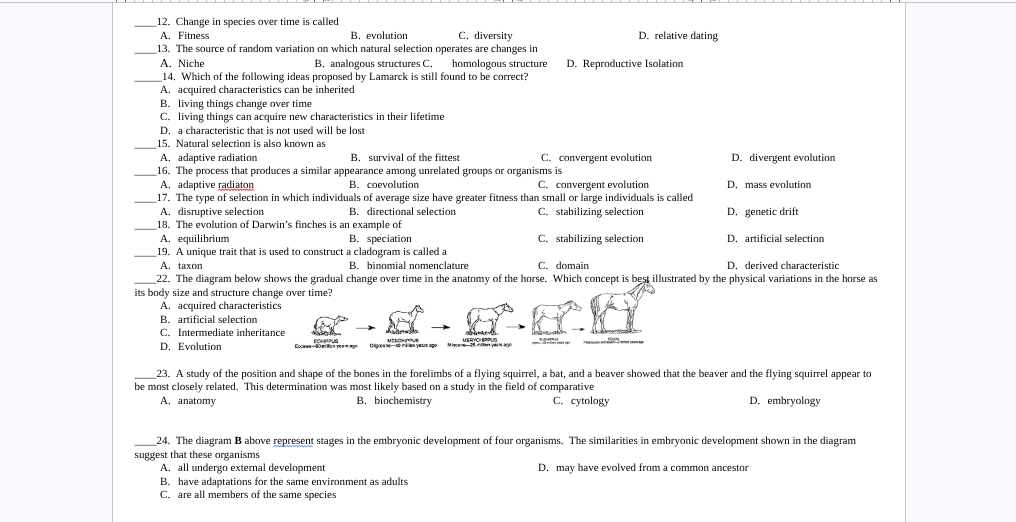
Question
- change in species over time is called
a. fitness
b. evolution
c. diversity
d. relative dating
- the source of random variation on which natural selection operates are changes in
a. niche
b. analogous structures
c. homologous structure
d. reproductive isolation
- which of the following ideas proposed by lamarck is still found to be correct?
a. acquired characteristics can be inherited
b. living things change over time
c. living things can acquire new characteristics in their lifetime
d. a characteristic that is not used will be lost
- natural selection is also known as
a. adaptive radiation
b. survival of the fittest
c. convergent evolution
d. divergent evolution
- the process that produces a similar appearance among unrelated groups or organisms is
a. adaptive radiation
b. coevolution
c. convergent evolution
d. mass evolution
- the type of selection in which individuals of average size have greater fitness than small or large individuals is called
a. disruptive selection
b. directional selection
c. stabilizing selection
d. genetic drift
- the evolution of darwins finches is an example of
a. equilibrium
b. speciation
c. stabilizing selection
d. artificial selection
- a unique trait that is used to construct a cladogram is called a
a. taxon
b. binomial nomenclature
c. domain
d. derived characteristic
- the diagram below shows the gradual change over time in the anatomy of the horse. which concept is best illustrated by the physical variations in the horse as its body size and structure change over time?
a. acquired characteristics
b. artificial selection
c. intermediate inheritance
d. evolution
- a study of the position and shape of the bones in the forelimbs of a flying squirrel, a bat, and a beaver showed that the beaver and the flying squirrel appear to be most closely related. this determination was most likely based on a study in the field of comparative
a. anatomy
b. biochemistry
c. cytology
d. embryology
- the diagram b above represent stages in the embryonic development of four organisms. the similarities in embryonic development shown in the diagram suggest that these organisms
a. all undergo external development
b. have adaptations for the same environment as adults
c. are all members of the same species
d. may have evolved from a common ancestor
⚡ Using what you learned: mechanisms of evolution and natural selection
Step 1: Solve Question 12
- Question: Change in species over time is called
- Analysis: The definition of biological evolution is the change in the inherited characteristics of a population over successive generations.
- Answer: B. evolution
Step 2: Solve Question 13
- Question: The source of random variation on which natural selection operates are changes in
- Analysis: Natural selection acts on phenotypic variations that originate from genetic differences. While the options listed do not explicitly say "genes" or "DNA", the closest biological concept related to the origin of these differences in a population's gene pool is not represented directly by the choices. However, looking at standard biology curricula, this question typically refers to "genes" (often a typo in test banks where "genes" is replaced or omitted, but here we must evaluate the given options). Let's re-evaluate: random variations on which natural selection operates are changes in genes/DNA. If we look at the options: A. Niche, B. analogous structures, C. homologous structures, D. Reproductive Isolation. None of these are the direct molecular source (mutations/genes). However, in some simplified curriculums, genetic changes are linked to the genetic makeup. Let's look for a common test-bank match: "changes in genes" is the standard answer. If "genes" is missing, it is highly likely a scanning/printing error on the test sheet where "genes" was omitted or mislabeled. Assuming the intended answer is "genes" (often option A or C in the original source of this question: "The source of random variation on which natural selection operates are changes in: A. codons / B. proteins / C. genes / D. amino acids"). Given the options printed: none are scientifically the source of random variation. We will note the standard biological answer is genes/DNA.
Step 3: Solve Question 14
- Question: Which of the following ideas proposed by Lamarck is still found to be correct?
- Analysis: Lamarck's ideas about the inheritance of acquired characteristics and use/disuse have been disproven. However, his fundamental premise that organisms change over time in response to their environment remains a cornerstone of evolutionary biology.
- Answer: B. living things change over time
Step 4: Solve Question 15
- Question: Natural selection is also known as
- Analysis: Charles Darwin used the term "natural selection," which Herbert Spencer later famously described as "survival of the fittest" to explain how organisms best adapted to their environment tend to survive and transmit their genetic characters.
- Answer: B. survival of the fittest
Step 5: Solve Question 16
- Question: The process that produces a similar appearance among unrelated groups of organisms is
- Analysis: When unrelated species occupy similar environments, they face similar selective pressures, leading them to evolve analogous adaptations. This is known as convergent evolution.
- Answer: C. convergent evolution
Step 6: Solve Question 17
- Question: The type of selection in which individuals of average size have greater fitness than small or large individuals is called
- Analysis: Stabilizing selection favors intermediate variants by acting against extreme phenotypes.
- Answer: C. stabilizing selection
Step 7: Solve Question 18
- Question: The evolution of Darwin's finches is an example of
- Analysis: The diversification of a founding species into mul…

Snap & solve any problem in the app
Get step-by-step solutions on Sovi AI
Photo-based solutions with guided steps
Explore more problems and detailed explanations
- 12. B. evolution
- 13. Note: The standard scientific answer is changes in genes/DNA (the options listed in the image appear to contain a printing/formatting error from the original test bank).
- 14. B. living things change over time
- 15. B. survival of the fittest
- 16. C. convergent evolution
- 17. C. stabilizing selection
- 18. B. speciation
- 19. D. derived characteristic
- 22. D. Evolution
- 23. A. anatomy
- 24. D. may have evolved from a common ancestor