QUESTION IMAGE
Question
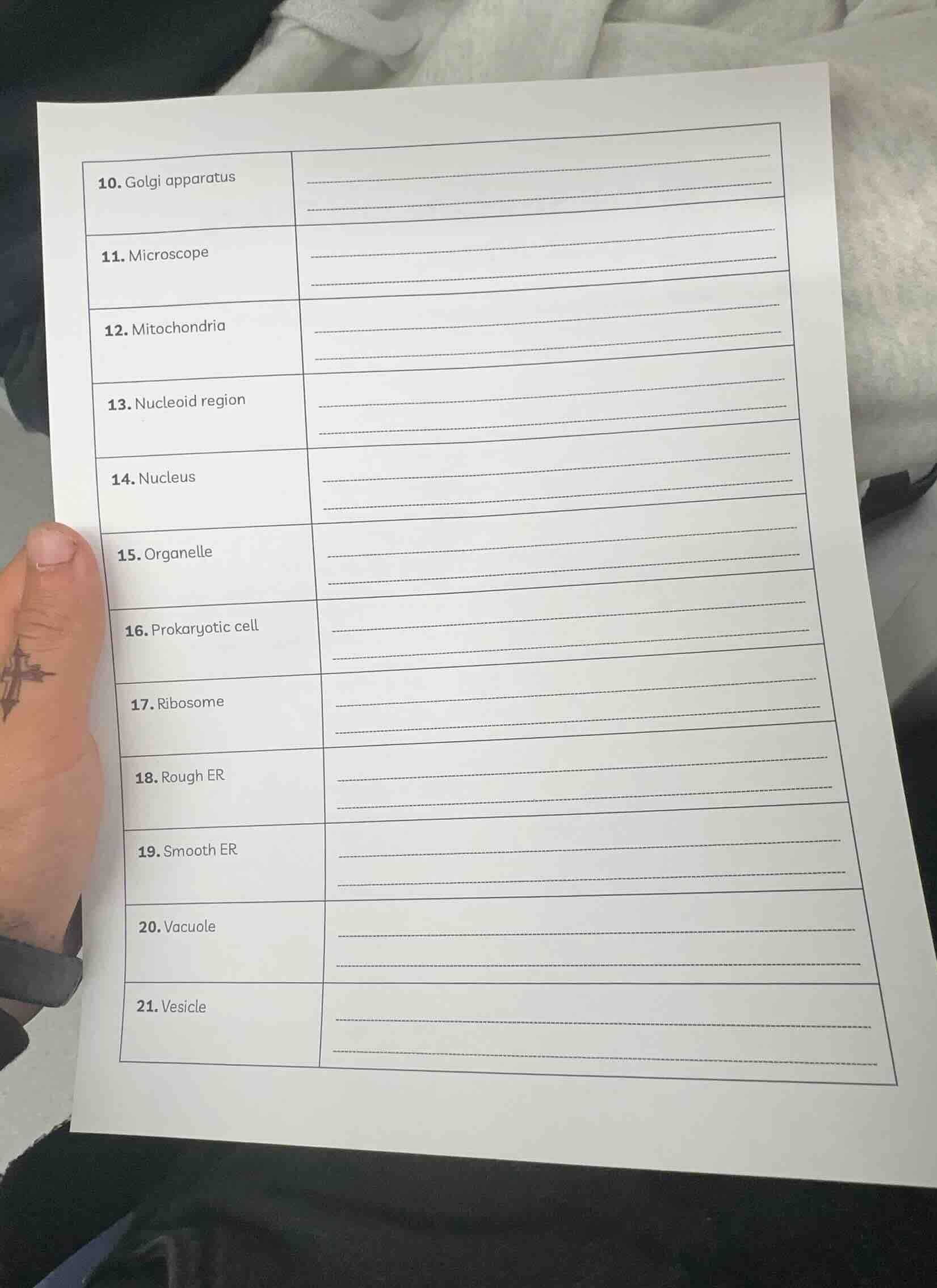
- golgi apparatus
- microscope
- mitochondria
- nucleoid region
- nucleus
- organelle
- prokaryotic cell
- ribosome
- rough er
- smooth er
- vacuole
- vesicle
Identify vocabulary terms
The worksheet lists 12 biology terms related to cell structure and microscopy:
- Golgi apparatus
- Microscope
- Mitochondria
- Nucleoid region
- Nucleus
- Organelle
- Prokaryotic cell
- Ribosome
- Rough ER
- Smooth ER
- Vacuole
- Vesicle
Define each term
We will define each term concisely, highlighting its primary function or characteristic.
- Golgi apparatus: Modifies, sorts, and packages proteins and lipids for transport.
- Microscope: An instrument used to magnify small objects, such as cells.
- Mitochondria: The powerhouse of the cell, generating chemical energy (ATP).
- Nucleoid region: The irregularly shaped region in prokaryotes containing genetic material.
- Nucleus: The membrane-bound organelle in eukaryotes containing DNA.
- Organelle: A specialized subunit within a cell that has a specific function.
- Prokaryotic cell: A simple, single-celled organism lacking a membrane-bound nucleus.
- Ribosome: The cellular structure that synthesizes proteins.
- Rough ER: Endoplasmic reticulum studded with ribosomes, involved in protein synthesis.
- Smooth ER: Endoplasmic reticulum lacking ribosomes, involved in lipid synthesis.
- Vacuole: A storage organelle, particularly large in plant cells for water.
- Vesicle: A small membrane-bound sac used for transporting materials.
Apply student profile
The student has mastered Cellular Organelles. We will use this context to provide clear, structured definitions that connect these individual structures to their broader roles within the cell.

Snap & solve any problem in the app
Get step-by-step solutions on Sovi AI
Photo-based solutions with guided steps
Explore more problems and detailed explanations
| No. | Term | Definition |
|---|---|---|
| 11 | Microscope | An instrument used to magnify and view objects too small to be seen by the naked eye. |
| 12 | Mitochondria | Organelles that generate chemical energy (ATP) through cellular respiration. |
| 13 | Nucleoid region | The area in a prokaryotic cell where the genetic material (DNA) is concentrated. |
| 14 | Nucleus | The membrane-bound organelle in eukaryotic cells that houses the genetic material. |
| 15 | Organelle | A specialized, membrane-bound structure within a cell that performs a specific function. |
| 16 | Prokaryotic cell | A simple cell lacking a membrane-bound nucleus and other membrane-bound organelles. |
| 17 | Ribosome | A cellular structure made of RNA and protein that synthesizes proteins. |
| 18 | Rough ER | A network of membranes studded with ribosomes, involved in protein synthesis and folding. |
| 19 | Smooth ER | A network of membranes lacking ribosomes, involved in lipid synthesis and detoxification. |
| 20 | Vacuole | A membrane-bound sac used for storing water, nutrients, and waste products. |
| 21 | Vesicle | A small, membrane-bound sac that transports materials within or outside the cell. |