QUESTION IMAGE
Question
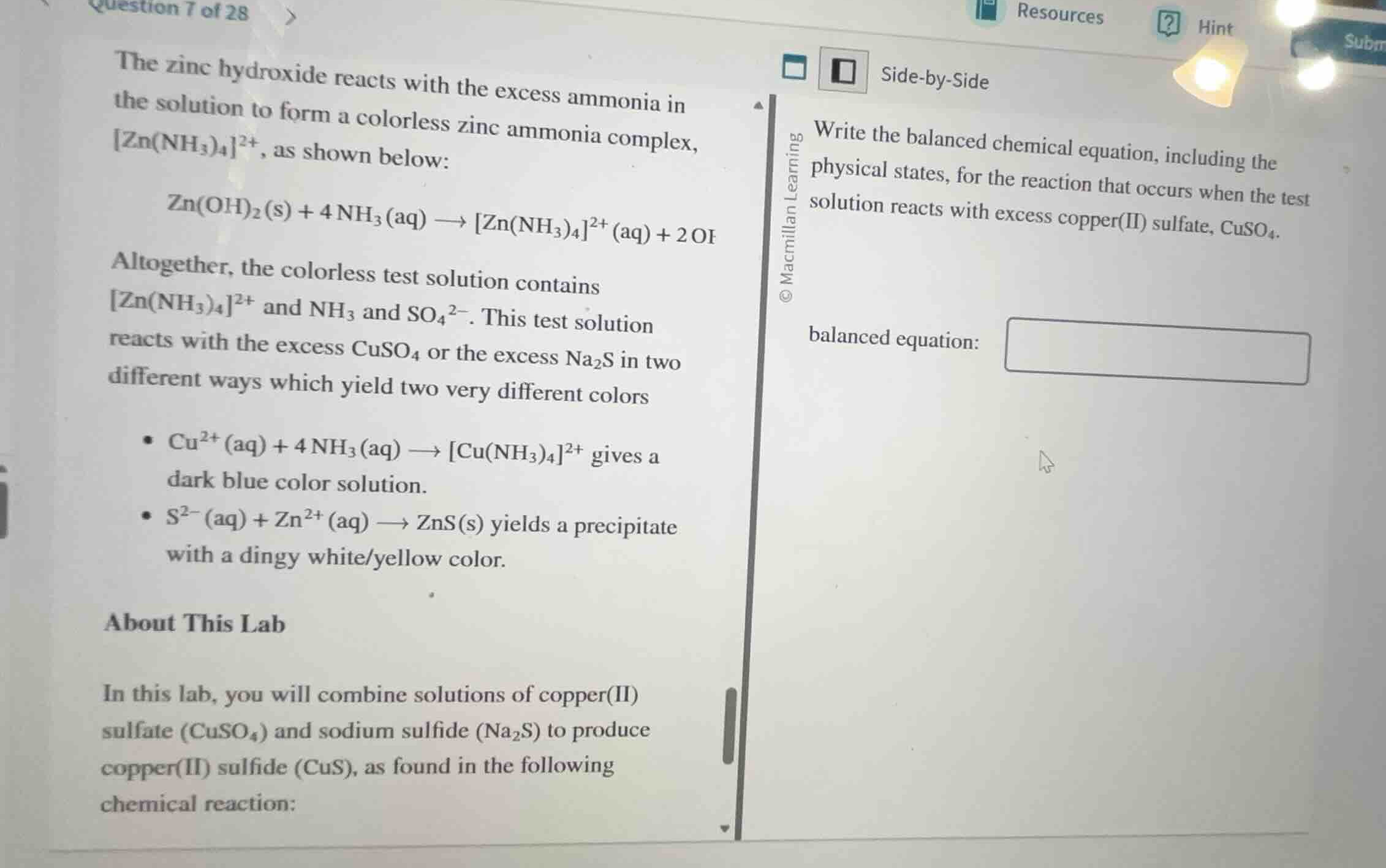
the zinc hydroxide reacts with the excess ammonia in the solution to form a colorless zinc ammonia complex, \\(\text{zn}(\text{nh}_3)_4^{2+}\\), as shown below:
\\\text{zn}(\text{oh})_2(\text{s}) + 4\text{nh}_3(\text{aq}) \longrightarrow \text{zn}(\text{nh}_3)_4^{2+}(\text{aq}) + 2\text{oh}^-(\text{aq})\\
altogether, the colorless test solution contains \\(\text{zn}(\text{nh}_3)_4^{2+}\\) and \\(\text{nh}_3\\) and \\(\text{so}_4^{2-}\\). this test solution reacts with the excess \\(\text{cuso}_4\\) or the excess \\(\text{na}_2\text{s}\\) in two different ways which yield two very different colors
- \\(\text{cu}^{2+}(\text{aq}) + 4\text{nh}_3(\text{aq}) \longrightarrow \text{cu}(\text{nh}_3)_4^{2+}\\) gives a dark blue color solution.
- \\(\text{s}^{2-}(\text{aq}) + \text{zn}^{2+}(\text{aq}) \longrightarrow \text{zns}(\text{s})\\) yields a precipitate with a dingy white/yellow color.
about this lab
in this lab, you will combine solutions of copper(ii) sulfate (\\(\text{cuso}_4\\)) and sodium sulfide (\\(\text{na}_2\text{s}\\)) to produce copper(ii) sulfide (\\(\text{cus}\\)), as found in the following chemical reaction:
write the balanced chemical equation, including the physical states, for the reaction that occurs when the test solution reacts with excess copper(ii) sulfate, \\(\text{cuso}_4\\).
balanced equation:
Identify the reactants in the solution
The problem states that the colorless test solution contains \([\text{Zn}(\text{NH}_3)_4]^{2+}(\text{aq})\), \(\text{NH}_3(\text{aq})\), and \(\text{SO}_4^{2-}(\text{aq})\). This solution is reacted with excess copper(II) sulfate, \(\text{CuSO}_4(\text{aq})\), which dissociates into \(\text{Cu}^{2+}(\text{aq})\) and \(\text{SO}_4^{2-}(\text{aq})\).
Determine the chemical reaction
Using the Chemical Equation Balancing knowledge point, we analyze the species present. The text provides a key reaction:
The source of \(\text{NH}_3\) is the complex ion \([\text{Zn}(\text{NH}_3)_4]^{2+}\). When \(\text{Cu}^{2+}\) is added, it has a higher affinity for ammonia, displacing \(\text{Zn}^{2+}\) in a ligand exchange:
Include spectator ions for the full equation
The copper(II) reactant is added as \(\text{CuSO}_4(\text{aq})\). The sulfate ions \(\text{SO}_4^{2-}(\text{aq})\) act as spectator ions balancing the charges of the metal cations:
Verify the balanced equation and states
We check that all atoms and charges balance:
- Left side: \(1\text{ Zn}\), \(1\text{ Cu}\), \(4\text{ N}\), \(12\text{ H}\), \(2\text{ SO}_4^{2-}\)
- Right side: \(1\text{ Zn}\), \(1\text{ Cu}\), \(4\text{ N}\), \(12\text{ H}\), \(2\text{ SO}_4^{2-}\)
All reactants and products are soluble in aqueous solution, so their physical states are all \(\text{(aq)}\).

Snap & solve any problem in the app
Get step-by-step solutions on Sovi AI
Photo-based solutions with guided steps
Explore more problems and detailed explanations
Write the balanced chemical equation, including the physical states, for the reaction that occurs when the test solution reacts with excess copper(II) sulfate, \(\text{CuSO}_4\).
balanced equation: <blank>\([\text{Zn}(\text{NH}_3)_4]\text{SO}_4(\text{aq}) + \text{CuSO}_4(\text{aq})
ightarrow [\text{Cu}(\text{NH}_3)_4]\text{SO}_4(\text{aq}) + \text{ZnSO}_4(\text{aq})\)</blank>