QUESTION IMAGE
Question
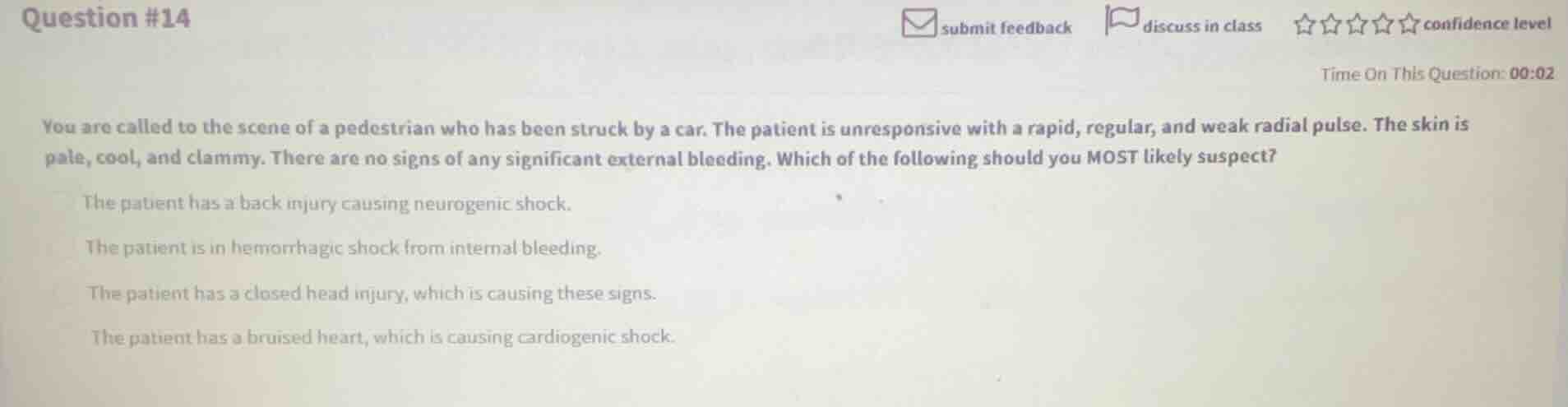
you are called to the scene of a pedestrian who has been struck by a car. the patient is unresponsive with a rapid, regular, and weak radial pulse. the skin is pale, cool, and clammy. there are no signs of any significant external bleeding. which of the following should you most likely suspect?
the patient has a back injury causing neurogenic shock.
the patient is in hemorrhagic shock from internal bleeding.
the patient has a closed head injury, which is causing these signs.
the patient has a bruised heart, which is causing cardiogenic shock.
<pre_analysis>
{
"quality": "clear",
"question_count": 1,
"skills_matched": [
"direct_cot",
"multiple_choice_formatter",
"explain_then_answer",
"tutor",
"mastery_adaptive_brevity"
],
"needs_drawing": false,
"concepts_used": [
"Hemorrhagic Shock",
"Decompensated Shock"
],
"new_concepts": [
"Hypovolemic Shock Assessment",
"Internal Bleeding Indicators"
],
"current_concepts": [
"Hemorrhagic Shock",
"Decompensated Shock",
"Hypovolemic Shock Assessment",
"Internal Bleeding Indicators"
]
}
</pre_analysis>
<reasoning>
Analyze the clinical presentation
The patient is an unresponsive pedestrian struck by a car (high-energy mechanism of injury). The physical findings include:
- A rapid, regular, and weak radial pulse (tachycardia with poor perfusion).
- Pale, cool, and clammy skin (systemic vasoconstriction shunting blood to core organs).
- No signs of significant external bleeding.
Evaluate the shock types
Using the Hemorrhagic Shock and Decompensated Shock knowledge points
- Hemorrhagic Shock: A high-energy impact like being struck by a car frequently causes severe internal injuries (e.g., pelvic fractures, abdominal organ lacerations) leading to occult internal hemorrhage. The classic signs of hypovolemic/hemorrhagic shock include tachycardia (rapid pulse), weak pulse pressure, and pale, cool, clammy skin due to compensatory sympathetic nervous system activation.
- Neurogenic Shock: Typically presents with bradycardia (slow pulse) and warm, dry, flushed skin below the level of the spinal injury due to the loss of sympathetic vascular tone. This contradicts the patient's rapid pulse and cool, clammy skin.
- Cardiogenic Shock: While a myocardial contusion (bruised heart) can cause cardiogenic shock, it is less common than internal hemorrhage in multi-trauma pedestrians, and the systemic signs here point directly to classic hypovolemia.
- Closed Head Injury: Typically presents with Cushing's triad (bradycardia, widening pulse pressure/hypertension, and irregular respirations) rather than tachycardia with a weak pulse and hypotension.
Select the most likely diagnosis
Based on the mechanism of injury and classic compensatory signs of volume depletion without external blood loss, the patient is most likely experiencing hemorrhagic shock from internal bleeding.
</reasoning>
<answer>
<mcq-option>The patient has a back injury causing neurogenic shock.</mcq-option>
<mcq-correct>The patient is in hemorrhagic shock from internal bleeding.</mcq-correct>
<mcq-option>The patient has a closed head injury, which is causing these signs.</mcq-option>
<mcq-option>The patient has a bruised heart, which is causing cardiogenic shock.</mcq-option>
</answer>
<post_analysis>
{
"subject": "Natural Science",
"question_type": "Multiple Choice",
"knowledge_point": [
"Natural Science",
"Medicine",
"Emergency Medical Services"
]
}
</post_analysis>
Snap & solve any problem in the app
Get step-by-step solutions on Sovi AI
Photo-based solutions with guided steps
Explore more problems and detailed explanations
<pre_analysis>
{
"quality": "clear",
"question_count": 1,
"skills_matched": [
"direct_cot",
"multiple_choice_formatter",
"explain_then_answer",
"tutor",
"mastery_adaptive_brevity"
],
"needs_drawing": false,
"concepts_used": [
"Hemorrhagic Shock",
"Decompensated Shock"
],
"new_concepts": [
"Hypovolemic Shock Assessment",
"Internal Bleeding Indicators"
],
"current_concepts": [
"Hemorrhagic Shock",
"Decompensated Shock",
"Hypovolemic Shock Assessment",
"Internal Bleeding Indicators"
]
}
</pre_analysis>
<reasoning>
Analyze the clinical presentation
The patient is an unresponsive pedestrian struck by a car (high-energy mechanism of injury). The physical findings include:
- A rapid, regular, and weak radial pulse (tachycardia with poor perfusion).
- Pale, cool, and clammy skin (systemic vasoconstriction shunting blood to core organs).
- No signs of significant external bleeding.
Evaluate the shock types
Using the Hemorrhagic Shock and Decompensated Shock knowledge points
- Hemorrhagic Shock: A high-energy impact like being struck by a car frequently causes severe internal injuries (e.g., pelvic fractures, abdominal organ lacerations) leading to occult internal hemorrhage. The classic signs of hypovolemic/hemorrhagic shock include tachycardia (rapid pulse), weak pulse pressure, and pale, cool, clammy skin due to compensatory sympathetic nervous system activation.
- Neurogenic Shock: Typically presents with bradycardia (slow pulse) and warm, dry, flushed skin below the level of the spinal injury due to the loss of sympathetic vascular tone. This contradicts the patient's rapid pulse and cool, clammy skin.
- Cardiogenic Shock: While a myocardial contusion (bruised heart) can cause cardiogenic shock, it is less common than internal hemorrhage in multi-trauma pedestrians, and the systemic signs here point directly to classic hypovolemia.
- Closed Head Injury: Typically presents with Cushing's triad (bradycardia, widening pulse pressure/hypertension, and irregular respirations) rather than tachycardia with a weak pulse and hypotension.
Select the most likely diagnosis
Based on the mechanism of injury and classic compensatory signs of volume depletion without external blood loss, the patient is most likely experiencing hemorrhagic shock from internal bleeding.
</reasoning>
<answer>
<mcq-option>The patient has a back injury causing neurogenic shock.</mcq-option>
<mcq-correct>The patient is in hemorrhagic shock from internal bleeding.</mcq-correct>
<mcq-option>The patient has a closed head injury, which is causing these signs.</mcq-option>
<mcq-option>The patient has a bruised heart, which is causing cardiogenic shock.</mcq-option>
</answer>
<post_analysis>
{
"subject": "Natural Science",
"question_type": "Multiple Choice",
"knowledge_point": [
"Natural Science",
"Medicine",
"Emergency Medical Services"
]
}
</post_analysis>