QUESTION IMAGE
Question
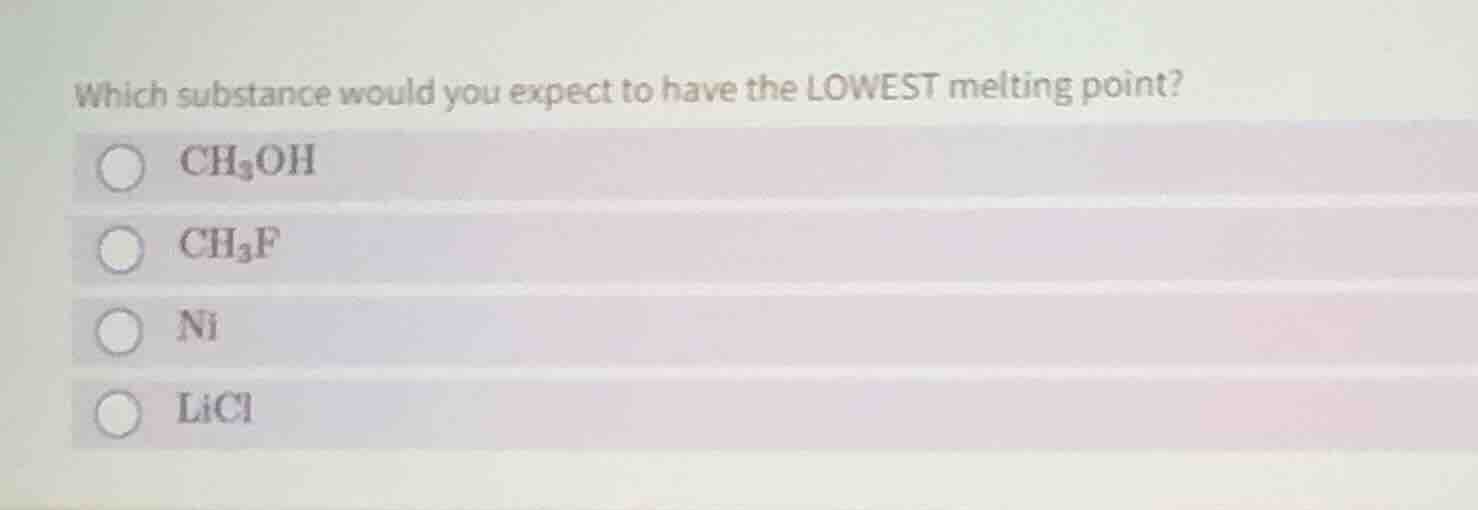
which substance would you expect to have the lowest melting point?
\\(\text{ch}_3\text{oh}\\)
\\(\text{ch}_3\text{f}\\)
\\(\text{ni}\\)
\\(\text{licl}\\)
Identify the types of solids
To compare melting points, we first classify each substance by its chemical bonding and solid-state structure.
- \(\text{CH}_3\text{OH}\) (methanol): Molecular solid.
- \(\text{CH}_3\text{F}\) (fluoromethane): Molecular solid.
- \(\text{Ni}\) (nickel): Metallic solid.
- \(\text{LiCl}\) (lithium chloride): Ionic solid.
Compare bonding strengths
We evaluate the relative strength of the forces holding each solid lattice together.
- Ionic bonds in \(\text{LiCl}\) and metallic bonds in \(\text{Ni}\) are extremely strong primary chemical bonds, resulting in very high melting points.
- Molecular solids are held together by much weaker Intermolecular Forces, giving them significantly lower melting points.
Compare molecular solids
We compare the intermolecular forces between the two molecular candidates, \(\text{CH}_3\text{OH}\) and \(\text{CH}_3\text{F}\).
- \(\text{CH}_3\text{OH}\) exhibits Hydrogen Bonding because it has a hydrogen atom directly bonded to a highly electronegative oxygen atom (\(\text{O-H}\) bond).
- \(\text{CH}_3\text{F}\) experiences dipole-dipole interactions and London dispersion forces, but cannot form hydrogen bonds because its hydrogen atoms are bonded to carbon, not fluorine.
- Since hydrogen bonding is significantly stronger than dipole-dipole interactions, \(\text{CH}_3\text{OH}\) has stronger cohesive forces than \(\text{CH}_3\text{F}\).
Determine the lowest melting point
Because \(\text{CH}_3\text{F}\) has the weakest overall intermolecular forces among all the options, it requires the least thermal energy to overcome these forces and melt. Therefore, \(\text{CH}_3\text{F}\) has the lowest melting point.

Snap & solve any problem in the app
Get step-by-step solutions on Sovi AI
Photo-based solutions with guided steps
Explore more problems and detailed explanations
- (A) \(\text{CH}_3\text{OH}\)
- (B) \(\text{CH}_3\text{F}\) (Correct answer)
- (C) \(\text{Ni}\)
- (D) \(\text{LiCl}\)