QUESTION IMAGE
Question
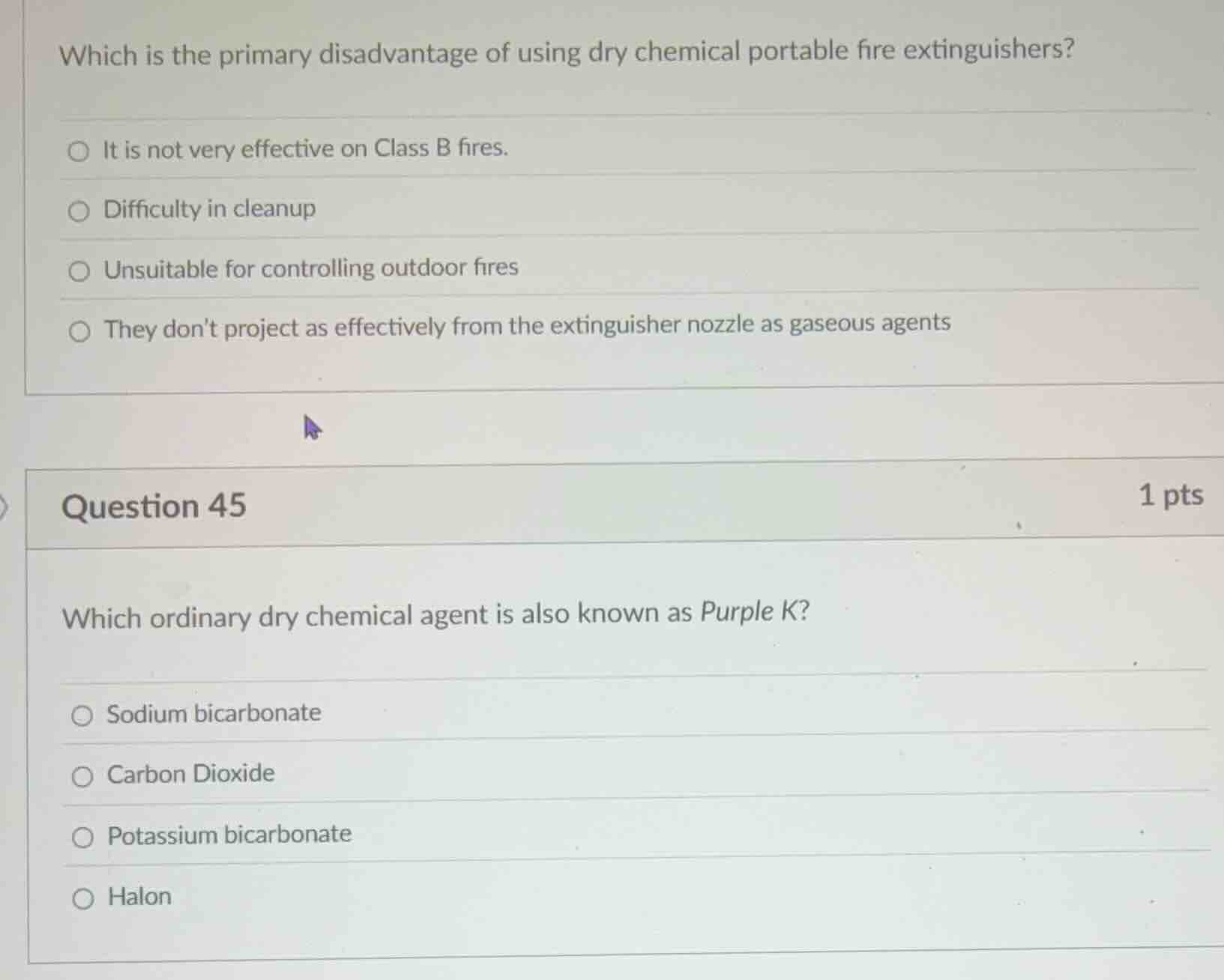
which is the primary disadvantage of using dry chemical portable fire extinguishers?
it is not very effective on class b fires.
difficulty in cleanup
unsuitable for controlling outdoor fires
they dont project as effectively from the extinguisher nozzle as gaseous agents
question 45
which ordinary dry chemical agent is also known as purple k?
sodium bicarbonate
carbon dioxide
potassium bicarbonate
halon
Analyze the first question
The first question asks for the primary disadvantage of using dry chemical portable fire extinguishers. Dry chemical agents leave a fine, powdery residue after discharge. This residue is highly corrosive to electronic equipment and extremely difficult to clean up, making cleanup difficulty the primary disadvantage.
Analyze the second question
The second question asks which ordinary dry chemical agent is also known as Purple K. Purple K is a dry chemical fire extinguishing agent containing potassium bicarbonate (\(\text{KHCO}_3\)). The "K" stands for potassium (chemical symbol K), and it is named "Purple" because the chemical is colored violet/purple to distinguish it from other dry chemical agents.
Evaluate options for Question 1
- Option 1: Dry chemicals are highly effective on Class B (flammable liquid) fires.
- Option 2: Difficulty in cleanup is a well-known primary disadvantage.
- Option 3: They are suitable for outdoor fires, though wind can disperse the powder.
- Option 4: They project effectively from nozzles.
Thus, the correct choice is "Difficulty in cleanup".
Evaluate options for Question 2
- Option 1: Sodium bicarbonate is ordinary dry chemical (often colored blue or white).
- Option 2: Carbon Dioxide is a gaseous agent, not a dry chemical.
- Option 3: Potassium bicarbonate is the active ingredient in Purple K.
- Option 4: Halon is a liquefied gas agent.
Thus, the correct choice is "Potassium bicarbonate".

Snap & solve any problem in the app
Get step-by-step solutions on Sovi AI
Photo-based solutions with guided steps
Explore more problems and detailed explanations
Question 1
- It is not very effective on Class B fires.
- Difficulty in cleanup (Correct answer)
- Unsuitable for controlling outdoor fires
- They don't project as effectively from the extinguisher nozzle as gaseous agents
Question 2
- Sodium bicarbonate
- Carbon Dioxide
- Potassium bicarbonate (Correct answer)
- Halon