QUESTION IMAGE
Question
which point represents the half way point (or half-equivalence point) of the titration?
point b
point c
point d
point e
Identify the titration type and key regions
Using the Titration Curves knowledge point
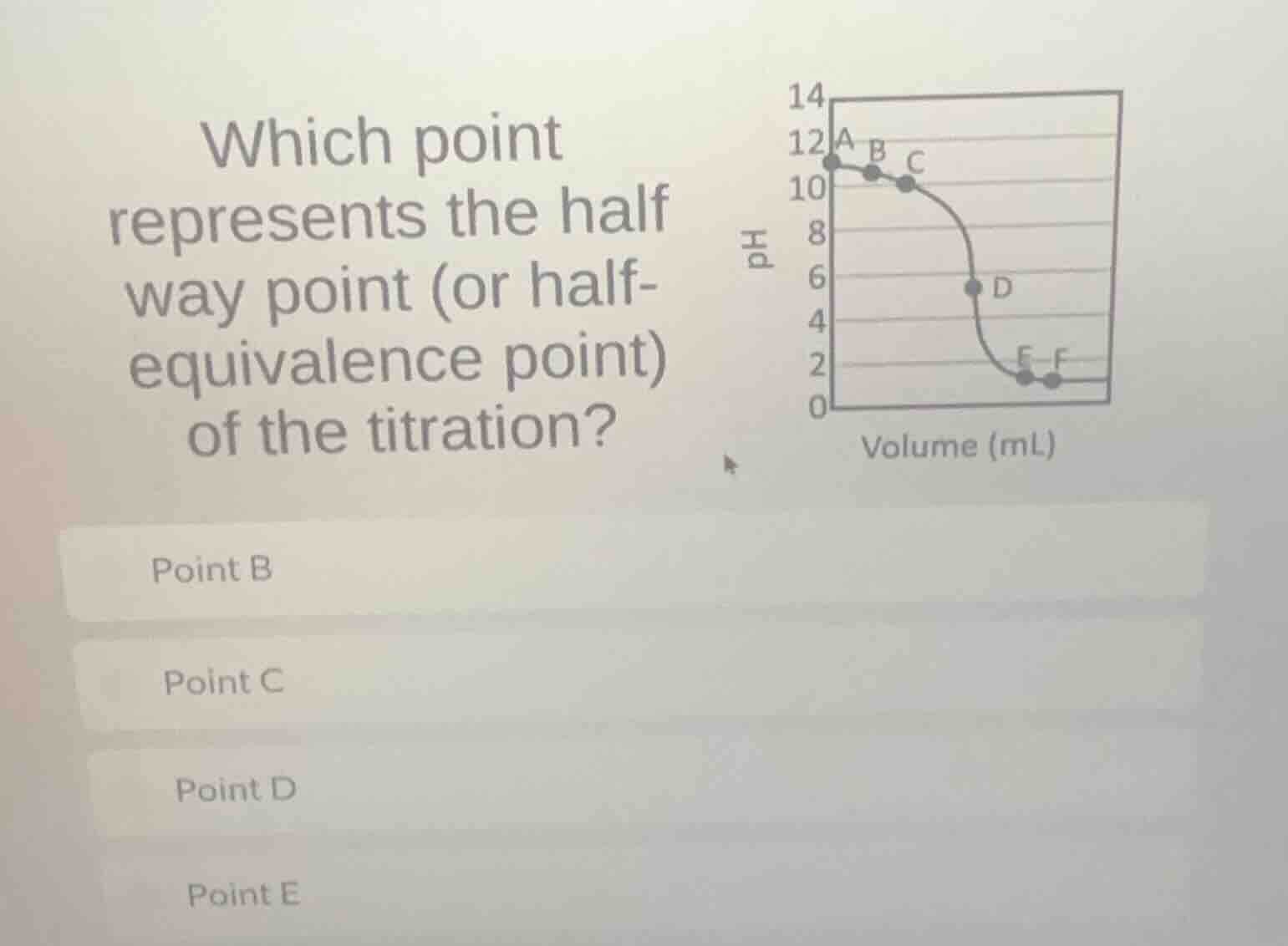
The titration curve starts at a high pH (around 11) and decreases as acid is added, indicating the titration of a weak base with a strong acid.
- Point A represents the initial weak base solution before any acid is added.
- The region containing points B and C is the buffer region.
- Point D is located in the steep vertical section of the curve, representing the equivalence point.
- Points E and F represent the region of excess strong acid after the equivalence point.
Determine the equivalence point
Using the Equivalence Point pH knowledge point
The equivalence point is the point of inflection where the pH changes most rapidly with addition of titrant. On this curve, the steep vertical drop occurs around pH 5 to 6, which corresponds directly to Point D.
Locate the half-equivalence point
Using the Titration Curves knowledge point
The half-equivalence (or halfway) point occurs when exactly half of the volume of titrant needed to reach the equivalence point has been added.
- If Point D represents the equivalence point volume \(V_{eq}\), the half-equivalence point occurs at \(\frac{1}{2}V_{eq}\).
- Looking at the horizontal axis (Volume), Point B is located approximately halfway between the starting point (Point A, \(V = 0\)) and the equivalence point (Point D).
- Therefore, Point B represents the half-equivalence point where pH equals \(\text{p}K_a\) of the conjugate acid.

Snap & solve any problem in the app
Get step-by-step solutions on Sovi AI
Photo-based solutions with guided steps
Explore more problems and detailed explanations
- Point B (Correct answer)
- Point C
- Point D
- Point E