QUESTION IMAGE
Question
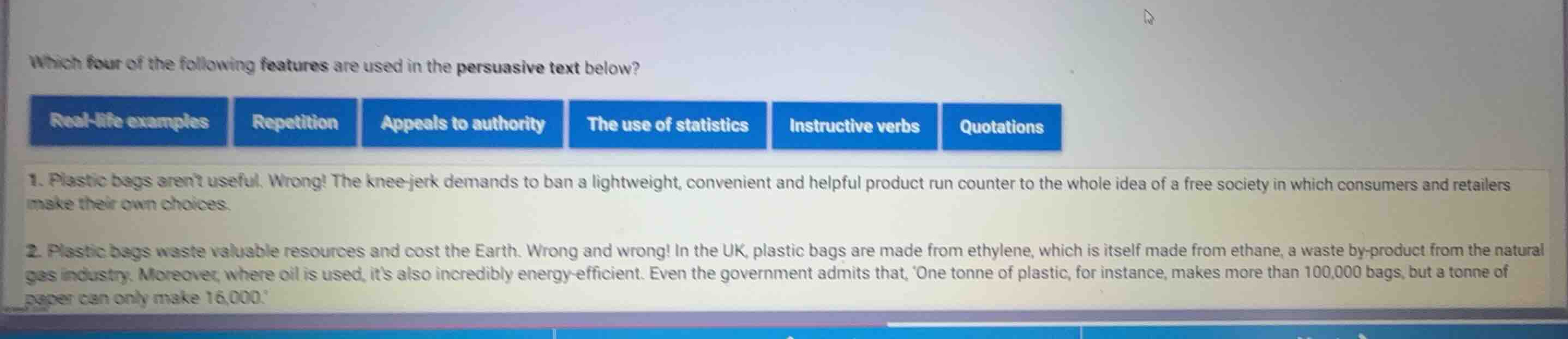
which four of the following features are used in the persuasive text below?
real-life examples | repetition | appeals to authority | the use of statistics | instructive verbs | quotations
- plastic bags arent useful. wrong! the knee-jerk demands to ban a lightweight, convenient and helpful product run counter to the whole idea of a free society in which consumers and retailers make their own choices.
- plastic bags waste valuable resources and cost the earth. wrong and wrong! in the uk, plastic bags are made from ethylene, which is itself made from ethane, a waste by-product from the natural gas industry. moreover, where oil is used, its also incredibly energy-efficient. even the government admits that, one tonne of plastic, for instance, makes more than 100,000 bags, but a tonne of paper can only make 16,000.
Identify the target question
The question asks to identify four persuasive features used in the provided text from the six options: "Real-life examples", "Repetition", "Appeals to authority", "The use of statistics", "Instructive verbs", and "Quotations".
Analyze the text for each feature
Let's evaluate the text against the six options using our understanding of Persuasive Devices:
- Repetition:
- Paragraph 1 contains: "Wrong!"
- Paragraph 2 contains: "Wrong and wrong!"
- This is a clear use of repetition for emphasis.
- Appeals to authority:
- Paragraph 2 states: "Even the government admits that..."
- This is a direct appeal to an authoritative body (the government) to support the argument.
- The use of statistics:
- Paragraph 2 contains numerical data: "100,000 bags" and "16,000".
- This represents the use of statistics to provide factual weight.
- Quotations:
- Paragraph 2 includes a direct quote: "...admits that, 'One tonne of plastic, for instance, makes more than 100,000 bags, but a tonne of paper can only make 16,000.'"
- The presence of quotation marks and cited speech confirms the use of quotations.
- Real-life examples:
- There are no specific real-life anecdotes, case studies, or individual stories mentioned.
- Instructive verbs:
- Instructive (imperative) verbs command the reader to do something (e.g., "Stop", "Buy", "Think"). The text does not contain commands directed at the reader.
Select the four active features
The four features present in the text are:
- Repetition
- Appeals to authority
- The use of statistics
- Quotations

Snap & solve any problem in the app
Get step-by-step solutions on Sovi AI
Photo-based solutions with guided steps
Explore more problems and detailed explanations
- Real-life examples
- Repetition (Correct answer)
- Appeals to authority (Correct answer)
- The use of statistics (Correct answer)
- Instructive verbs
- Quotations (Correct answer)