Sovi.AI - AI Math Tutor

Scan to solve math questions

QUESTION IMAGE

which of the following oxygen or ventilation therapy choices would be a…

Question

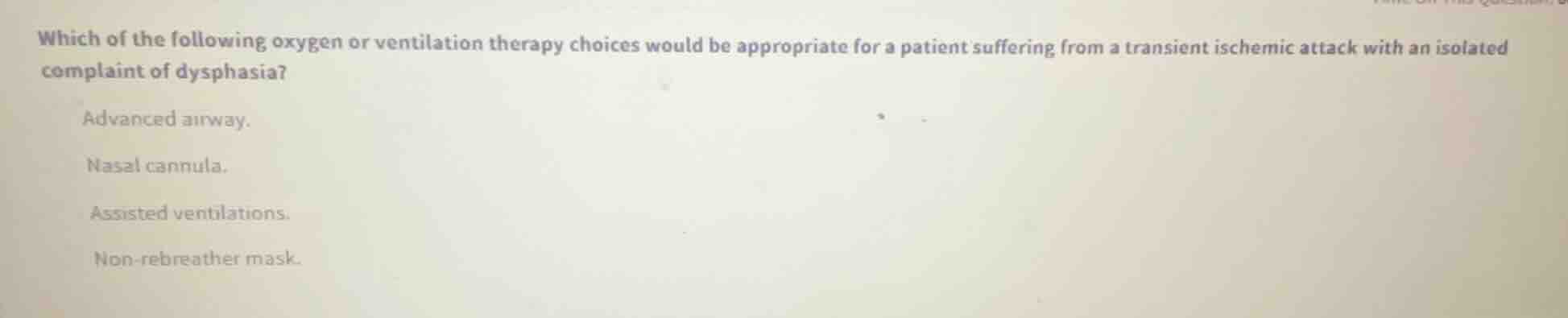
which of the following oxygen or ventilation therapy choices would be appropriate for a patient suffering from a transient ischemic attack with an isolated complaint of dysphasia?

advanced airway.
nasal cannula.
assisted ventilations.
non-rebreather mask.

Explanation:

Response

<pre_analysis>
{
"quality": "clear",
"question_count": 1,
"skills_matched": [
"direct_cot",
"multiple_choice_formatter",
"explain_then_answer",
"tutor",
"mastery_adaptive_brevity"
],
"needs_drawing": false,
"concepts_used": [
"Transient Ischemic Attack",
"Oxygen Delivery Devices"
],
"new_concepts": [],
"current_concepts": [
"Transient Ischemic Attack",
"Oxygen Delivery Devices",
"Stroke Pathophysiology"
]
}
</pre_analysis>

<reasoning>

Analyze patient presentation

Using the Transient Ischemic Attack knowledge point

The patient is experiencing a transient ischemic attack (TIA) with an isolated complaint of dysphasia (difficulty speaking). There are no signs of respiratory distress, hypoxia, or airway compromise.

Determine oxygenation needs

Using the Oxygen Delivery Devices knowledge point

For stroke or TIA patients without signs of hypoxia (oxygen saturation \(\ge 94\%\)) or respiratory distress, routine high-concentration oxygen is avoided. If oxygen is indicated, a low-flow device like a nasal cannula is the standard, conservative choice.

Evaluate the options

Using the Oxygen Delivery Devices knowledge point

  • Advanced airway: Inappropriate; the patient is conscious and breathing adequately.
  • Nasal cannula: Appropriate; provides low-flow, low-concentration oxygen if needed without hyperoxygenating.
  • Assisted ventilations: Inappropriate; the patient has adequate rate and tidal volume.
  • Non-rebreather mask: Inappropriate; delivers high-concentration oxygen, which is unnecessary and potentially harmful for uncomplicated TIA/stroke.

</reasoning>

<answer>
<mcq-option>Advanced airway.</mcq-option>
<mcq-correct>Nasal cannula.</mcq-correct>
<mcq-option>Assisted ventilations.</mcq-option>
<mcq-option>Non-rebreather mask.</mcq-option>
</answer>

<post_analysis>
{
"subject": "Natural Science",
"question_type": "Multiple Choice",
"knowledge_point": [
"Natural Science",
"Medicine",
"Emergency Medical Services"
]
}
</post_analysis>

Answer:

<pre_analysis>
{
"quality": "clear",
"question_count": 1,
"skills_matched": [
"direct_cot",
"multiple_choice_formatter",
"explain_then_answer",
"tutor",
"mastery_adaptive_brevity"
],
"needs_drawing": false,
"concepts_used": [
"Transient Ischemic Attack",
"Oxygen Delivery Devices"
],
"new_concepts": [],
"current_concepts": [
"Transient Ischemic Attack",
"Oxygen Delivery Devices",
"Stroke Pathophysiology"
]
}
</pre_analysis>

<reasoning>

Analyze patient presentation

Using the Transient Ischemic Attack knowledge point

The patient is experiencing a transient ischemic attack (TIA) with an isolated complaint of dysphasia (difficulty speaking). There are no signs of respiratory distress, hypoxia, or airway compromise.

Determine oxygenation needs

Using the Oxygen Delivery Devices knowledge point

For stroke or TIA patients without signs of hypoxia (oxygen saturation \(\ge 94\%\)) or respiratory distress, routine high-concentration oxygen is avoided. If oxygen is indicated, a low-flow device like a nasal cannula is the standard, conservative choice.

Evaluate the options

Using the Oxygen Delivery Devices knowledge point

  • Advanced airway: Inappropriate; the patient is conscious and breathing adequately.
  • Nasal cannula: Appropriate; provides low-flow, low-concentration oxygen if needed without hyperoxygenating.
  • Assisted ventilations: Inappropriate; the patient has adequate rate and tidal volume.
  • Non-rebreather mask: Inappropriate; delivers high-concentration oxygen, which is unnecessary and potentially harmful for uncomplicated TIA/stroke.

</reasoning>

<answer>
<mcq-option>Advanced airway.</mcq-option>
<mcq-correct>Nasal cannula.</mcq-correct>
<mcq-option>Assisted ventilations.</mcq-option>
<mcq-option>Non-rebreather mask.</mcq-option>
</answer>

<post_analysis>
{
"subject": "Natural Science",
"question_type": "Multiple Choice",
"knowledge_point": [
"Natural Science",
"Medicine",
"Emergency Medical Services"
]
}
</post_analysis>