QUESTION IMAGE
Question
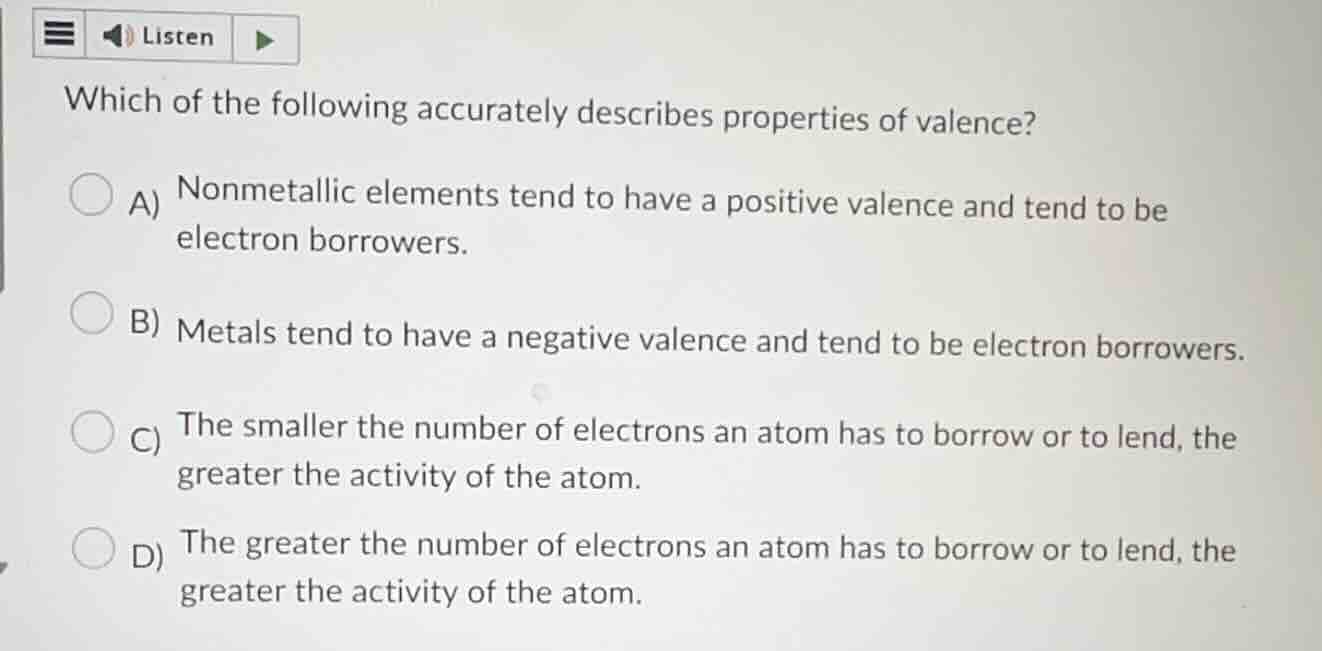
which of the following accurately describes properties of valence?
a) nonmetallic elements tend to have a positive valence and tend to be electron borrowers.
b) metals tend to have a negative valence and tend to be electron borrowers.
c) the smaller the number of electrons an atom has to borrow or to lend, the greater the activity of the atom.
d) the greater the number of electrons an atom has to borrow or to lend, the greater the activity of the atom.
Analyze option A and B
Nonmetals gain (borrow) electrons, giving them a negative valence. Metals lose (lend) electrons, giving them a positive valence. Both options are incorrect.
Analyze chemical activity and valence
Chemical activity depends on how easily an atom gains or loses valence electrons to achieve a stable octet.
Compare electron transfer requirements
An atom needing to transfer fewer electrons (e.g., 1 electron) reacts much more vigorously than one needing to transfer more.
Determine the correct relationship
Fewer electrons to borrow or lend results in greater chemical activity of the atom.

Snap & solve any problem in the app
Get step-by-step solutions on Sovi AI
Photo-based solutions with guided steps
Explore more problems and detailed explanations
- (A) Nonmetallic elements tend to have a positive valence and tend to be electron borrowers.
- (B) Metals tend to have a negative valence and tend to be electron borrowers.
- (C) The smaller the number of electrons an atom has to borrow or to lend, the greater the activity of the atom. (Correct answer)
- (D) The greater the number of electrons an atom has to borrow or to lend, the greater the activity of the atom.