QUESTION IMAGE
Question
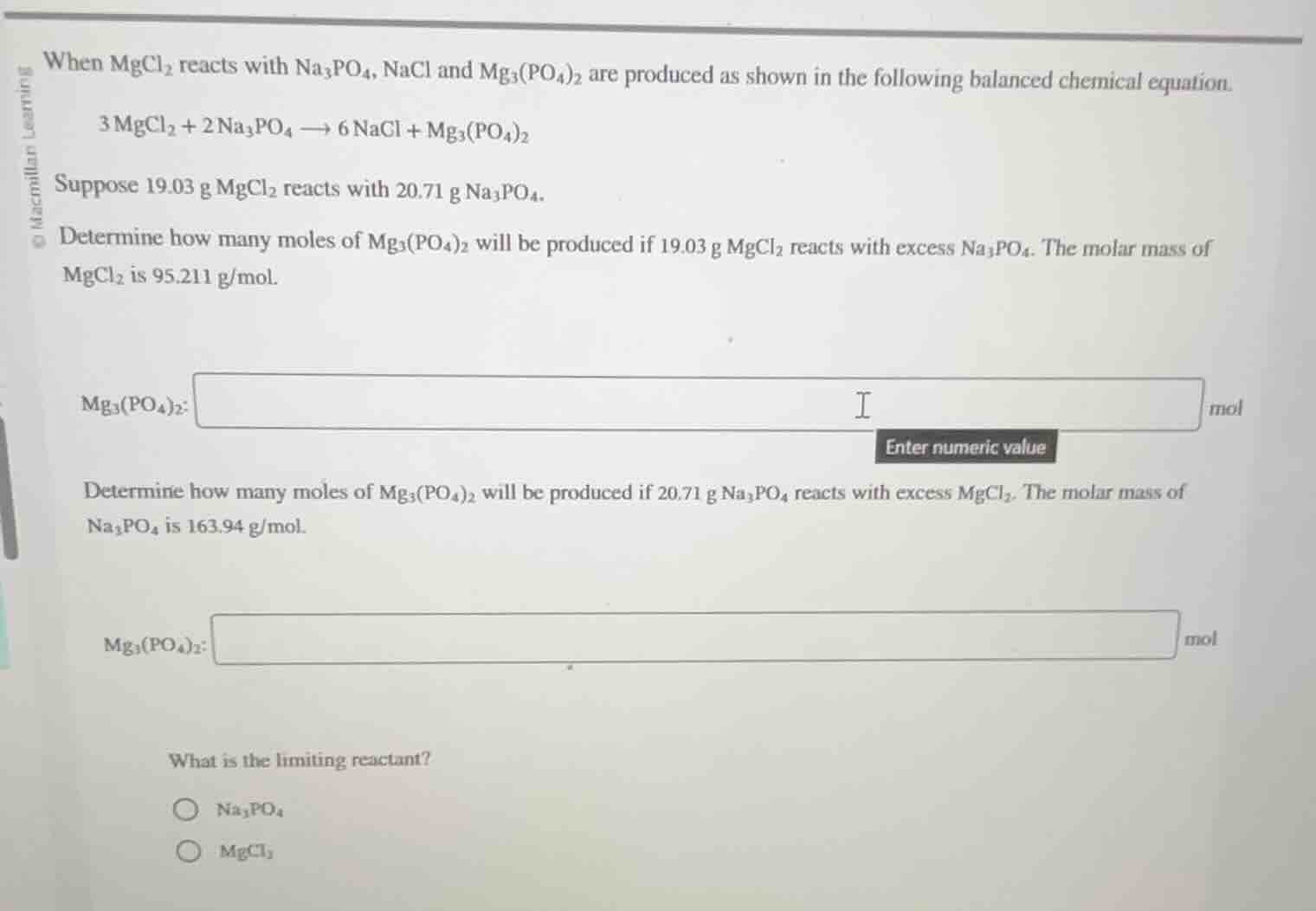
when \\(\text{mgcl}_2\\) reacts with \\(\text{na}_3\text{po}_4\\), \\(\text{nacl}\\) and \\(\text{mg}_3(\text{po}_4)_2\\) are produced as shown in the following balanced chemical equation.
\\3\text{mgcl}_2 + 2\text{na}_3\text{po}_4 \longrightarrow 6\text{nacl} + \text{mg}_3(\text{po}_4)_2\\
suppose \\(19.03\text{ g mgcl}_2\\) reacts with \\(20.71\text{ g na}_3\text{po}_4\\).
determine how many moles of \\(\text{mg}_3(\text{po}_4)_2\\) will be produced if \\(19.03\text{ g mgcl}_2\\) reacts with excess \\(\text{na}_3\text{po}_4\\). the molar mass of \\(\text{mgcl}_2\\) is \\(95.211\text{ g/mol}\\).
\\(\text{mg}_3(\text{po}_4)_2\\): mol
determine how many moles of \\(\text{mg}_3(\text{po}_4)_2\\) will be produced if \\(20.71\text{ g na}_3\text{po}_4\\) reacts with excess \\(\text{mgcl}_2\\). the molar mass of \\(\text{na}_3\text{po}_4\\) is \\(163.94\text{ g/mol}\\).
\\(\text{mg}_3(\text{po}_4)_2\\): mol
what is the limiting reactant?
( ) \\(\text{na}_3\text{po}_4\\)
( ) \\(\text{mgcl}_2\\)
Calculate moles of product from magnesium chloride
We convert the mass of \(\text{MgCl}_2\) to moles using its molar mass, then use the stoichiometric ratio.
Given:
- Mass of \(\text{MgCl}_2 = 19.03\text{ g}\)
- Molar mass of \(\text{MgCl}_2 = 95.211\text{ g/mol}\)
- Balanced ratio: \(3\text{ mol MgCl}_2 : 1\text{ mol Mg}_3(\text{PO}_4)_2\)
Calculate moles of product from sodium phosphate
We convert the mass of \(\text{Na}_3\text{PO}_4\) to moles using its molar mass, then use the stoichiometric ratio.
Given:
- Mass of \(\text{Na}_3\text{PO}_4 = 20.71\text{ g}\)
- Molar mass of \(\text{Na}_3\text{PO}_4 = 163.94\text{ g/mol}\)
- Balanced ratio: \(2\text{ mol Na}_3\text{PO}_4 : 1\text{ mol Mg}_3(\text{PO}_4)_2\)
Determine the limiting reactant
The limiting reactant is the reactant that produces the smaller amount of product.
- \(\text{MgCl}_2\) yields \(0.06662\text{ mol}\) of \(\text{Mg}_3(\text{PO}_4)_2\).
- \(\text{Na}_3\text{PO}_4\) yields \(0.06317\text{ mol}\) of \(\text{Mg}_3(\text{PO}_4)_2\).
Since \(\text{Na}_3\text{PO}_4\) produces less product, it is the limiting reactant.

Snap & solve any problem in the app
Get step-by-step solutions on Sovi AI
Photo-based solutions with guided steps
Explore more problems and detailed explanations
Question 1
Determine how many moles of \(\text{Mg}_3(\text{PO}_4)_2\) will be produced if \(19.03\text{ g}\) \(\text{MgCl}_2\) reacts with excess \(\text{Na}_3\text{PO}_4\).
\(\text{Mg}_3(\text{PO}_4)_2\): <blank>0.06662</blank> \(\text{mol}\)
Question 2
Determine how many moles of \(\text{Mg}_3(\text{PO}_4)_2\) will be produced if \(20.71\text{ g}\) \(\text{Na}_3\text{PO}_4\) reacts with excess \(\text{MgCl}_2\).
\(\text{Mg}_3(\text{PO}_4)_2\): <blank>0.06317</blank> \(\text{mol}\)
Question 3
What is the limiting reactant?
- \(\text{Na}_3\text{PO}_4\) (Correct answer)
- \(\text{MgCl}_2\)