Sovi.AI - AI Math Tutor

Scan to solve math questions

QUESTION IMAGE

when the blood serum insulin level falls, the patients: blood glucose l…

Question

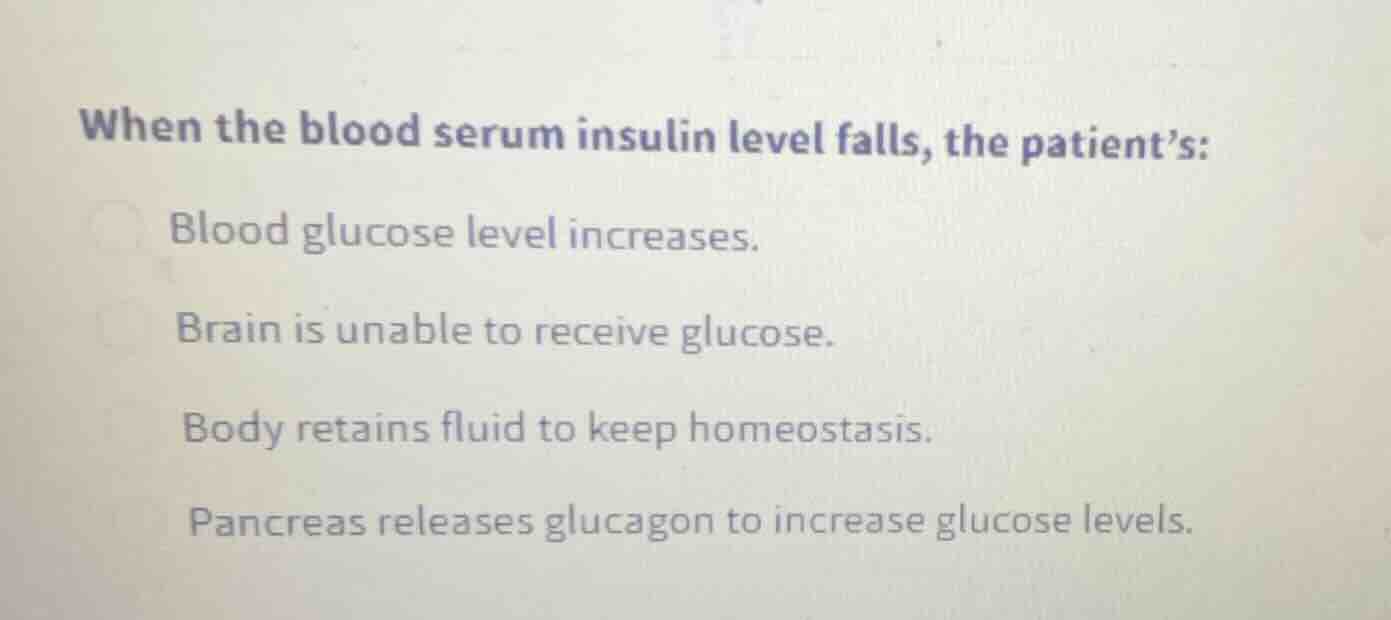
when the blood serum insulin level falls, the patients:

blood glucose level increases.
brain is unable to receive glucose.
body retains fluid to keep homeostasis.
pancreas releases glucagon to increase glucose levels.

Explanation:

Response

<pre_analysis>
{
"quality": "clear",
"question_count": 1,
"skills_matched": [
"direct_cot",
"multiple_choice_formatter",
"explain_then_answer",
"tutor",
"mastery_adaptive_brevity"
],
"needs_drawing": false,
"concepts_used": [
"Insulin Secretion",
"Cellular Glucose Uptake",
"Insulin-Independent Tissues"
],
"new_concepts": [
"Glucagon Secretion",
"Glucose Homeostasis"
],
"current_concepts": [
"Insulin Secretion",
"Cellular Glucose Uptake",
"Insulin-Independent Tissues",
"Glucagon Secretion",
"Glucose Homeostasis"
]
}
</pre_analysis>

<reasoning>

Analyze the physiological role of insulin

Using the Insulin Secretion and Cellular Glucose Uptake knowledge points, insulin is a hormone produced by the beta cells of the pancreas that facilitates the uptake of glucose into most body cells, thereby lowering blood glucose levels. When blood serum insulin levels fall, glucose cannot easily enter insulin-dependent cells, which typically leads to an increase in blood glucose levels (hyperglycemia).

Evaluate the brain's glucose supply

Using the Insulin-Independent Tissues knowledge point, the brain does not require insulin to take up glucose. Brain cells utilize insulin-independent glucose transporters (such as GLUT1 and GLUT3) to absorb glucose directly from the bloodstream, meaning the brain remains able to receive glucose even when insulin levels fall.

Assess the pancreatic response to falling insulin

When blood glucose levels drop, insulin secretion decreases, and the alpha cells of the pancreas release glucagon to mobilize stored glucose. However, the prompt specifically asks what happens when the insulin level falls. The direct physiological consequence of a lack of insulin's action on insulin-dependent tissues is that glucose remains in the bloodstream, causing the blood glucose level to rise.
</reasoning>

<answer>
<mcq-correct>(A) Blood glucose level increases.</mcq-correct>
<mcq-option>(B) Brain is unable to receive glucose.</mcq-option>
<mcq-option>(C) Body retains fluid to keep homeostasis.</mcq-option>
<mcq-option>(D) Pancreas releases glucagon to increase glucose levels.</mcq-option>
</answer>

<post_analysis>
{
"subject": "Natural Science",
"question_type": "Multiple Choice",
"knowledge_point": [
"Natural Science",
"Biology",
"Endocrine System"
]
}
</post_analysis>

Answer:

<pre_analysis>
{
"quality": "clear",
"question_count": 1,
"skills_matched": [
"direct_cot",
"multiple_choice_formatter",
"explain_then_answer",
"tutor",
"mastery_adaptive_brevity"
],
"needs_drawing": false,
"concepts_used": [
"Insulin Secretion",
"Cellular Glucose Uptake",
"Insulin-Independent Tissues"
],
"new_concepts": [
"Glucagon Secretion",
"Glucose Homeostasis"
],
"current_concepts": [
"Insulin Secretion",
"Cellular Glucose Uptake",
"Insulin-Independent Tissues",
"Glucagon Secretion",
"Glucose Homeostasis"
]
}
</pre_analysis>

<reasoning>

Analyze the physiological role of insulin

Using the Insulin Secretion and Cellular Glucose Uptake knowledge points, insulin is a hormone produced by the beta cells of the pancreas that facilitates the uptake of glucose into most body cells, thereby lowering blood glucose levels. When blood serum insulin levels fall, glucose cannot easily enter insulin-dependent cells, which typically leads to an increase in blood glucose levels (hyperglycemia).

Evaluate the brain's glucose supply

Using the Insulin-Independent Tissues knowledge point, the brain does not require insulin to take up glucose. Brain cells utilize insulin-independent glucose transporters (such as GLUT1 and GLUT3) to absorb glucose directly from the bloodstream, meaning the brain remains able to receive glucose even when insulin levels fall.

Assess the pancreatic response to falling insulin

When blood glucose levels drop, insulin secretion decreases, and the alpha cells of the pancreas release glucagon to mobilize stored glucose. However, the prompt specifically asks what happens when the insulin level falls. The direct physiological consequence of a lack of insulin's action on insulin-dependent tissues is that glucose remains in the bloodstream, causing the blood glucose level to rise.
</reasoning>

<answer>
<mcq-correct>(A) Blood glucose level increases.</mcq-correct>
<mcq-option>(B) Brain is unable to receive glucose.</mcq-option>
<mcq-option>(C) Body retains fluid to keep homeostasis.</mcq-option>
<mcq-option>(D) Pancreas releases glucagon to increase glucose levels.</mcq-option>
</answer>

<post_analysis>
{
"subject": "Natural Science",
"question_type": "Multiple Choice",
"knowledge_point": [
"Natural Science",
"Biology",
"Endocrine System"
]
}
</post_analysis>