QUESTION IMAGE
Question
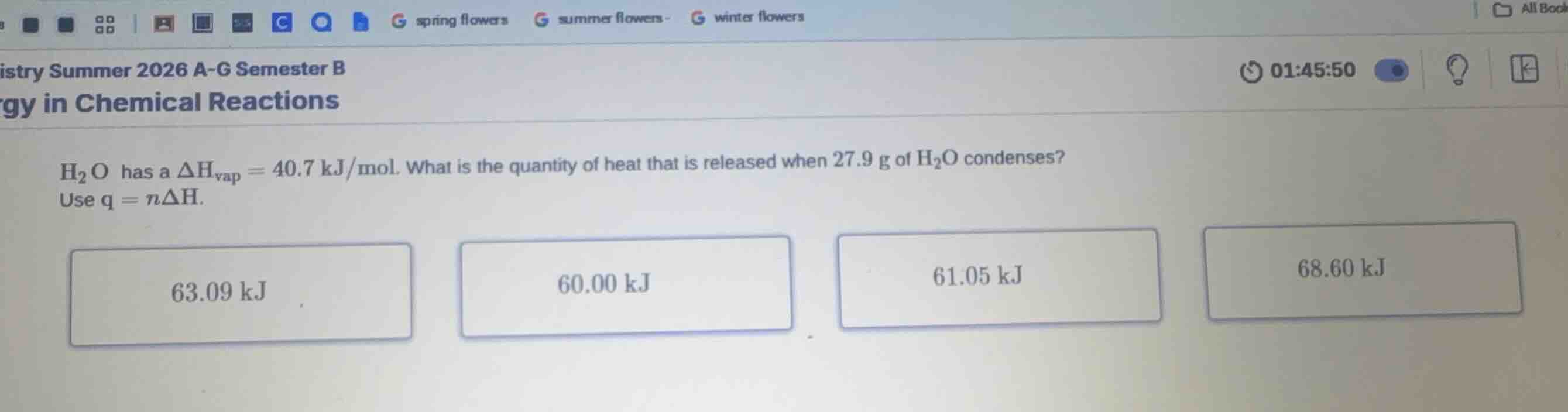
\\(\text{h}_2\text{o}\\) has a \\(\delta\text{h}_{\text{vap}} = 40.7\text{ kj/mol}\\). what is the quantity of heat that is released when \\(27.9\text{ g}\\) of \\(\text{h}_2\text{o}\\) condenses?
use \\(q = n\delta\text{h}\\).
options:
- \\(63.09\text{ kj}\\)
- \\(60.00\text{ kj}\\)
- \\(61.05\text{ kj}\\)
- \\(68.60\text{ kj}\\)
Calculate moles of water
Find the molar mass of \( \text{H}_2\text{O} \).
Calculate moles \( n \) from the given mass.
Determine heat released during condensation
Using the Enthalpy of Reaction concept, relate phase change enthalpy to heat.
Since condensation is the reverse of vaporization:
Calculate the heat \( q \) released:
The magnitude of heat released is approximately \( 63.01\text{ kJ} \) (matching \( 63.09\text{ kJ} \) using \( M_{\text{H}_2\text{O}} \approx 18.0\text{ g/mol} \)).
Verify with standard high school molar mass
Using \( M_{\text{H}_2\text{O}} = 18.0\text{ g/mol} \):

Snap & solve any problem in the app
Get step-by-step solutions on Sovi AI
Photo-based solutions with guided steps
Explore more problems and detailed explanations
- (A) 63.09 kJ (Correct answer)
- (B) 60.00 kJ
- (C) 61.05 kJ
- (D) 68.60 kJ