QUESTION IMAGE
Question
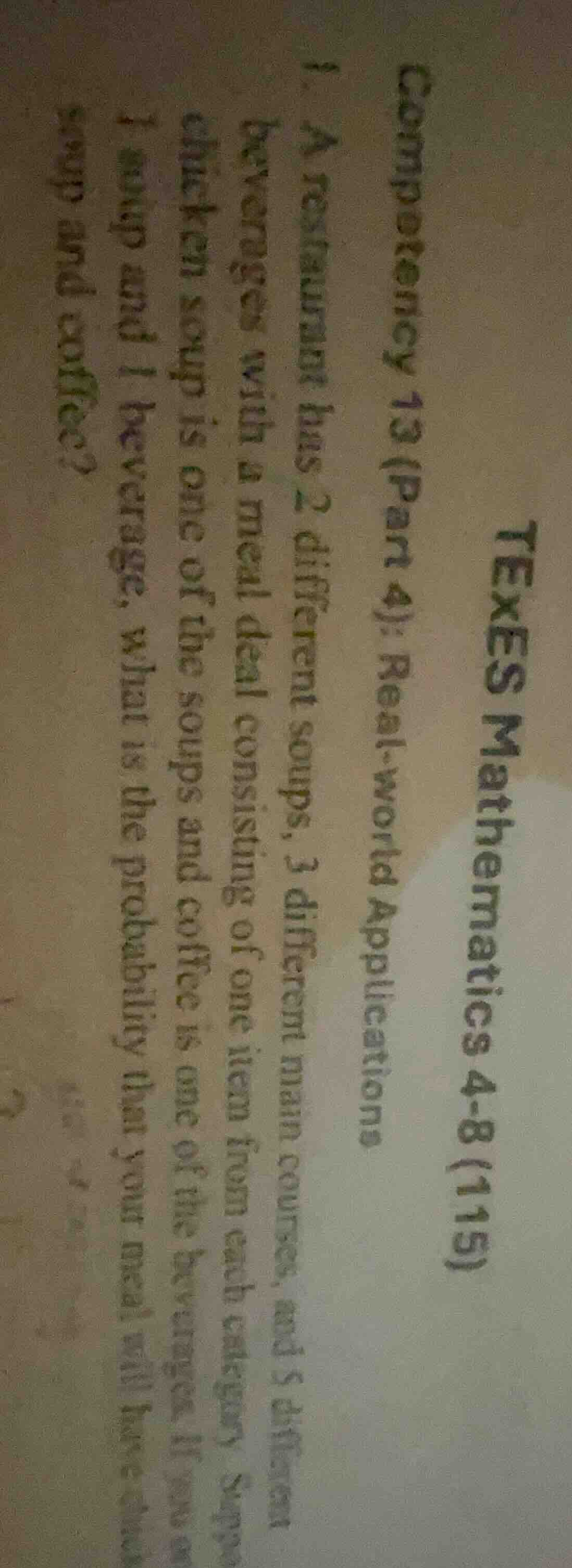
texes mathematics 4-8 (115)
competency 13 (part 4): real-world applications
- a restaurant has 2 different soups, 3 different main courses, and 5 different beverages with a meal deal consisting of one item from each category. suppose chicken soup is one of the soups and coffee is one of the beverages. if you order 1 soup and 1 beverage, what is the probability that your meal will have chicken soup and coffee?
⚡ Using what you learned: Simple Events and Compound Events
Step 1: Find the total number of possible meal combinations
Using the Fundamental Counting Principle, multiply the number of options in each category:
- Soups: \(2\)
- Main courses: \(3\)
- Beverages: \(5\)
$$
\text{Total combinations} = 2 \times 3 \times 5 = 30
$$
Step 2: Find the number of favorable outcomes
We want to find the number of combinations that include:
- Chicken soup (exactly \(1\) specific soup option)
- Any main course (\(3\) options)
- Coffee (exactly \(1\) specific beverage option)
$$
\text{Favorable combinations} = 1 \times 3 \times 1 = 3
$$
Step 3: Calculate the probability
Divide the number of favorable outcomes by the total number of outcomes:
$$
P(\text{chicken soup, any main, coffee}) = \frac{3}{30} = \frac{1}{10}
$$

Snap & solve any problem in the app
Get step-by-step solutions on Sovi AI
Photo-based solutions with guided steps
Explore more problems and detailed explanations
\(\frac{1}{10}\) (or \(0.1\), which is \(10\%\))