QUESTION IMAGE
Question
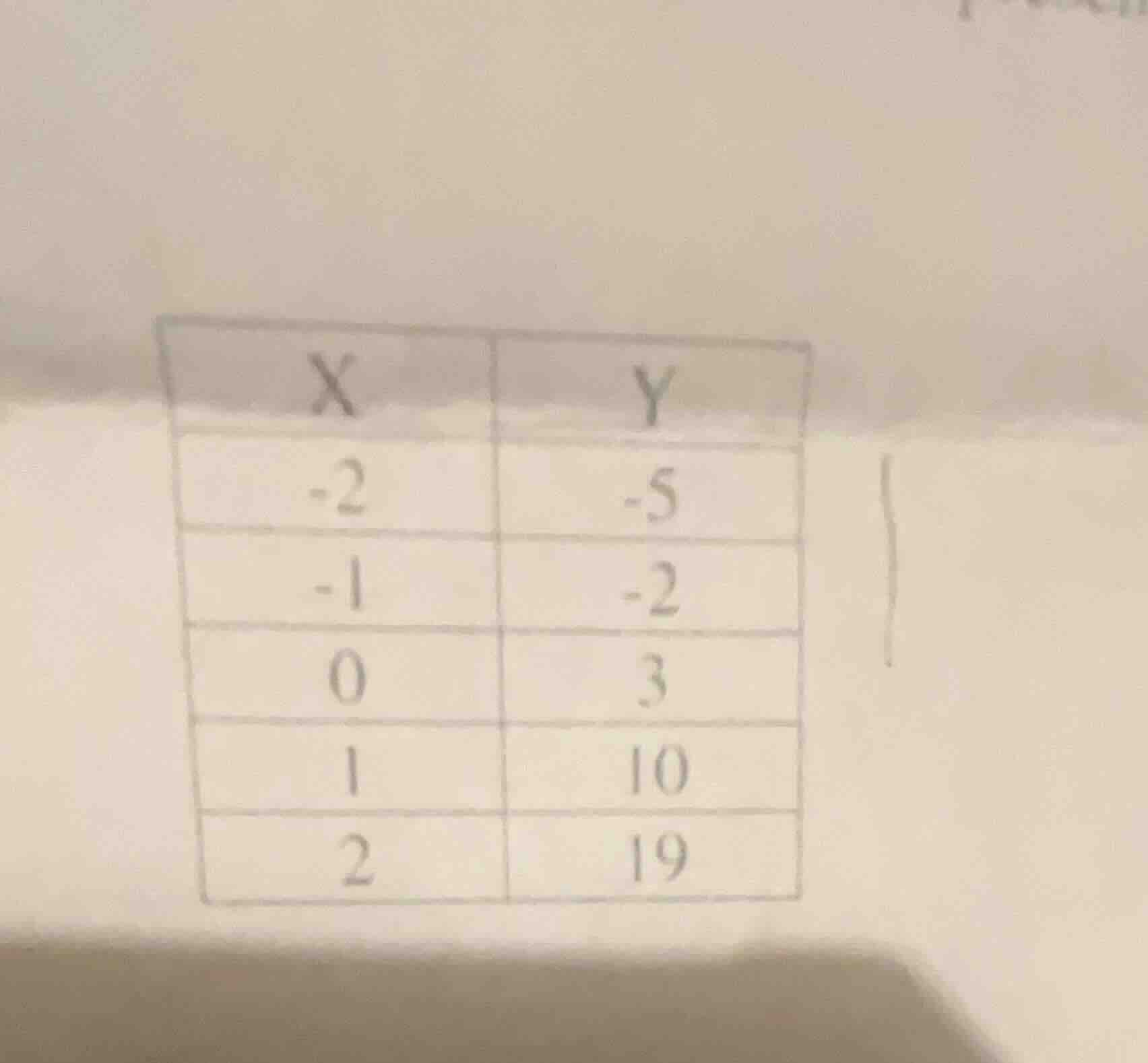
the table shows the corresponding values of x and y: when x is -2, y is -5; when x is -1, y is -2; when x is 0, y is 3; when x is 1, y is 10; when x is 2, y is 19.
To determine the relationship between \( x \) and \( y \), we can assume a quadratic function of the form \( y = ax^2 + bx + c \) (since the differences of differences might be constant, indicating a quadratic relationship).
Step 1: Use the point \( (0, 3) \)
When \( x = 0 \), \( y = 3 \). Substituting into \( y = ax^2 + bx + c \):
Step 2: Use the point \( (-1, -2) \)
Substitute \( x = -1 \), \( y = -2 \), and \( c = 3 \) into \( y = ax^2 + bx + c \):
Step 3: Use the point \( (1, 10) \)
Substitute \( x = 1 \), \( y = 10 \), and \( c = 3 \) into \( y = ax^2 + bx + c \):
Step 4: Solve the system of equations
We have the system:
Add the two equations:
Substitute \( a = 1 \) into equation (2):
Step 5: Verify the function
The quadratic function is \( y = x^2 + 6x + 3 \). Let's verify with \( x = -2 \):
Which matches the table. For \( x = 2 \):
Which also matches the table.
So the relationship between \( x \) and \( y \) is \( \boldsymbol{y = x^2 + 6x + 3} \).

Snap & solve any problem in the app
Get step-by-step solutions on Sovi AI
Photo-based solutions with guided steps
Explore more problems and detailed explanations
To determine the relationship between \( x \) and \( y \), we can assume a quadratic function of the form \( y = ax^2 + bx + c \) (since the differences of differences might be constant, indicating a quadratic relationship).
Step 1: Use the point \( (0, 3) \)
When \( x = 0 \), \( y = 3 \). Substituting into \( y = ax^2 + bx + c \):
Step 2: Use the point \( (-1, -2) \)
Substitute \( x = -1 \), \( y = -2 \), and \( c = 3 \) into \( y = ax^2 + bx + c \):
Step 3: Use the point \( (1, 10) \)
Substitute \( x = 1 \), \( y = 10 \), and \( c = 3 \) into \( y = ax^2 + bx + c \):
Step 4: Solve the system of equations
We have the system:
Add the two equations:
Substitute \( a = 1 \) into equation (2):
Step 5: Verify the function
The quadratic function is \( y = x^2 + 6x + 3 \). Let's verify with \( x = -2 \):
Which matches the table. For \( x = 2 \):
Which also matches the table.
So the relationship between \( x \) and \( y \) is \( \boldsymbol{y = x^2 + 6x + 3} \).