QUESTION IMAGE
Question
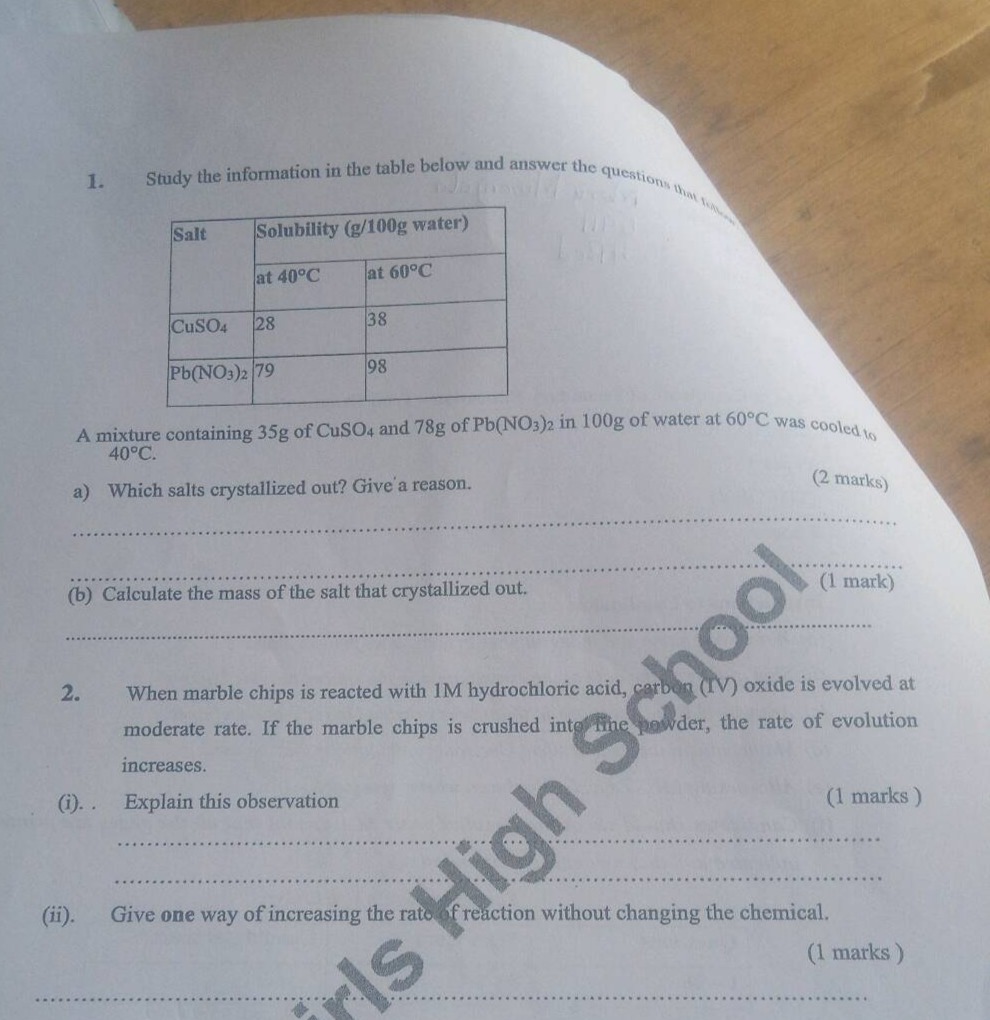
- study the information in the table below and answer the questions that follow.
\
a mixture containing \\(35\text{g}\\) of \\(\text{cuso}_4\\) and \\(78\text{g}\\) of \\(\text{pb(no}_3)_2\\) in \\(100\text{g}\\) of water at \\(60^\circ\text{c}\\) was cooled to \\(40^\circ\text{c}\\).
a) which salts crystallized out? give a reason. (2 marks)
(b) calculate the mass of the salt that crystallized out. (1 mark)
- when marble chips is reacted with \\(1\text{m}\\) hydrochloric acid, carbon (iv) oxide is evolved at moderate rate. if the marble chips is crushed into fine powder, the rate of evolution increases.
(i) explain this observation (1 marks)
(ii) give one way of increasing the rate of reaction without changing the chemical. (1 marks)
🆕 New Concept Discovered: Solubility and Crystallization
How temperature changes affect dissolved substances
---
Step 1: Analyze the initial mixture at \(60^\circ\text{C}\)
At \(60^\circ\text{C}\), the mixture contains:
- \(35\text{ g}\) of \(\text{CuSO}_4\)
- \(78\text{ g}\) of \(\text{Pb(NO}_3)_2\)
- \(100\text{ g}\) of water
Let's check if both salts are fully dissolved at \(60^\circ\text{C}\) by comparing these amounts to their maximum solubilities at \(60^\circ\text{C}\):
- Solubility of \(\text{CuSO}_4\) at \(60^\circ\text{C}\) is \(38\text{ g}/100\text{ g}\) of water. Since \(35\text{ g} < 38\text{ g}\), all \(\text{CuSO}_4\) is fully dissolved.
- Solubility of \(\text{Pb(NO}_3)_2\) at \(60^\circ\text{C}\) is \(98\text{ g}/100\text{ g}\) of water. Since \(78\text{ g} < 98\text{ g}\), all \(\text{Pb(NO}_3)_2\) is fully dissolved.
---
Step 2: Analyze the mixture after cooling to \(40^\circ\text{C}\) (Part a)
When cooled to \(40^\circ\text{C}\), the maximum amount of each salt that can remain dissolved in \(100\text{ g}\) of water decreases to their respective solubility limits at \(40^\circ\text{C}\):
- For \(\text{CuSO}_4\): The solubility limit drops to \(28\text{ g}\). Since we have \(35\text{ g}\) present in the mixture, the water cannot hold all of it. The excess salt will crystallize out of the solution.
- For \(\text{Pb(NO}_3)_2\): The solubility limit drops to \(79\text{ g}\). Since we only have \(78\text{ g}\) present in the mixture, and \(78\text{ g} < 79\text{ g}\), all of it remains completely dissolved. No \(\text{Pb(NO}_3)_2\) crystallizes out.
Therefore, only \(\text{CuSO}_4\) crystallizes out.
---
Step 3: Calculate the mass of the crystallized salt (Part b)
To find the mass of \(\text{CuSO}_4\) that crystallizes out, subtract its solubility limit at \(40^\circ\text{C}\) from the initial mass present in the solution:
---
Step 4: Explain the effect of surface area on reaction rate (Part 2i)
🆕 New Concept Discovered: Collision Theory and Surface Area
How physical state affects chemical reaction rates
When solid marble chips (\(\text{CaCO}_3\)) are crushed into a fine powder, the total surface area exposed to the hydrochloric acid increases significantly. According to collision theory, a larger surface area increases the frequency of effective collisions between the reactant particles per unit time, thereby increasing the rate of reaction.
---
Step 5: Identify another method to increase the reaction rate (Part 2ii)
To increase the rate of reaction without changing the chemical substances (marble chips and hydrochloric acid), we can alter other physical conditions:
- Increase the temperature of the reaction mixture (which gives particles more kinetic energy, leading to more frequent and energetic collisions).
- Increase the concentration of the hydrochloric acid (which increases the number of reacting particles per unit volume).
---

Snap & solve any problem in the app
Get step-by-step solutions on Sovi AI
Photo-based solutions with guided steps
Explore more problems and detailed explanations
1.
- a) Which salts crystallized out? Give a reason.