QUESTION IMAGE
Question
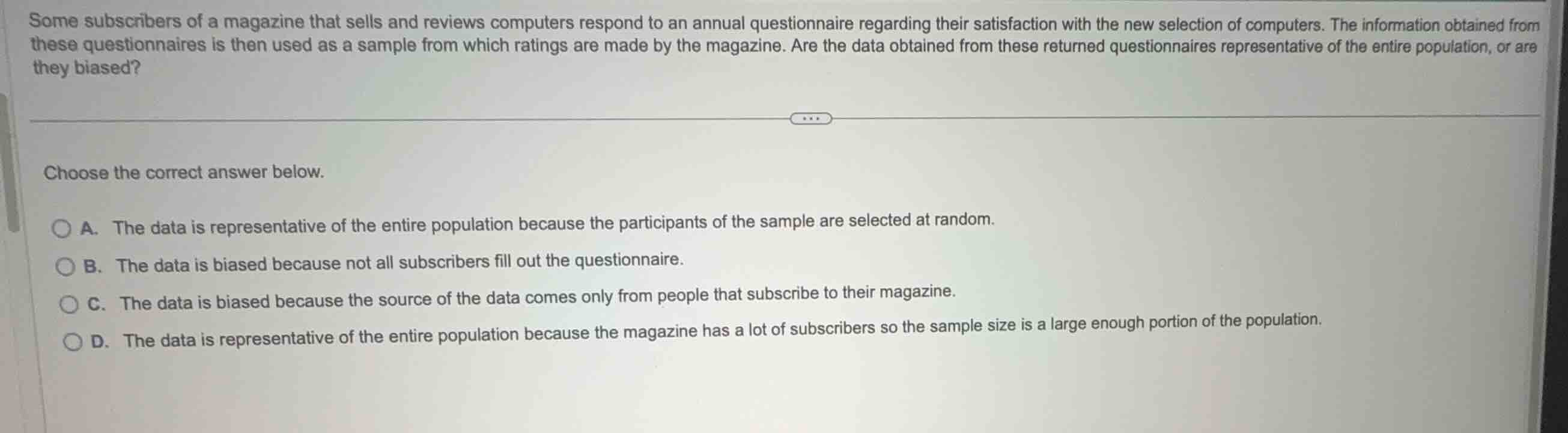
some subscribers of a magazine that sells and reviews computers respond to an annual questionnaire regarding their satisfaction with the new selection of computers. the information obtained from these questionnaires is then used as a sample from which ratings are made by the magazine. are the data obtained from these returned questionnaires representative of the entire population, or are they biased?
choose the correct answer below.
a. the data is representative of the entire population because the participants of the sample are selected at random.
b. the data is biased because not all subscribers fill out the questionnaire.
c. the data is biased because the source of the data comes only from people that subscribe to their magazine.
d. the data is representative of the entire population because the magazine has a lot of subscribers so the sample size is a large enough portion of the population.
Analyze the sampling method
The scenario describes a situation where "some subscribers of a magazine... respond to an annual questionnaire." This is a classic example of a voluntary response sample, which is a type of non-probability sampling. In voluntary response sampling, individuals self-select into the sample by choosing to respond.
Identify potential sources of bias
Using Statistical Misinterpretation concepts, we evaluate why this sample is not representative of the entire population:
- Undercoverage/Selection Bias: The sample only includes subscribers to this specific computer magazine, completely excluding non-subscribers who also buy and use computers.
- Voluntary Response Bias: Only those subscribers who feel strongly enough to fill out and return the questionnaire are represented.
Evaluate the given options
- Option A is incorrect because the participants are self-selected, not randomly selected by the researchers.
- Option B states the data is biased because not all subscribers fill it out. While non-response is an issue, the fundamental bias in representing the entire population of computer users comes from the sampling frame itself.
- Option C states the data is biased because the source of the data comes only from people that subscribe to their magazine. This correctly identifies the selection bias (undercoverage) relative to the entire population of computer users.
- Option D is incorrect because a large sample size from a biased sampling frame does not make the sample representative.
Select the best option
Option C directly addresses why the sample cannot represent the entire population of computer users: the sampling frame is restricted solely to subscribers of that specific magazine.

Snap & solve any problem in the app
Get step-by-step solutions on Sovi AI
Photo-based solutions with guided steps
Explore more problems and detailed explanations
- (A) The data is representative of the entire population because the participants of the sample are selected at random.
- (B) The data is biased because not all subscribers fill out the questionnaire.
- (C) The data is biased because the source of the data comes only from people that subscribe to their magazine. (Correct answer)
- (D) The data is representative of the entire population because the magazine has a lot of subscribers so the sample size is a large enough portion of the population.