QUESTION IMAGE
Question
some information about a bleach solution
- caustic
- causes severe burns when exposed to skin
- causes mild respiratory tract irritation after a single exposure when vapours are inhaled
question 16
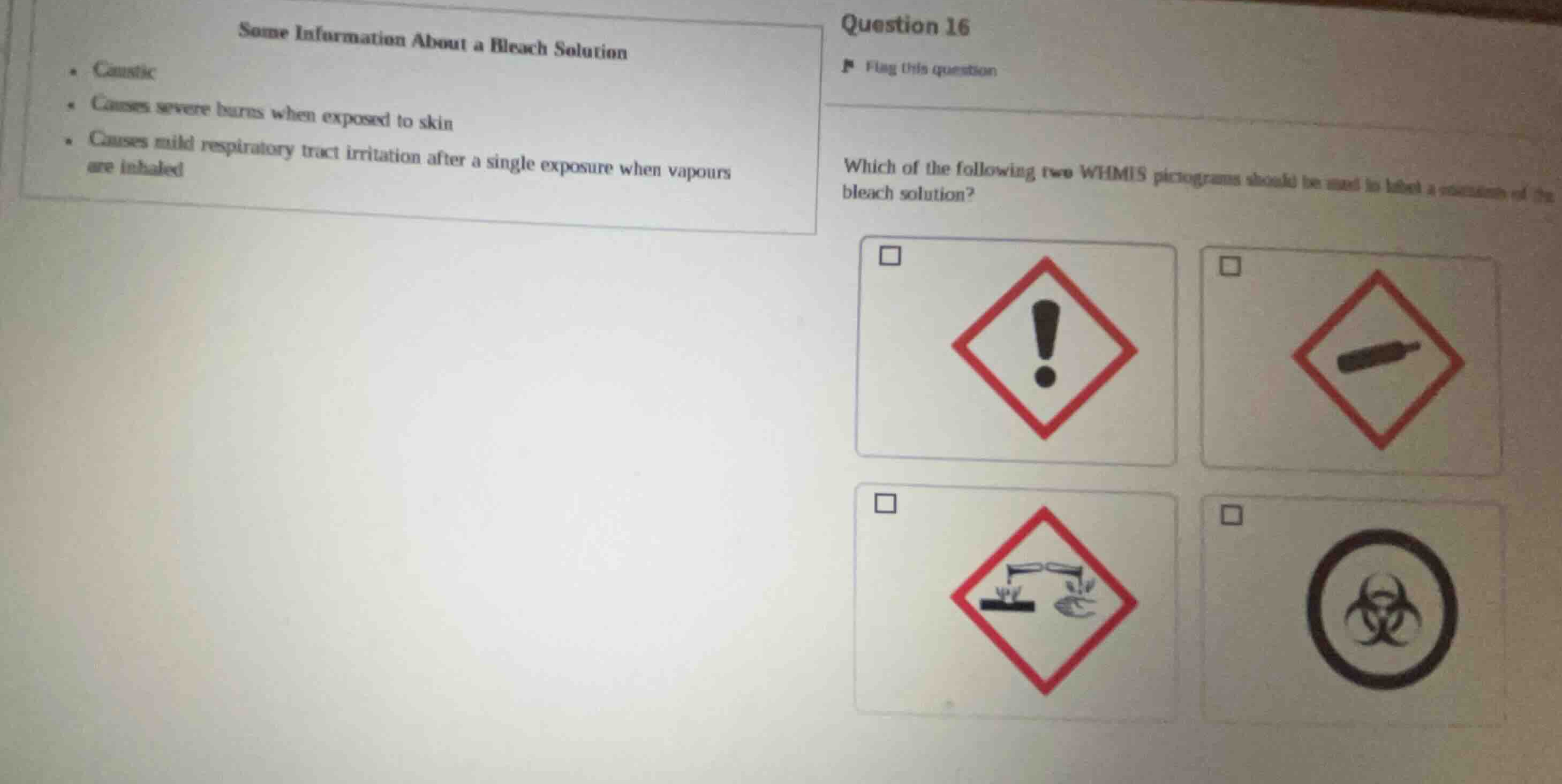
which of the following two whmis pictograms should be used to label a container of the bleach solution?
<pre_analysis>
{
"quality": "clear",
"question_count": 1,
"skills_matched": [
"direct_cot",
"multiple_choice_formatter",
"explain_then_answer",
"tutor"
],
"needs_drawing": false,
"concepts_used": [
"Chemical Properties"
],
"new_concepts": [
"WHMIS Pictograms",
"Chemical Hazard Symbols"
],
"current_concepts": [
"Chemical Properties",
"WHMIS Pictograms",
"Chemical Hazard Symbols"
]
}
</pre_analysis>
<reasoning>
Analyze the given properties of the bleach solution
The provided information describes the bleach solution with three key characteristics:
- Caustic (corrosive to metals and living tissue)
- Causes severe burns when exposed to skin (corrosive hazard)
- Causes mild respiratory tract irritation after a single exposure when vapours are inhaled (acute toxicity/irritant hazard)
We will use our understanding of Chemical Properties to match these hazards to the correct safety symbols.
Identify the corresponding WHMIS pictograms
Let's evaluate the four displayed WHMIS pictograms:
- Exclamation Mark (top-left): Represents less severe health hazards, such as skin/eye irritation or respiratory tract irritation. This matches the property "Causes mild respiratory tract irritation."
- Gas Cylinder (top-right): Represents gases under pressure. Bleach solution is a liquid, so this is incorrect.
- Corrosion (bottom-left): Shows liquids pouring onto a surface and a hand, causing damage. This represents corrosive materials that cause severe skin burns and eye damage, matching "Caustic" and "Causes severe burns."
- Biohazardous Infectious Materials (bottom-right): Represents organisms or toxins that can cause diseases. Bleach is a chemical mixture, not an infectious biological agent, so this is incorrect.
Therefore, the two correct pictograms are the Exclamation Mark (top-left) and the Corrosion symbol (bottom-left).
</reasoning>
<answer>
<mcq-correct>Top-left (Exclamation mark) and Bottom-left (Corrosion)</mcq-correct>
<mcq-option>Top-left (Exclamation mark) and Top-right (Gas cylinder)</mcq-option>
<mcq-option>Bottom-left (Corrosion) and Bottom-right (Biohazardous)</mcq-option>
<mcq-option>Top-right (Gas cylinder) and Bottom-right (Biohazardous)</mcq-option>
</answer>
<post_analysis>
{
"subject": "Natural Science",
"question_type": "Multiple Choice",
"knowledge_point": [
"Natural Science",
"Chemistry",
"Chemical Hazard Symbols"
]
}
</post_analysis>
Snap & solve any problem in the app
Get step-by-step solutions on Sovi AI
Photo-based solutions with guided steps
Explore more problems and detailed explanations
<pre_analysis>
{
"quality": "clear",
"question_count": 1,
"skills_matched": [
"direct_cot",
"multiple_choice_formatter",
"explain_then_answer",
"tutor"
],
"needs_drawing": false,
"concepts_used": [
"Chemical Properties"
],
"new_concepts": [
"WHMIS Pictograms",
"Chemical Hazard Symbols"
],
"current_concepts": [
"Chemical Properties",
"WHMIS Pictograms",
"Chemical Hazard Symbols"
]
}
</pre_analysis>
<reasoning>
Analyze the given properties of the bleach solution
The provided information describes the bleach solution with three key characteristics:
- Caustic (corrosive to metals and living tissue)
- Causes severe burns when exposed to skin (corrosive hazard)
- Causes mild respiratory tract irritation after a single exposure when vapours are inhaled (acute toxicity/irritant hazard)
We will use our understanding of Chemical Properties to match these hazards to the correct safety symbols.
Identify the corresponding WHMIS pictograms
Let's evaluate the four displayed WHMIS pictograms:
- Exclamation Mark (top-left): Represents less severe health hazards, such as skin/eye irritation or respiratory tract irritation. This matches the property "Causes mild respiratory tract irritation."
- Gas Cylinder (top-right): Represents gases under pressure. Bleach solution is a liquid, so this is incorrect.
- Corrosion (bottom-left): Shows liquids pouring onto a surface and a hand, causing damage. This represents corrosive materials that cause severe skin burns and eye damage, matching "Caustic" and "Causes severe burns."
- Biohazardous Infectious Materials (bottom-right): Represents organisms or toxins that can cause diseases. Bleach is a chemical mixture, not an infectious biological agent, so this is incorrect.
Therefore, the two correct pictograms are the Exclamation Mark (top-left) and the Corrosion symbol (bottom-left).
</reasoning>
<answer>
<mcq-correct>Top-left (Exclamation mark) and Bottom-left (Corrosion)</mcq-correct>
<mcq-option>Top-left (Exclamation mark) and Top-right (Gas cylinder)</mcq-option>
<mcq-option>Bottom-left (Corrosion) and Bottom-right (Biohazardous)</mcq-option>
<mcq-option>Top-right (Gas cylinder) and Bottom-right (Biohazardous)</mcq-option>
</answer>
<post_analysis>
{
"subject": "Natural Science",
"question_type": "Multiple Choice",
"knowledge_point": [
"Natural Science",
"Chemistry",
"Chemical Hazard Symbols"
]
}
</post_analysis>