QUESTION IMAGE
Question
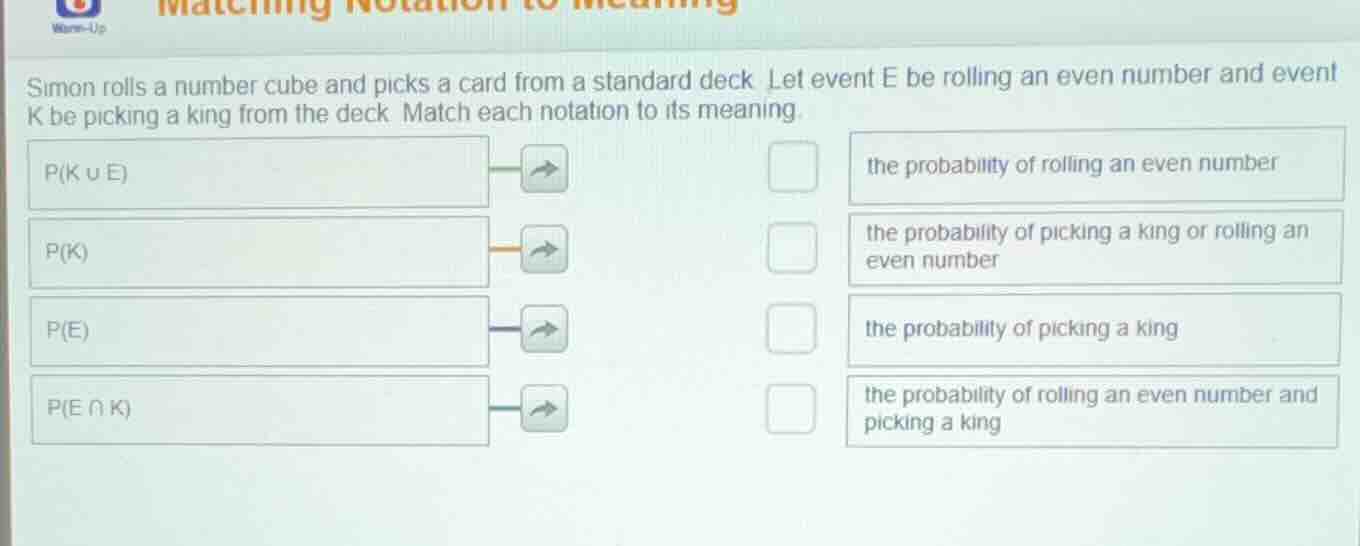
simon rolls a number cube and picks a card from a standard deck. let event e be rolling an even number and event k be picking a king from the deck. match each notation to its meaning.
- \\(p(k \cup e)\\)
- \\(p(k)\\)
- \\(p(e)\\)
- \\(p(e \cap k)\\)
meanings:
- the probability of rolling an even number
- the probability of picking a king or rolling an even number
- the probability of picking a king
- the probability of rolling an even number and picking a king
Define the events and notation
Using the Theoretical Probability knowledge point
- Let \(E\) represent the event of rolling an even number.
- Let \(K\) represent the event of picking a king.
- The notation \(P(A)\) represents the probability of event \(A\) occurring.
Match single event probabilities
Using the Theoretical Probability knowledge point
- \(P(K)\) represents the probability of event \(K\) occurring, which is:
"the probability of picking a king"
- \(P(E)\) represents the probability of event \(E\) occurring, which is:
"the probability of rolling an even number"
Match compound event union
Using the Probability Addition Rule knowledge point
- The symbol \(\cup\) represents the union of two sets or events (logical "OR").
- Therefore, \(P(K \cup E)\) represents:
"the probability of picking a king or rolling an even number"
Match compound event intersection
Using the Probability Multiplication Rule knowledge point
- The symbol \(\cap\) represents the intersection of two sets or events (logical "AND").
- Therefore, \(P(E \cap K)\) represents:
"the probability of rolling an even number and picking a king"

Snap & solve any problem in the app
Get step-by-step solutions on Sovi AI
Photo-based solutions with guided steps
Explore more problems and detailed explanations
| Notation | Meaning |
|---|---|
| \(P(K)\) | the probability of picking a king |
| \(P(E)\) | the probability of rolling an even number |
| \(P(E \cap K)\) | the probability of rolling an even number and picking a king |