Sovi.AI - AI Math Tutor

Scan to solve math questions

QUESTION IMAGE

9. a scientist claims that climate change is responsible for the rise i…

Question

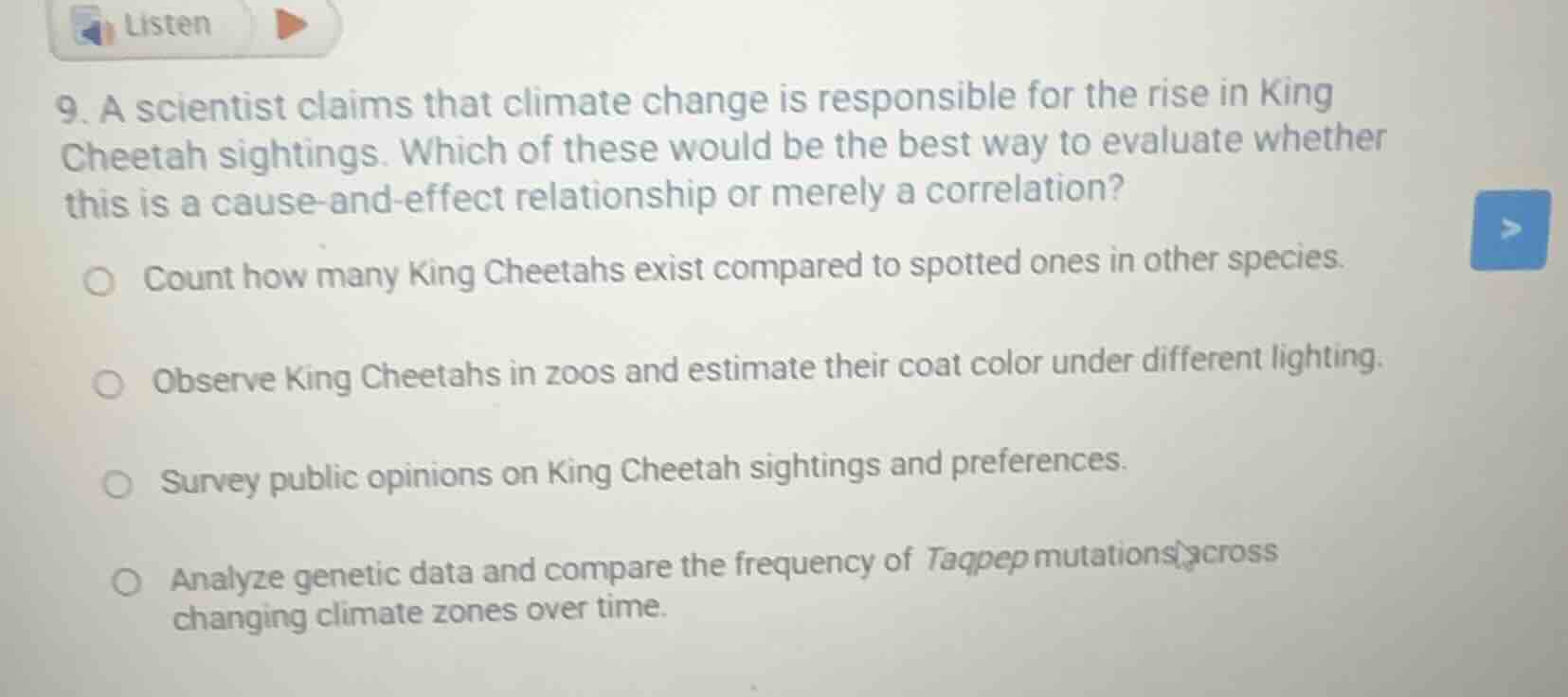
  1. a scientist claims that climate change is responsible for the rise in king cheetah sightings. which of these would be the best way to evaluate whether this is a cause-and-effect relationship or merely a correlation?
  • count how many king cheetahs exist compared to spotted ones in other species.
  • observe king cheetahs in zoos and estimate their coat color under different lighting.
  • survey public opinions on king cheetah sightings and preferences.
  • analyze genetic data and compare the frequency of taqpep mutations across changing climate zones over time.

Explanation:

Response

<pre_analysis>
{
"quality": "clear",
"question_count": 1,
"skills_matched": [
"direct_cot",
"multiple_choice_formatter",
"explain_then_answer",
"tutor"
],
"needs_drawing": false,
"concepts_used": [
"Genetic Mutations",
"Natural Selection"
],
"new_concepts": [
"Scientific Evaluation",
"Cause and Effect vs Correlation"
],
"current_concepts": [
"Genetic Mutations",
"Natural Selection",
"Scientific Evaluation",
"Cause and Effect vs Correlation"
]
}
</pre_analysis>

<reasoning>

Identify the core scientific claim

The scientist claims that climate change (environmental factor) is responsible for the rise in King Cheetah sightings (phenotypic change). We need to evaluate if this is a direct cause-and-effect relationship or just a correlation.

Analyze the biological basis of the phenotype

The King Cheetah phenotype is a rare pattern variation caused by a mutation in the Taqpep gene. To show a cause-and-effect relationship involving Genetic Mutations and Natural Selection, we must track how the frequency of this specific genetic variant changes in response to environmental shifts over time.

Evaluate the given options

  • Option 1: Counting King Cheetahs compared to other species does not address the environmental cause.
  • Option 2: Observing coat color in zoos under different lighting only tests visual perception, not genetic adaptation.
  • Option 3: Surveying public opinions measures human perception, not biological facts.
  • Option 4: Analyzing genetic data and comparing the frequency of Taqpep mutations across changing climate zones over time directly tests if climate changes correlate with genetic shifts, helping establish a causal link.

</reasoning>

<answer>
<mcq-option>Count how many King Cheetahs exist compared to spotted ones in other species.</mcq-option>
<mcq-option>Observe King Cheetahs in zoos and estimate their coat color under different lighting.</mcq-option>
<mcq-option>Survey public opinions on King Cheetah sightings and preferences.</mcq-option>
<mcq-correct>Analyze genetic data and compare the frequency of Taqpep mutations across changing climate zones over time.</mcq-correct>
</answer>

<post_analysis>
{
"subject": "Natural Science",
"question_type": "Multiple Choice",
"knowledge_point": [
"Natural Science",
"Biology",
"Natural Selection"
]
}
</post_analysis>

Answer:

<pre_analysis>
{
"quality": "clear",
"question_count": 1,
"skills_matched": [
"direct_cot",
"multiple_choice_formatter",
"explain_then_answer",
"tutor"
],
"needs_drawing": false,
"concepts_used": [
"Genetic Mutations",
"Natural Selection"
],
"new_concepts": [
"Scientific Evaluation",
"Cause and Effect vs Correlation"
],
"current_concepts": [
"Genetic Mutations",
"Natural Selection",
"Scientific Evaluation",
"Cause and Effect vs Correlation"
]
}
</pre_analysis>

<reasoning>

Identify the core scientific claim

The scientist claims that climate change (environmental factor) is responsible for the rise in King Cheetah sightings (phenotypic change). We need to evaluate if this is a direct cause-and-effect relationship or just a correlation.

Analyze the biological basis of the phenotype

The King Cheetah phenotype is a rare pattern variation caused by a mutation in the Taqpep gene. To show a cause-and-effect relationship involving Genetic Mutations and Natural Selection, we must track how the frequency of this specific genetic variant changes in response to environmental shifts over time.

Evaluate the given options

  • Option 1: Counting King Cheetahs compared to other species does not address the environmental cause.
  • Option 2: Observing coat color in zoos under different lighting only tests visual perception, not genetic adaptation.
  • Option 3: Surveying public opinions measures human perception, not biological facts.
  • Option 4: Analyzing genetic data and comparing the frequency of Taqpep mutations across changing climate zones over time directly tests if climate changes correlate with genetic shifts, helping establish a causal link.

</reasoning>

<answer>
<mcq-option>Count how many King Cheetahs exist compared to spotted ones in other species.</mcq-option>
<mcq-option>Observe King Cheetahs in zoos and estimate their coat color under different lighting.</mcq-option>
<mcq-option>Survey public opinions on King Cheetah sightings and preferences.</mcq-option>
<mcq-correct>Analyze genetic data and compare the frequency of Taqpep mutations across changing climate zones over time.</mcq-correct>
</answer>

<post_analysis>
{
"subject": "Natural Science",
"question_type": "Multiple Choice",
"knowledge_point": [
"Natural Science",
"Biology",
"Natural Selection"
]
}
</post_analysis>