QUESTION IMAGE
Question
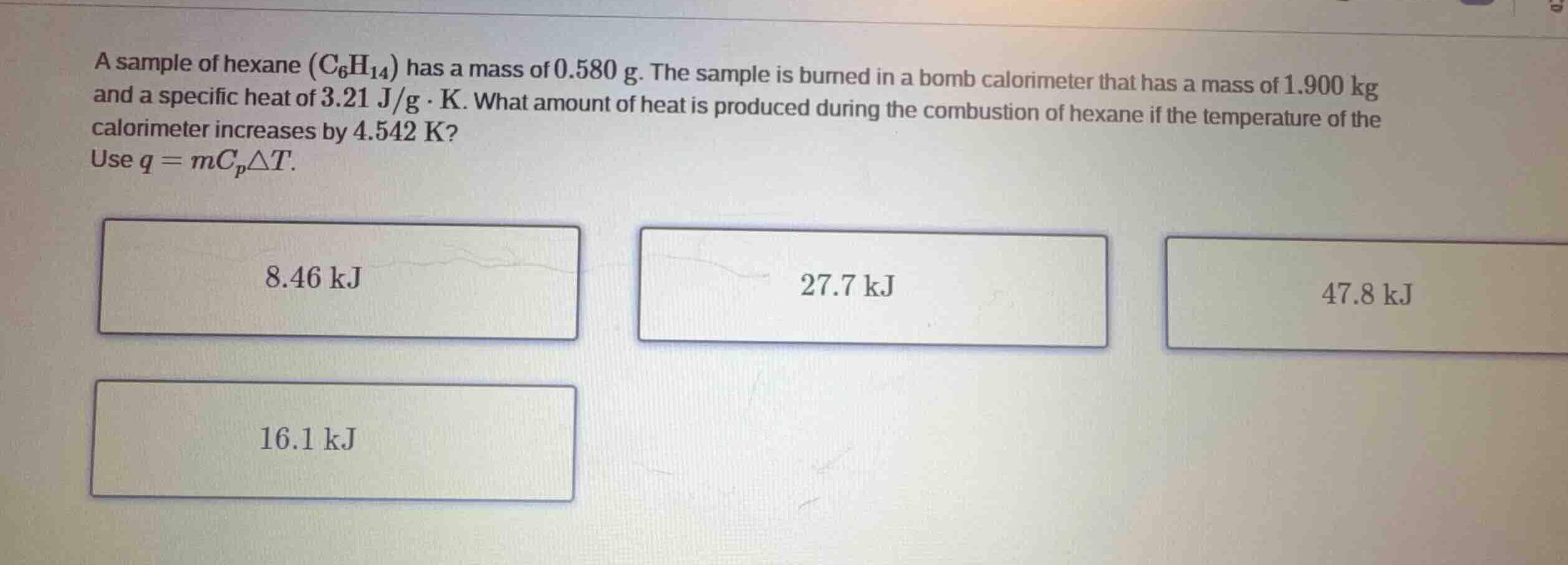
a sample of hexane (\\(\text{c}_6\text{h}_{14}\\)) has a mass of \\(0.580\text{ g}\\). the sample is burned in a bomb calorimeter that has a mass of \\(1.900\text{ kg}\\) and a specific heat of \\(3.21\text{ j/g}\cdot\text{k}\\). what amount of heat is produced during the combustion of hexane if the temperature of the calorimeter increases by \\(4.542\text{ k}\\)?
use \\(q = mc_p\delta t\\).
- \\(8.46\text{ kj}\\)
- \\(27.7\text{ kj}\\)
- \\(47.8\text{ kj}\\)
- \\(16.1\text{ kj}\\)
Identify given values
We extract the parameters from the problem statement:
- Mass of calorimeter, \(m = 1.900\text{ kg} = 1900\text{ g}\)
- Specific heat capacity of calorimeter, \(C_p = 3.21\text{ J/g}\cdot\text{K}\)
- Temperature change, \(\Delta T = 4.542\text{ K}\)
- Formula: \(q = m C_p \Delta T\)
Calculate heat absorbed
Using the Calorimetry and Specific Heat Capacity concepts:
$$
q = 1900\text{ g} \times 3.21\text{ J/g}\cdot\text{K} \times 4.542\text{ K}
$$
$$
q = 27701.658\text{ J}
$$
Convert to kilojoules
Convert the energy from Joules to kilojoules:
$$
q = \frac{27701.658\text{ J}}{1000\text{ J/kJ}} \approx 27.7\text{ kJ}
$$

Snap & solve any problem in the app
Get step-by-step solutions on Sovi AI
Photo-based solutions with guided steps
Explore more problems and detailed explanations
- 8.46 kJ
- 27.7 kJ (Correct answer)
- 47.8 kJ
- 16.1 kJ