QUESTION IMAGE
Question
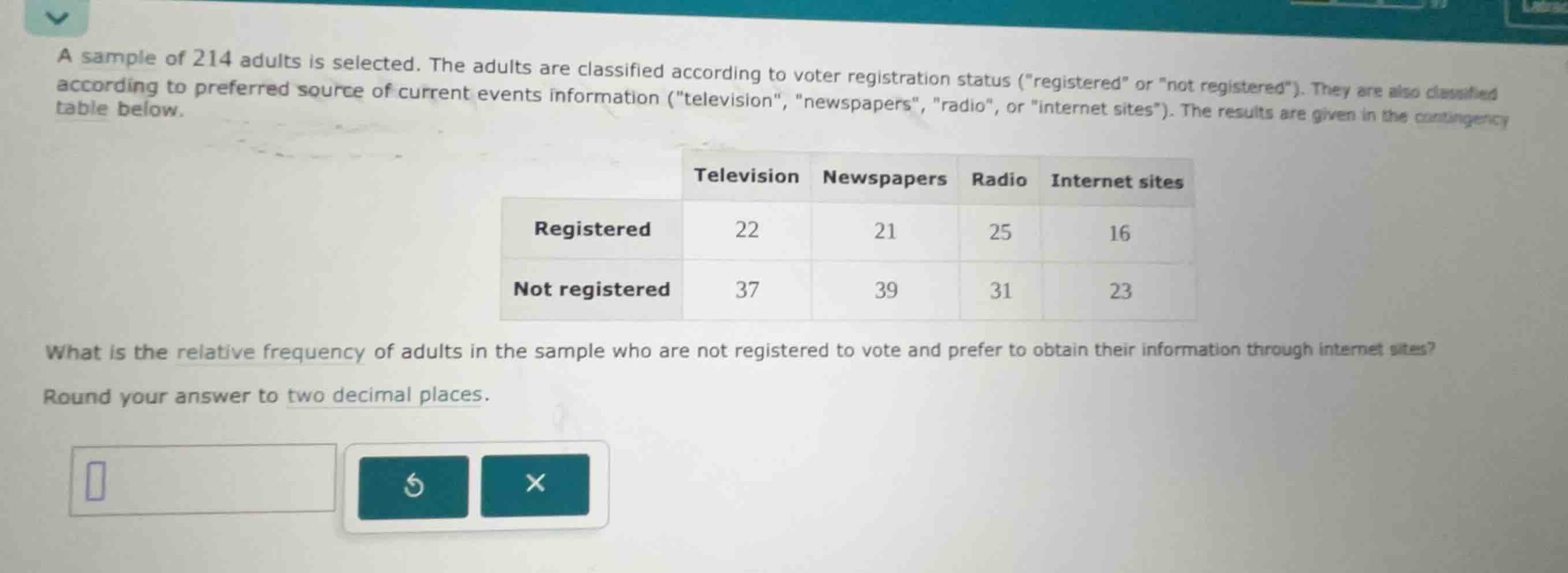
a sample of 214 adults is selected. the adults are classified according to voter registration status (
egistered\ or
ot registered\). they are also classified according to preferred source of current events information (\television\,
ewspapers\,
adio\, or \internet sites\). the results are given in the contingency table below.
\
what is the relative frequency of adults in the sample who are not registered to vote and prefer to obtain their information through internet sites?
round your answer to two decimal places.
Identify the target group and sample size
We need to find the relative frequency of adults who are "not registered" to vote and prefer "internet sites".
- The total sample size \(N\) is given as \(214\).
- Using Contingency Table Analysis, we locate the cell corresponding to the row "Not registered" and the column "Internet sites".
Extract the joint frequency
From the contingency table:
- Row: "Not registered"
- Column: "Internet sites"
- The value in this cell is \(23\).
Calculate the relative frequency
Using Relative Frequency Calculation, we divide the frequency of the target group by the total sample size:
Round to two decimal places
Rounding \(0.1074766\) to two decimal places gives:

Snap & solve any problem in the app
Get step-by-step solutions on Sovi AI
Photo-based solutions with guided steps
Explore more problems and detailed explanations
What is the relative frequency of adults in the sample who are not registered to vote and prefer to obtain their information through internet sites?
Round your answer to two decimal places.
<blank>0.11</blank>