QUESTION IMAGE
Question
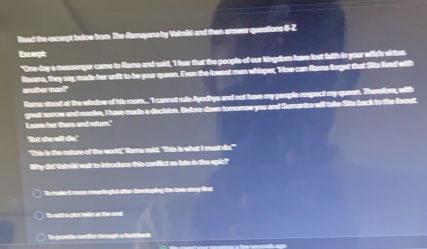
read the excerpt below from the ramayana by valmiki and then answer questions 6-7.
excerpt:
\one day a messenger came to rama and said, i fear that the people of our kingdom have lost faith in your wifes virtue. ravana, they say, made her unfit to be your queen. even the lowest men whisper, how can rama forget that sita lived with another man?\
rama stood at the window of his room... \i cannot rule ayodhya and not have my people respect my queen. therefore, with great sorrow and resolve, i have made a decision. before dawn tomorrow you and sumantra will take sita back to the forest. leave her there and return.\
\but she will die.\
\this is the nature of the world,\ rama said. \this is what i must do.\
why did valmiki wait to introduce this conflict so late in the epic?
to make it more meaningful after developing the love story first
to add a plot twist at the end
to provide conflict through a flashback
🆕 New Concept Discovered: Narrative Pacing and Conflict Placement
How authors time key events to maximize emotional impact.
Step 1: Analyze the excerpt and the conflict
The excerpt describes a painful conflict: Rama decides to banish his wife, Sita, to the forest because the citizens of Ayodhya doubt her virtue after she lived in Ravana's kingdom. This is a devastating decision for both of them, as they have endured immense struggles to be reunited.
Step 2: Evaluate the purpose of timing this conflict late in the epic
An epic narrative spends a significant amount of time building up the deep love, devotion, and shared trials of its main characters. By introducing this tragic conflict late in the epic—after the reader has fully witnessed Rama and Sita's profound bond and their hard-won victory over Ravana—the emotional weight of their separation is greatly intensified.
- Option 1 ("To make it more meaningful after developing the love story first") directly aligns with this narrative strategy. Developing the love story first ensures the audience is emotionally invested, making the eventual separation far more impactful and tragic.
- Option 2 ("To add a plot twist at the end") trivializes the deep thematic and emotional weight of the banishment by treating it merely as a sudden surprise.
- Option 3 ("To provide conflict through a flashback") is incorrect because this event is happening in the present timeline of the narrative, not as a flashback.

Snap & solve any problem in the app
Get step-by-step solutions on Sovi AI
Photo-based solutions with guided steps
Explore more problems and detailed explanations
To make it more meaningful after developing the love story first