QUESTION IMAGE
Question
raising questions
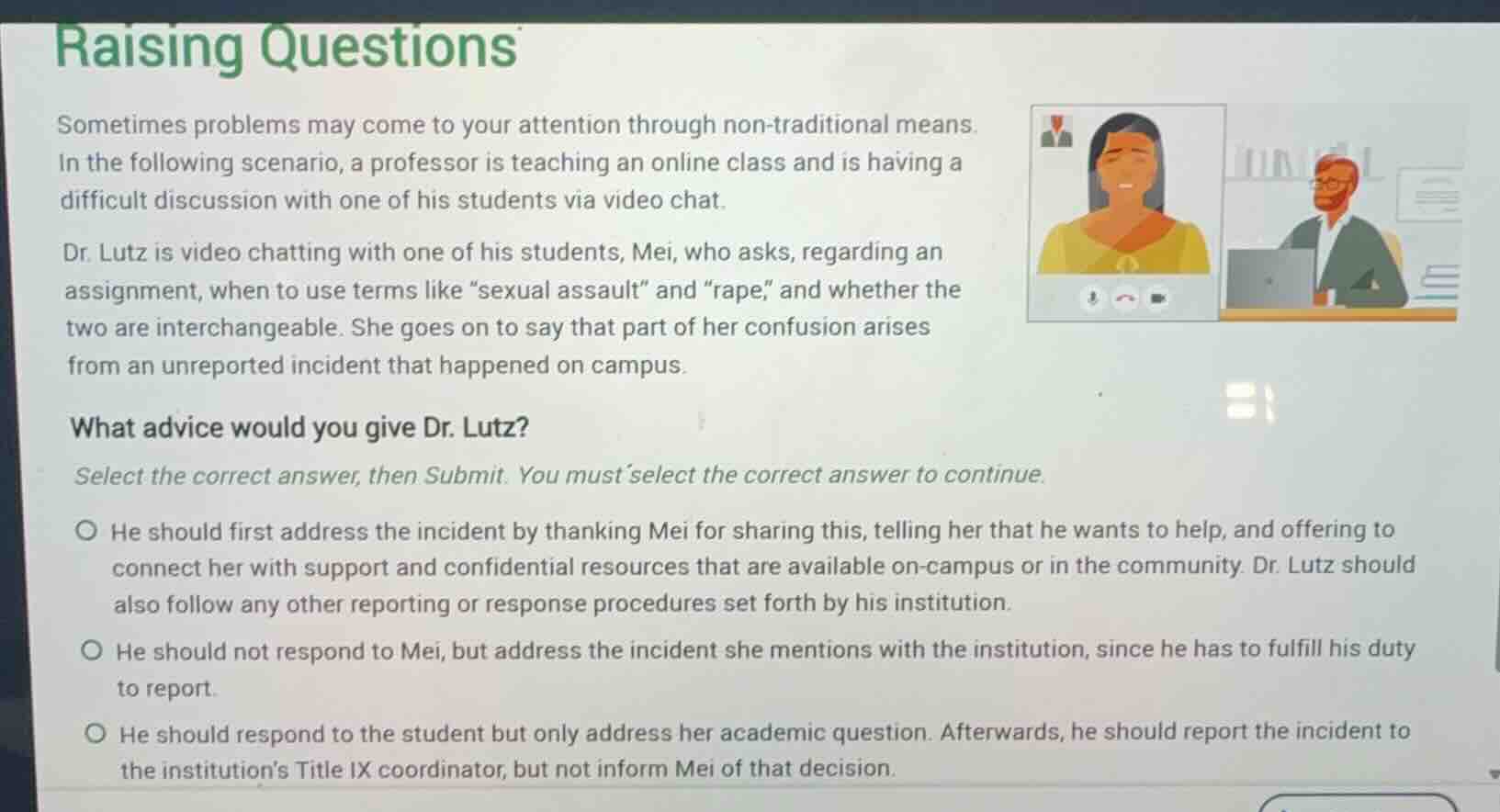
sometimes problems may come to your attention through non-traditional means. in the following scenario, a professor is teaching an online class and is having a difficult discussion with one of his students via video chat.
dr. lutz is video chatting with one of his students, mei, who asks, regarding an assignment, when to use terms like \sexual assault\ and
ape,\ and whether the two are interchangeable. she goes on to say that part of her confusion arises from an unreported incident that happened on campus.
what advice would you give dr. lutz?
select the correct answer, then submit. you must select the correct answer to continue.
he should first address the incident by thanking mei for sharing this, telling her that he wants to help, and offering to connect her with support and confidential resources that are available on-campus or in the community. dr. lutz should also follow any other reporting or response procedures set forth by his institution.
he should not respond to mei, but address the incident she mentions with the institution, since he has to fulfill his duty to report.
he should respond to the student but only address her academic question. afterwards, he should report the incident to the institutions title ix coordinator, but not inform mei of that decision.
Analyze the student's disclosure and academic context
The student, Mei, mentions an unreported campus incident involving potential sexual assault or rape during an academic discussion. This constitutes a disclosure of potential sexual misconduct to a university employee (Dr. Lutz).
Evaluate institutional and supportive responsibilities
A supportive, trauma-informed response requires acknowledging the disclosure, thanking the student for sharing, and offering connections to confidential resources. Simultaneously, as a university employee, Dr. Lutz must comply with institutional reporting requirements (such as Title IX obligations).
Compare the given options
- Option 1 correctly balances supportive communication (thanking Mei, offering confidential resources) with institutional compliance (following reporting procedures).
- Option 2 incorrectly advises ignoring the student directly.
- Option 3 incorrectly advises ignoring the personal disclosure during the interaction and reporting without informing the student about the resources or the reporting process.

Snap & solve any problem in the app
Get step-by-step solutions on Sovi AI
Photo-based solutions with guided steps
Explore more problems and detailed explanations
- (A) He should first address the incident by thanking Mei for sharing this, telling her that he wants to help, and offering to connect her with support and confidential resources that are available on-campus or in the community. Dr. Lutz should also follow any other reporting or response procedures set forth by his institution. (Correct answer)
- (B) He should not respond to Mei, but address the incident she mentions with the institution, since he has to fulfill his duty to report.
- (C) He should respond to the student but only address her academic question. Afterwards, he should report the incident to the institution's Title IX coordinator, but not inform Mei of that decision.