QUESTION IMAGE
Question
question 1
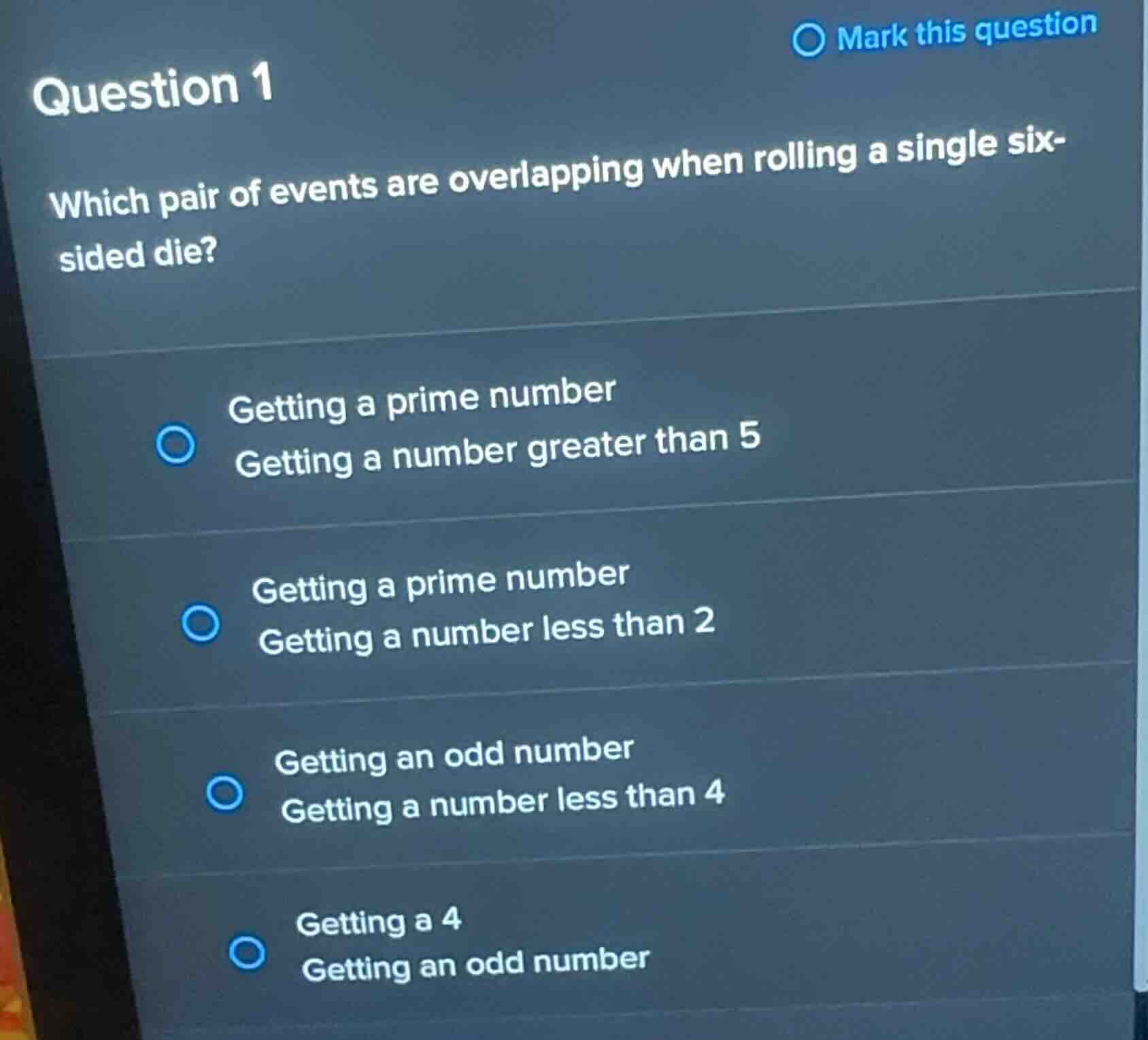
which pair of events are overlapping when rolling a single six-sided die?
getting a prime number
getting a number greater than 5
getting a prime number
getting a number less than 2
getting an odd number
getting a number less than 4
getting a 4
getting an odd number
Define overlapping events
Using the Mutually Exclusive Events knowledge point
Two events are overlapping (not mutually exclusive) if they can occur at the same time, meaning their intersection is non-empty:
Define the sample space
The sample space for rolling a single six-sided die is:
Analyze each option
Using the Mutually Exclusive Events knowledge point
- Option 1:
- Prime numbers: \(P = \{2, 3, 5\}\)
- Numbers greater than 5: \(G = \{6\}\)
- Intersection: \(P \cap G = \emptyset\) (Mutually exclusive)
- Option 2:
- Prime numbers: \(P = \{2, 3, 5\}\)
- Numbers less than 2: \(L = \{1\}\)
- Intersection: \(P \cap L = \emptyset\) (Mutually exclusive)
- Option 3:
- Odd numbers: \(O = \{1, 3, 5\}\)
- Numbers less than 4: \(T = \{1, 2, 3\}\)
- Intersection: \(O \cap T = \{1, 3\}\) (Overlapping)
- Option 4:
- Getting a 4: \(F = \{4\}\)
- Odd numbers: \(O = \{1, 3, 5\}\)
- Intersection: \(F \cap O = \emptyset\) (Mutually exclusive)
Identify the correct pair
The only pair of events that share common outcomes (overlap) is getting an odd number and getting a number less than 4, as both events contain the outcomes 1 and 3.

Snap & solve any problem in the app
Get step-by-step solutions on Sovi AI
Photo-based solutions with guided steps
Explore more problems and detailed explanations
- Getting a prime number / Getting a number greater than 5
- Getting a prime number / Getting a number less than 2
- Getting an odd number / Getting a number less than 4 (Correct answer)
- Getting a 4 / Getting an odd number