QUESTION IMAGE
Question
question 3
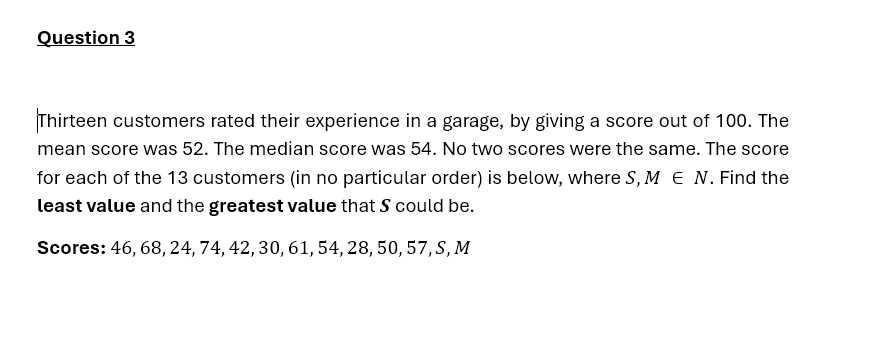
thirteen customers rated their experience in a garage, by giving a score out of 100. the mean score was 52. the median score was 54. no two scores were the same. the score for each of the 13 customers (in no particular order) is below, where \\(s, m \in \mathbb{n}\\). find the least value and the greatest value that \\(s\\) could be.
scores: \\(46, 68, 24, 74, 42, 30, 61, 54, 28, 50, 57, s, m\\)
🆕 New Concept Discovered: Median and Mean Constraints
Using statistical properties to find boundary values of unknown data points.
Step 1: Analyze the given data and constraints
We have \(13\) distinct integer scores out of \(100\). Let's list the \(11\) known scores:
The two unknown scores are \(S\) and \(M\), where \(S, M \in \mathbb{N}\) (positive integers).
Since no two scores are the same, all \(13\) scores must be unique integers between \(1\) and \(100\).
Let's calculate the sum of the \(11\) known scores:
The mean of all \(13\) scores is \(52\). This means the total sum of all \(13\) scores is:
Therefore, the sum of the two unknown scores \(S\) and \(M\) must be:
Step 2: Apply the median constraint
For \(13\) sorted scores, the median is the \(7\)-th score. We are given that the median score is \(54\).
Let's look at the sorted position of the \(11\) known scores:
Currently, \(54\) is the \(7\)-th value in this list of \(11\) sorted numbers, with \(6\) values below it and \(4\) values above it:
- Values below \(54\): \(24, 28, 30, 42, 46, 50\) (6 values)
- Values above \(54\): \(57, 61, 68, 74\) (4 values)
For \(54\) to remain the median (the \(7\)-th value) when \(S\) and \(M\) are added to the list of \(13\) elements, there must be exactly \(6\) values strictly less than \(54\), and exactly \(6\) values strictly greater than \(54\).
Since we already have \(6\) known values below \(54\), neither \(S\) nor \(M\) can be less than \(54\). If even one of them were less than \(54\), there would be at least \(7\) values below \(54\), pushing the median below \(54\).
Thus, both \(S\) and \(M\) must be greater than \(54\):
Step 3: Find the boundaries for \(S\)
Since \(S\) and \(M\) must be distinct integers (no two scores are the same) and both must be greater than \(54\), we can establish the limits.
Finding the least value of \(S\):
To make \(S\) as small as possible, it must be the smallest integer greater than \(54\) that is not already in our dataset.
- The integers starting above \(54\) are \(55, 56, 57, \dots\)
- \(57\) is already in the dataset, but \(55\) and \(56\) are free.
- If we set the least value of \(S = 55\):
However, the scores are out of \(100\), so \(M\) cannot be \(137\).
Let's find the minimum value of \(S\) that keeps \(M \le 100\):
Since \(92\) is not in our dataset, we can set:
Both \(92\) and \(100\) are greater than \(54\), are not in the existing list of scores, and are \(\le 100\).
Thus, the least possible value for \(S\) is \(92\) (which makes \(M = 100\)).
Finding the greatest value of \(S\):
By symmetry, to make \(S\) as large as possible, we must make \(M\) as small as possible.
The smallest possible value for either of these two variables is constrained by the fact that both must be greater than \(54\) and cannot equal any existing scores in the dataset:
- The smallest available integers greater than \(54\) are \(55\) and \(56\) (since \(57\) is already taken).
- If we set \(M = 55\), then:
This is invalid because scores cannot exceed \(100\).
Therefore, the maximum value any score can have is \(100\).
If we set the maximum possible value for \(S\):
\[…

Snap & solve any problem in the app
Get step-by-step solutions on Sovi AI
Photo-based solutions with guided steps
Explore more problems and detailed explanations
- Least value of \(S\): \(92\)
- Greatest value of \(S\): \(100\)