QUESTION IMAGE
Question
question 4 1 pts
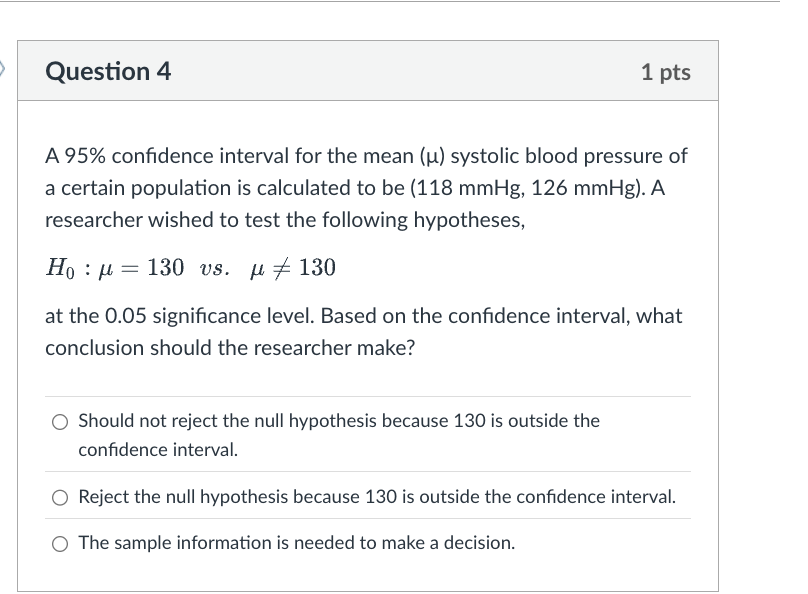
a 95% confidence interval for the mean (\mu) systolic blood pressure of a certain population is calculated to be (118 mmhg, 126 mmhg). a researcher wished to test the following hypotheses,
\\h_0 : \mu = 130 \text{ vs. } \mu \
eq 130\\
at the 0.05 significance level. based on the confidence interval, what conclusion should the researcher make?
- should not reject the null hypothesis because 130 is outside the confidence interval.
- reject the null hypothesis because 130 is outside the confidence interval.
- the sample information is needed to make a decision.
⚡ Using what you learned: Hypothesis Testing · Point Estimation and Interval Estimation
Step 1: Identify the relationship between confidence intervals and hypothesis tests
A two-sided hypothesis test at significance level \( \alpha \) is equivalent to checking whether the hypothesized value \( \mu_0 \) lies within a \( (1 - \alpha) \times 100\% \) confidence interval:
- If \( \mu_0 \) is inside the interval, we fail to reject \( H_0 \).
- If \( \mu_0 \) is outside the interval, we reject \( H_0 \).
Step 2: Compare the hypothesized value to the interval
- Hypothesized value: \( \mu_0 = 130 \)
- Confidence interval: \( (118, 126) \)
- Significance level: \( \alpha = 0.05 \) (corresponds to the \( 95\% \) confidence level)
Since \( 130 \) is outside the interval \( (118, 126) \), we reject the null hypothesis \( H_0 \).

Snap & solve any problem in the app
Get step-by-step solutions on Sovi AI
Photo-based solutions with guided steps
Explore more problems and detailed explanations
Reject the null hypothesis because 130 is outside the confidence interval.