Sovi.AI - AI Math Tutor

Scan to solve math questions

QUESTION IMAGE

question 21 the classical categorical approach reflects which tradition…

Question

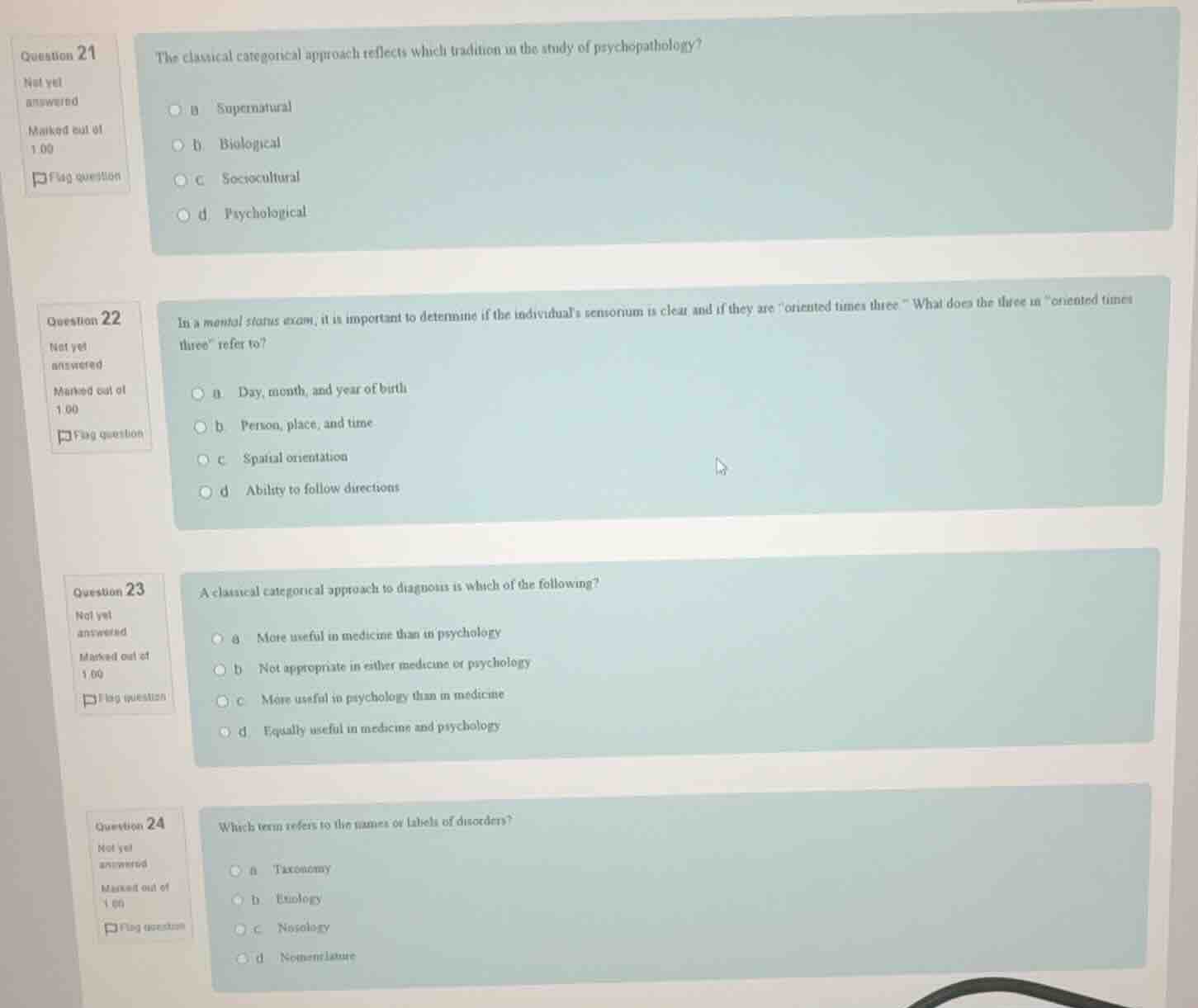
question 21
the classical categorical approach reflects which tradition in the study of psychopathology?
a. supernatural
b. biological
c. sociocultural
d. psychological

question 22
in a mental status exam, it is important to determine if the individuals sensorium is clear and if they are \oriented times three.\ what does the three in \oriented times three\ refer to?
a. day, month, and year of birth
b. person, place, and time
c. spatial orientation
d. ability to follow directions

question 23
a classical categorical approach to diagnosis is which of the following?
a. more useful in medicine than in psychology
b. not appropriate in either medicine or psychology
c. more useful in psychology than in medicine
d. equally useful in medicine and psychology

question 24
which term refers to the names or labels of disorders?
a. taxonomy
b. etiology
c. nosology
d. nomenclature

Explanation:

Response

<pre_analysis>
{
"quality": "clear",
"question_count": 4,
"skills_matched": [
"direct_cot",
"multiple_choice_formatter",
"explain_then_answer",
"quick"
],
"needs_drawing": false,
"concepts_used": [],
"new_concepts": [
"Categorical Approach",
"Mental Status Exam",
"Psychiatric Nomenclature"
],
"current_concepts": [
"Categorical Approach",
"Mental Status Exam",
"Psychiatric Nomenclature",
"Nosology"
]
}
</pre_analysis>

<reasoning>

Question 21: Classical categorical approach tradition

The classical categorical approach to psychopathology assumes that every diagnosis has a clear underlying pathophysiological cause, which is a hallmark of the biological tradition.

Question 22: Oriented times three definition

In a mental status exam, "oriented times three" refers to an individual's awareness of person (who they are), place (where they are), and time (what day/time it is).

Question 23: Classical categorical approach utility

The classical categorical approach assumes distinct, non-overlapping categories with specific physical causes, which is highly useful and standard in medicine (e.g., infectious diseases) but less suited to the complex, dimensional nature of psychological disorders.

Question 24: Names or labels of disorders

Nomenclature refers specifically to the system of names or labels applied to disorders, whereas taxonomy is the broader classification system and nosology is classification in a medical context.
</reasoning>

<answer>

Question 21

<mcq-option>a. Supernatural</mcq-option>
<mcq-correct>b. Biological</mcq-correct>
<mcq-option>c. Sociocultural</mcq-option>
<mcq-option>d. Psychological</mcq-option>

Question 22

<mcq-option>a. Day, month, and year of birth</mcq-option>
<mcq-correct>b. Person, place, and time</mcq-correct>
<mcq-option>c. Spatial orientation</mcq-option>
<mcq-option>d. Ability to follow directions</mcq-option>

Question 23

<mcq-correct>a. More useful in medicine than in psychology</mcq-correct>
<mcq-option>b. Not appropriate in either medicine or psychology</mcq-option>
<mcq-option>c. More useful in psychology than in medicine</mcq-option>
<mcq-option>d. Equally useful in medicine and psychology</mcq-option>

Question 24

<mcq-option>a. Taxonomy</mcq-option>
<mcq-option>b. Etiology</mcq-option>
<mcq-option>c. Nosology</mcq-option>
<mcq-correct>d. Nomenclature</mcq-correct>
</answer>

<post_analysis>
{
"subject": "Natural Science",
"question_type": "Multiple Choice",
"knowledge_point": [
"Natural Science",
"Psychiatry",
"Clinical Assessment and Diagnosis"
]
}
</post_analysis>

Answer:

<pre_analysis>
{
"quality": "clear",
"question_count": 4,
"skills_matched": [
"direct_cot",
"multiple_choice_formatter",
"explain_then_answer",
"quick"
],
"needs_drawing": false,
"concepts_used": [],
"new_concepts": [
"Categorical Approach",
"Mental Status Exam",
"Psychiatric Nomenclature"
],
"current_concepts": [
"Categorical Approach",
"Mental Status Exam",
"Psychiatric Nomenclature",
"Nosology"
]
}
</pre_analysis>

<reasoning>

Question 21: Classical categorical approach tradition

The classical categorical approach to psychopathology assumes that every diagnosis has a clear underlying pathophysiological cause, which is a hallmark of the biological tradition.

Question 22: Oriented times three definition

In a mental status exam, "oriented times three" refers to an individual's awareness of person (who they are), place (where they are), and time (what day/time it is).

Question 23: Classical categorical approach utility

The classical categorical approach assumes distinct, non-overlapping categories with specific physical causes, which is highly useful and standard in medicine (e.g., infectious diseases) but less suited to the complex, dimensional nature of psychological disorders.

Question 24: Names or labels of disorders

Nomenclature refers specifically to the system of names or labels applied to disorders, whereas taxonomy is the broader classification system and nosology is classification in a medical context.
</reasoning>

<answer>

Question 21

<mcq-option>a. Supernatural</mcq-option>
<mcq-correct>b. Biological</mcq-correct>
<mcq-option>c. Sociocultural</mcq-option>
<mcq-option>d. Psychological</mcq-option>

Question 22

<mcq-option>a. Day, month, and year of birth</mcq-option>
<mcq-correct>b. Person, place, and time</mcq-correct>
<mcq-option>c. Spatial orientation</mcq-option>
<mcq-option>d. Ability to follow directions</mcq-option>

Question 23

<mcq-correct>a. More useful in medicine than in psychology</mcq-correct>
<mcq-option>b. Not appropriate in either medicine or psychology</mcq-option>
<mcq-option>c. More useful in psychology than in medicine</mcq-option>
<mcq-option>d. Equally useful in medicine and psychology</mcq-option>

Question 24

<mcq-option>a. Taxonomy</mcq-option>
<mcq-option>b. Etiology</mcq-option>
<mcq-option>c. Nosology</mcq-option>
<mcq-correct>d. Nomenclature</mcq-correct>
</answer>

<post_analysis>
{
"subject": "Natural Science",
"question_type": "Multiple Choice",
"knowledge_point": [
"Natural Science",
"Psychiatry",
"Clinical Assessment and Diagnosis"
]
}
</post_analysis>