QUESTION IMAGE
Question
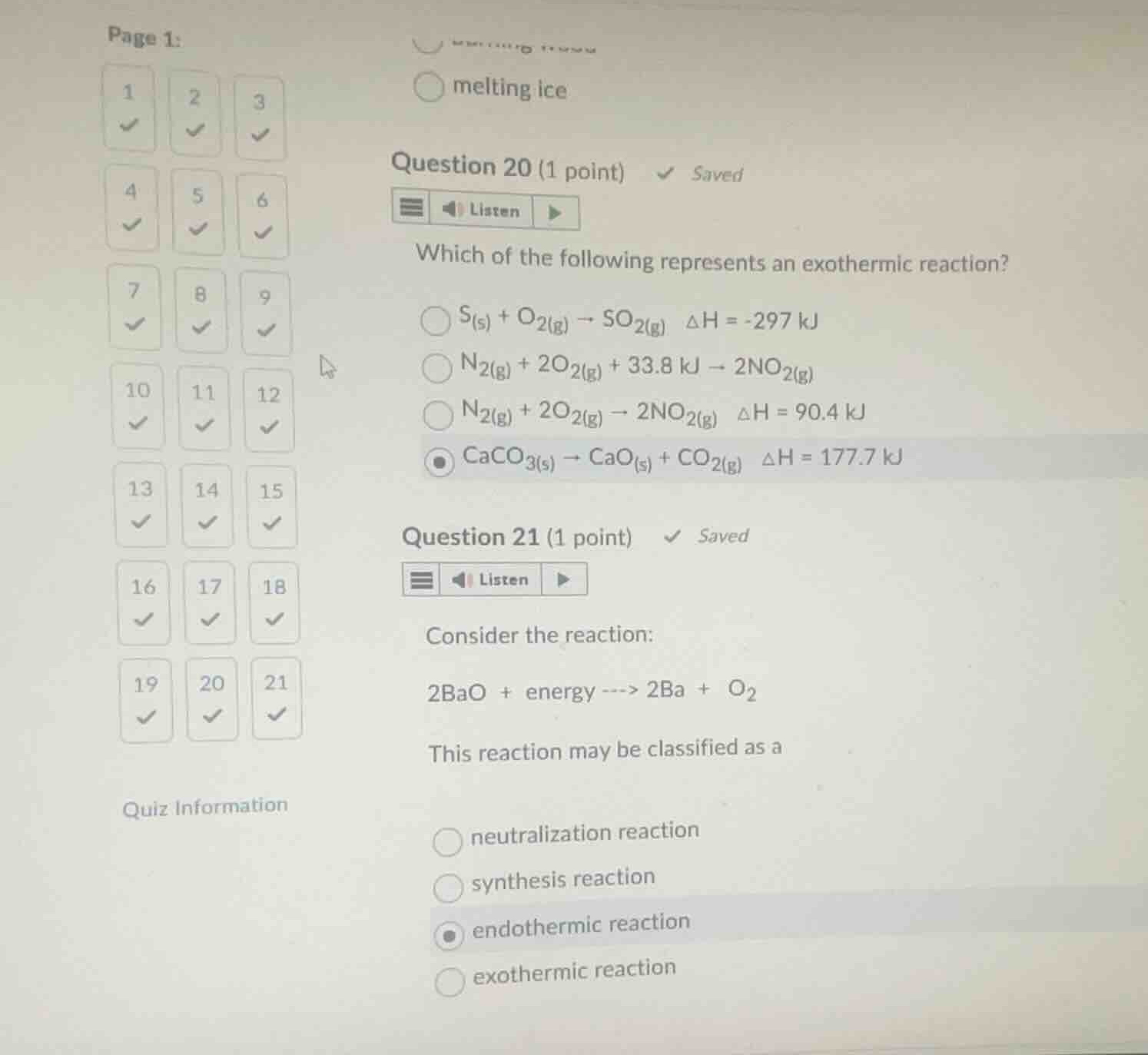
question 20 (1 point)
which of the following represents an exothermic reaction?
\\( \mathrm{s}_{(s)} + \mathrm{o}_{2(g)} \
ightarrow \mathrm{so}_{2(g)} \quad \delta h = -297 \text{ kj} \\)
\\( \mathrm{n}_{2(g)} + 2\mathrm{o}_{2(g)} + 33.8 \text{ kj} \
ightarrow 2\mathrm{no}_{2(g)} \\)
\\( \mathrm{n}_{2(g)} + 2\mathrm{o}_{2(g)} \
ightarrow 2\mathrm{no}_{2(g)} \quad \delta h = 90.4 \text{ kj} \\)
\\( \mathrm{caco}_{3(s)} \
ightarrow \mathrm{cao}_{(s)} + \mathrm{co}_{2(g)} \quad \delta h = 177.7 \text{ kj} \\)
question 21 (1 point)
consider the reaction:
\\( 2\mathrm{bao} + \text{energy} \
ightarrow 2\mathrm{ba} + \mathrm{o}_2 \\)
this reaction may be classified as a
neutralization reaction
synthesis reaction
endothermic reaction
exothermic reaction
Identify exothermic reaction criteria
An exothermic reaction releases heat to the surroundings.
In thermochemical equations, this is represented by:
- A negative enthalpy change: \(\Delta H < 0\)
- Energy written as a product on the right side.
Analyze Question 20 options
Let's evaluate each given option:
- Option 1: \(\text{S}_{(s)} + \text{O}_{2(g)}
ightarrow \text{SO}_{2(g)} \quad \Delta H = -297\text{ kJ}\)
Since \(\Delta H\) is negative, this reaction is exothermic.
- Option 2: \(\text{N}_{2(g)} + 2\text{O}_{2(g)} + 33.8\text{ kJ}
ightarrow 2\text{NO}_{2(g)}\)
Energy is on the reactant side, meaning it is endothermic.
- Option 3: \(\text{N}_{2(g)} + 2\text{O}_{2(g)}
ightarrow 2\text{NO}_{2(g)} \quad \Delta H = 90.4\text{ kJ}\)
Since \(\Delta H\) is positive, this reaction is endothermic.
- Option 4: \(\text{CaCO}_{3(s)}
ightarrow \text{CaO}_{(s)} + \text{CO}_{2(g)} \quad \Delta H = 177.7\text{ kJ}\)
Since \(\Delta H\) is positive, this reaction is endothermic.
Analyze Question 21 reaction
We are given the following chemical equation:
Energy is written on the reactant (left) side.
This means energy is absorbed during the chemical process.
Classify Question 21 reaction
A reaction that absorbs energy is classified as endothermic.
Therefore, this reaction is an endothermic reaction.

Snap & solve any problem in the app
Get step-by-step solutions on Sovi AI
Photo-based solutions with guided steps
Explore more problems and detailed explanations
Question 20
- **(A) \(\text{S}_{(s)} + \text{O}_{2(g)}
ightarrow \text{SO}_{2(g)} \quad \Delta H = -297\text{ kJ}\) (Correct answer)**
- (B) \(\text{N}_{2(g)} + 2\text{O}_{2(g)} + 33.8\text{ kJ}
ightarrow 2\text{NO}_{2(g)}\)
- (C) \(\text{N}_{2(g)} + 2\text{O}_{2(g)}
ightarrow 2\text{NO}_{2(g)} \quad \Delta H = 90.4\text{ kJ}\)
- (D) \(\text{CaCO}_{3(s)}
ightarrow \text{CaO}_{(s)} + \text{CO}_{2(g)} \quad \Delta H = 177.7\text{ kJ}\)
Question 21
- (A) neutralization reaction
- (B) synthesis reaction
- (C) endothermic reaction (Correct answer)
- (D) exothermic reaction