Sovi.AI - AI Math Tutor

Scan to solve math questions

QUESTION IMAGE

question 19 two sisters witness a major automobile accident while ridin…

Question

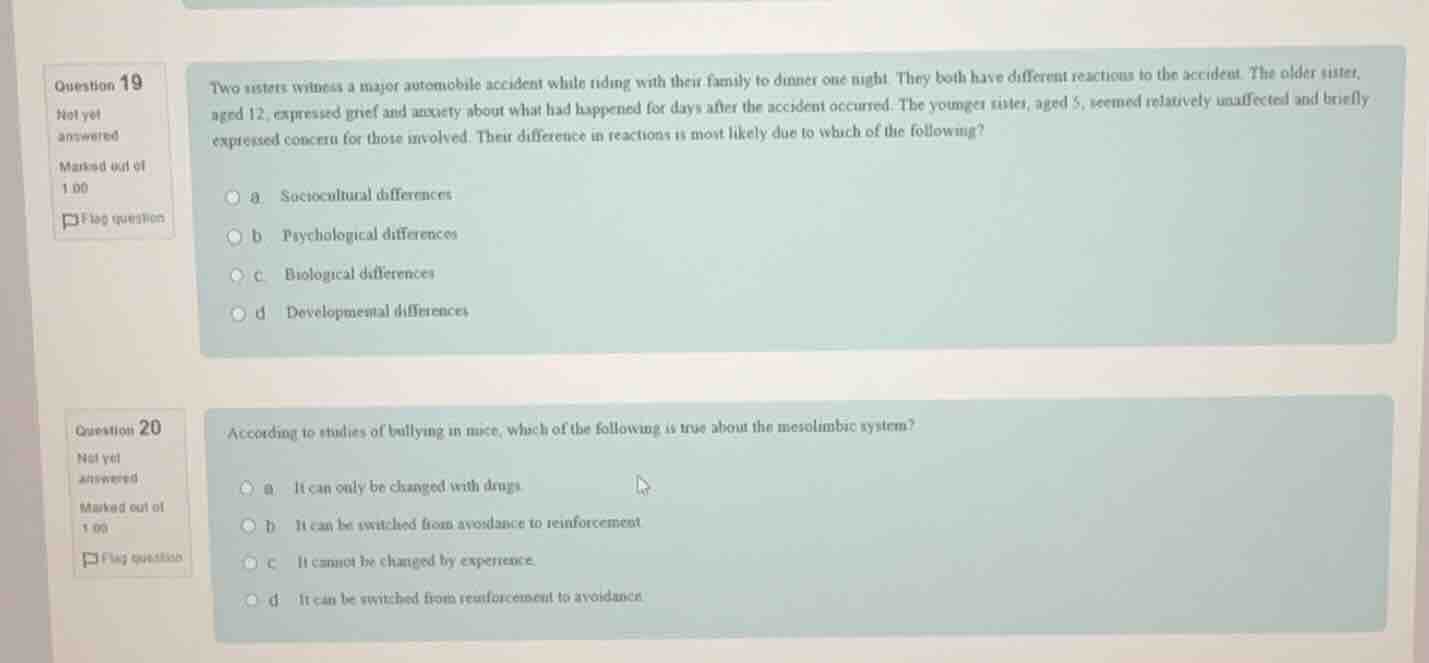
question 19
two sisters witness a major automobile accident while riding with their family to dinner one night. they both have different reactions to the accident. the older sister, aged 12, expressed grief and anxiety about what had happened for days after the accident occurred. the younger sister, aged 5, seemed relatively unaffected and briefly expressed concern for those involved. their difference in reactions is most likely due to which of the following?
a. sociocultural differences
b. psychological differences
c. biological differences
d. developmental differences

question 20
according to studies of bullying in mice, which of the following is true about the mesolimbic system?
a. it can only be changed with drugs.
b. it can be switched from avoidance to reinforcement.
c. it cannot be changed by experience.
d. it can be switched from reinforcement to avoidance.

Explanation:

Response

<pre_analysis>
{
"quality": "clear",
"question_count": 2,
"skills_matched": [
"direct_cot",
"multiple_choice_formatter",
"explain_then_answer",
"tutor"
],
"needs_drawing": false,
"concepts_used": [],
"new_concepts": [
"Developmental Psychopathology",
"Mesolimbic Dopamine System"
],
"current_concepts": [
"Developmental Psychopathology",
"Mesolimbic Dopamine System"
]
}
</pre_analysis>

<reasoning>

Analyze age-related trauma responses

The first question describes two sisters, aged 12 and 5, who witness the same automobile accident but react very differently. The 12-year-old expresses prolonged grief and anxiety, while the 5-year-old appears relatively unaffected. Because the primary difference highlighted between the two sisters is their age (12 vs. 5), their cognitive, emotional, and neurological maturity levels differ significantly. This points directly to developmental differences in how children process, understand, and react to traumatic events.

Evaluate Question 19 options

  • Sociocultural differences: Both sisters belong to the same family and witnessed the event together, making major sociocultural differences unlikely.
  • Psychological differences: While psychological differences exist, they are fundamentally driven by their distinct developmental stages in this context.
  • Biological differences: Though biological differences exist, age-linked cognitive development is the most direct explanation.
  • Developmental differences: This is the most accurate option, as cognitive and emotional processing of trauma is highly dependent on a child's developmental stage.

Analyze mesolimbic system in social defeat

The second question asks about the mesolimbic system based on studies of bullying (chronic social defeat stress) in mice. The mesolimbic dopamine pathway is central to reward, reinforcement, and motivation. Research on social defeat in mice shows that susceptibility or resilience to bullying is mediated by plastic changes in this pathway. Specifically, chronic social defeat can alter the mesolimbic dopamine system, switching its functional response to social targets from reinforcement (seeking social interaction) to avoidance (social aversion).

Evaluate Question 20 options

  • It can only be changed with drugs: Incorrect, as social experiences (like bullying) directly induce plastic changes in this system.
  • It can be switched from avoidance to reinforcement: Incorrect, as the experience of bullying typically drives the system in the opposite direction (from positive social engagement to avoidance).
  • It cannot be changed by experience: Incorrect, as the system exhibits high neuroplasticity in response to social stress.
  • It can be switched from reinforcement to avoidance: Correct, as chronic social defeat stress (bullying) alters mesolimbic signaling to turn social reward/reinforcement into social avoidance.

</reasoning>

<answer>

Question 19

<mcq-option>a. Sociocultural differences</mcq-option>
<mcq-option>b. Psychological differences</mcq-option>
<mcq-option>c. Biological differences</mcq-option>
<mcq-correct>d. Developmental differences</mcq-correct>

Question 20

<mcq-option>a. It can only be changed with drugs.</mcq-option>
<mcq-option>b. It can be switched from avoidance to reinforcement.</mcq-option>
<mcq-option>c. It cannot be changed by experience.</mcq-option>
<mcq-correct>d. It can be switched from reinforcement to avoidance.</mcq-correct>
</answer>

<post_analysis>
{
"subject": "Natural Science",
"question_type": "M…

Answer:

<pre_analysis>
{
"quality": "clear",
"question_count": 2,
"skills_matched": [
"direct_cot",
"multiple_choice_formatter",
"explain_then_answer",
"tutor"
],
"needs_drawing": false,
"concepts_used": [],
"new_concepts": [
"Developmental Psychopathology",
"Mesolimbic Dopamine System"
],
"current_concepts": [
"Developmental Psychopathology",
"Mesolimbic Dopamine System"
]
}
</pre_analysis>

<reasoning>

Analyze age-related trauma responses

The first question describes two sisters, aged 12 and 5, who witness the same automobile accident but react very differently. The 12-year-old expresses prolonged grief and anxiety, while the 5-year-old appears relatively unaffected. Because the primary difference highlighted between the two sisters is their age (12 vs. 5), their cognitive, emotional, and neurological maturity levels differ significantly. This points directly to developmental differences in how children process, understand, and react to traumatic events.

Evaluate Question 19 options

  • Sociocultural differences: Both sisters belong to the same family and witnessed the event together, making major sociocultural differences unlikely.
  • Psychological differences: While psychological differences exist, they are fundamentally driven by their distinct developmental stages in this context.
  • Biological differences: Though biological differences exist, age-linked cognitive development is the most direct explanation.
  • Developmental differences: This is the most accurate option, as cognitive and emotional processing of trauma is highly dependent on a child's developmental stage.

Analyze mesolimbic system in social defeat

The second question asks about the mesolimbic system based on studies of bullying (chronic social defeat stress) in mice. The mesolimbic dopamine pathway is central to reward, reinforcement, and motivation. Research on social defeat in mice shows that susceptibility or resilience to bullying is mediated by plastic changes in this pathway. Specifically, chronic social defeat can alter the mesolimbic dopamine system, switching its functional response to social targets from reinforcement (seeking social interaction) to avoidance (social aversion).

Evaluate Question 20 options

  • It can only be changed with drugs: Incorrect, as social experiences (like bullying) directly induce plastic changes in this system.
  • It can be switched from avoidance to reinforcement: Incorrect, as the experience of bullying typically drives the system in the opposite direction (from positive social engagement to avoidance).
  • It cannot be changed by experience: Incorrect, as the system exhibits high neuroplasticity in response to social stress.
  • It can be switched from reinforcement to avoidance: Correct, as chronic social defeat stress (bullying) alters mesolimbic signaling to turn social reward/reinforcement into social avoidance.

</reasoning>

<answer>

Question 19

<mcq-option>a. Sociocultural differences</mcq-option>
<mcq-option>b. Psychological differences</mcq-option>
<mcq-option>c. Biological differences</mcq-option>
<mcq-correct>d. Developmental differences</mcq-correct>

Question 20

<mcq-option>a. It can only be changed with drugs.</mcq-option>
<mcq-option>b. It can be switched from avoidance to reinforcement.</mcq-option>
<mcq-option>c. It cannot be changed by experience.</mcq-option>
<mcq-correct>d. It can be switched from reinforcement to avoidance.</mcq-correct>
</answer>

<post_analysis>
{
"subject": "Natural Science",
"question_type": "Multiple Choice",
"knowledge_point": [
"Natural Science",
"Psychology",
"Biological Psychology"
]
}
</post_analysis>