QUESTION IMAGE
Question
question 17 of 25
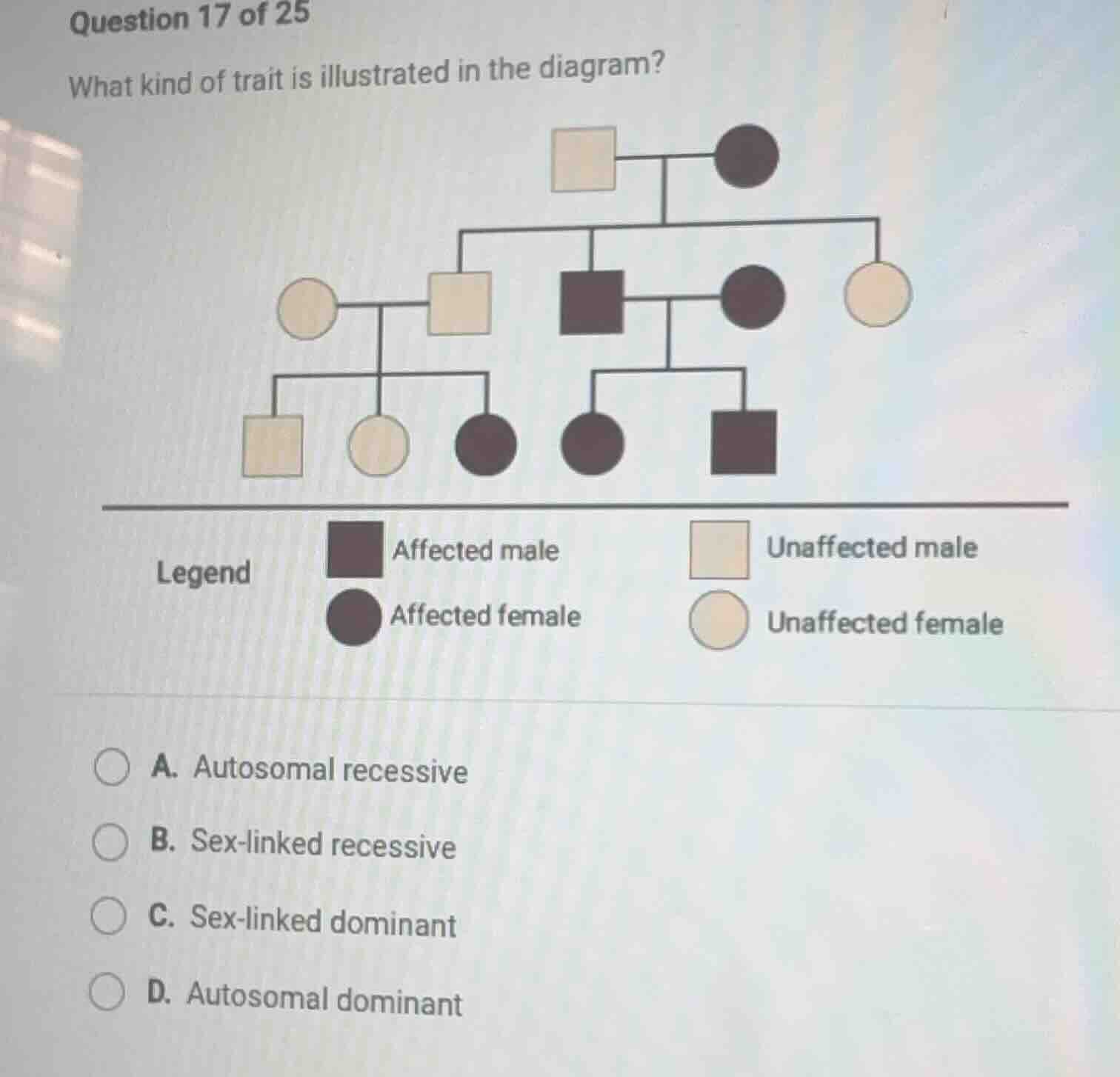
what kind of trait is illustrated in the diagram?
a. autosomal recessive
b. sex-linked recessive
c. sex-linked dominant
d. autosomal dominant
<pre_analysis>
{
"quality": "clear",
"question_count": 1,
"skills_matched": [
"direct_cot",
"multiple_choice_formatter",
"explain_then_answer",
"tutor"
],
"needs_drawing": false,
"concepts_used": [
"Pedigree Analysis"
],
"new_concepts": [],
"current_concepts": [
"Pedigree Analysis",
"Mendelian Genetics",
"Sex-Linked Inheritance"
]
}
</pre_analysis>
<reasoning>
Analyze the inheritance pattern
Using the Pedigree Analysis knowledge point, we observe that the trait appears in every generation, which is characteristic of a dominant trait. Let's test the hypothesis of an autosomal dominant trait. If the trait is autosomal dominant, an affected individual must have at least one affected parent. In this pedigree, every affected offspring has at least one affected parent.
Rule out recessive inheritance
If the trait were recessive (either autosomal or sex-linked), two unaffected parents could not have an affected child. In the second generation, the left couple consists of two unaffected individuals (unaffected female and unaffected male) who have an affected daughter (affected female in the third generation). This is impossible for a dominant trait, but let's re-examine the parent phenotypes.
Wait, looking closely at the second generation, the left couple consists of an unaffected female (circle) and an unaffected male (square). They have three children: an unaffected male, an unaffected female, and an affected female. If two unaffected parents have an affected child, the trait must be recessive. Let's verify this: if the trait is recessive, the unaffected parents can be carriers (heterozygous, \(Aa\)) and pass on the recessive alleles to produce an affected child (\(aa\)). This perfectly fits autosomal recessive inheritance.
Rule out sex-linked recessive inheritance
If the trait were sex-linked recessive (X-linked recessive), an affected female (\(X^aX^a\)) must have an affected father (\(X^aY\)). In the third generation, the affected female on the left has an unaffected father. Since her father is unaffected, he must carry the dominant normal allele (\(X^AY\)) and would pass it to his daughter, making her unaffected. Thus, the trait cannot be sex-linked recessive.
Confirm autosomal recessive inheritance
Since the trait cannot be dominant (due to unaffected parents having an affected child) and cannot be sex-linked recessive (due to an affected female having an unaffected father), it must be autosomal recessive.
</reasoning>
<answer>
<mcq-correct>A. Autosomal recessive</mcq-correct>
<mcq-option>B. Sex-linked recessive</mcq-option>
<mcq-option>C. Sex-linked dominant</mcq-option>
<mcq-option>D. Autosomal dominant</mcq-option>
</answer>
<post_analysis>
{
"subject": "Natural Science",
"question_type": "Multiple Choice",
"knowledge_point": [
"Natural Science",
"Biology",
"Pedigree Analysis"
]
}
</post_analysis>
Snap & solve any problem in the app
Get step-by-step solutions on Sovi AI
Photo-based solutions with guided steps
Explore more problems and detailed explanations
<pre_analysis>
{
"quality": "clear",
"question_count": 1,
"skills_matched": [
"direct_cot",
"multiple_choice_formatter",
"explain_then_answer",
"tutor"
],
"needs_drawing": false,
"concepts_used": [
"Pedigree Analysis"
],
"new_concepts": [],
"current_concepts": [
"Pedigree Analysis",
"Mendelian Genetics",
"Sex-Linked Inheritance"
]
}
</pre_analysis>
<reasoning>
Analyze the inheritance pattern
Using the Pedigree Analysis knowledge point, we observe that the trait appears in every generation, which is characteristic of a dominant trait. Let's test the hypothesis of an autosomal dominant trait. If the trait is autosomal dominant, an affected individual must have at least one affected parent. In this pedigree, every affected offspring has at least one affected parent.
Rule out recessive inheritance
If the trait were recessive (either autosomal or sex-linked), two unaffected parents could not have an affected child. In the second generation, the left couple consists of two unaffected individuals (unaffected female and unaffected male) who have an affected daughter (affected female in the third generation). This is impossible for a dominant trait, but let's re-examine the parent phenotypes.
Wait, looking closely at the second generation, the left couple consists of an unaffected female (circle) and an unaffected male (square). They have three children: an unaffected male, an unaffected female, and an affected female. If two unaffected parents have an affected child, the trait must be recessive. Let's verify this: if the trait is recessive, the unaffected parents can be carriers (heterozygous, \(Aa\)) and pass on the recessive alleles to produce an affected child (\(aa\)). This perfectly fits autosomal recessive inheritance.
Rule out sex-linked recessive inheritance
If the trait were sex-linked recessive (X-linked recessive), an affected female (\(X^aX^a\)) must have an affected father (\(X^aY\)). In the third generation, the affected female on the left has an unaffected father. Since her father is unaffected, he must carry the dominant normal allele (\(X^AY\)) and would pass it to his daughter, making her unaffected. Thus, the trait cannot be sex-linked recessive.
Confirm autosomal recessive inheritance
Since the trait cannot be dominant (due to unaffected parents having an affected child) and cannot be sex-linked recessive (due to an affected female having an unaffected father), it must be autosomal recessive.
</reasoning>
<answer>
<mcq-correct>A. Autosomal recessive</mcq-correct>
<mcq-option>B. Sex-linked recessive</mcq-option>
<mcq-option>C. Sex-linked dominant</mcq-option>
<mcq-option>D. Autosomal dominant</mcq-option>
</answer>
<post_analysis>
{
"subject": "Natural Science",
"question_type": "Multiple Choice",
"knowledge_point": [
"Natural Science",
"Biology",
"Pedigree Analysis"
]
}
</post_analysis>