QUESTION IMAGE
Question
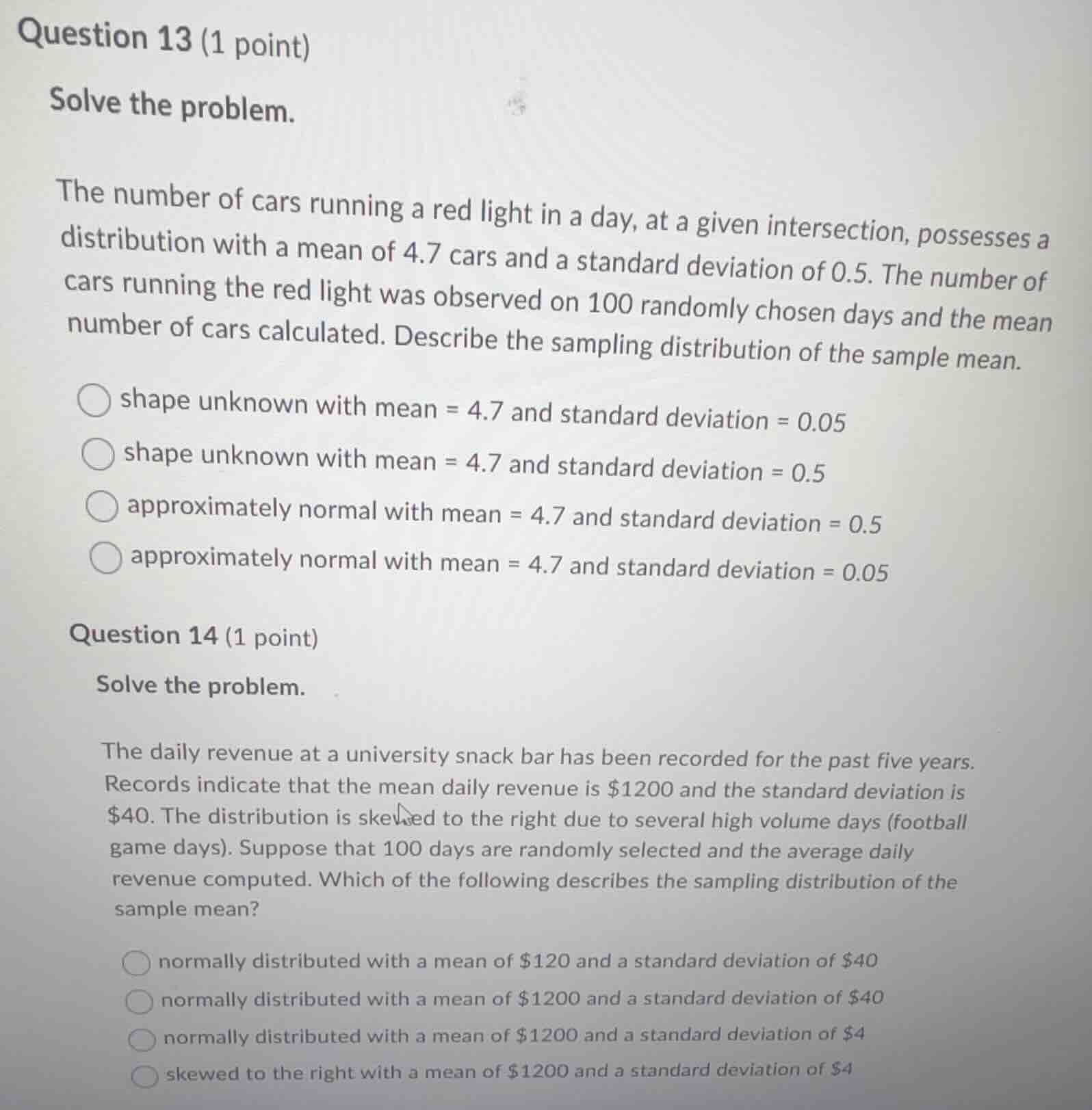
question 13 (1 point)
solve the problem.
the number of cars running a red light in a day, at a given intersection, possesses a distribution with a mean of 4.7 cars and a standard deviation of 0.5. the number of cars running the red light was observed on 100 randomly chosen days and the mean number of cars calculated. describe the sampling distribution of the sample mean.
shape unknown with mean = 4.7 and standard deviation = 0.05
shape unknown with mean = 4.7 and standard deviation = 0.5
approximately normal with mean = 4.7 and standard deviation = 0.5
approximately normal with mean = 4.7 and standard deviation = 0.05
question 14 (1 point)
solve the problem.
the daily revenue at a university snack bar has been recorded for the past five years. records indicate that the mean daily revenue is $1200 and the standard deviation is $40. the distribution is skewed to the right due to several high volume days (football game days). suppose that 100 days are randomly selected and the average daily revenue computed. which of the following describes the sampling distribution of the sample mean?
normally distributed with a mean of $120 and a standard deviation of $40
normally distributed with a mean of $1200 and a standard deviation of $40
normally distributed with a mean of $1200 and a standard deviation of $4
skewed to the right with a mean of $1200 and a standard deviation of $4
Identify parameters for Question 13
Using the Sampling Distribution of the Sample Mean knowledge point
- Population mean \(\mu = 4.7\)
- Population standard deviation \(\sigma = 0.5\)
- Sample size \(n = 100\)
Determine shape and standard error for Question 13
Using the Standard Error of the Mean and Sampling Distribution of the Sample Mean knowledge points
- Since \(n = 100 \ge 30\), by the Central Limit Theorem, the sampling distribution of the sample mean is approximately normal.
- Mean of the sample mean: \(\mu_{\bar{x}} = \mu = 4.7\)
- Standard error of the mean: \(\sigma_{\bar{x}} = \frac{\sigma}{\sqrt{n}} = \frac{0.5}{\sqrt{100}} = 0.05\)
Identify parameters for Question 14
Using the Sampling Distribution of the Sample Mean knowledge point
- Population mean \(\mu = \$1200\)
- Population standard deviation \(\sigma = \$40\)
- Sample size \(n = 100\)
Determine shape and standard error for Question 14
Using the Standard Error of the Mean and Sampling Distribution of the Sample Mean knowledge points
- Since \(n = 100 \ge 30\), by the Central Limit Theorem, the sampling distribution of the sample mean is approximately normal (or normally distributed), regardless of the original skewed population distribution.
- Mean of the sample mean: \(\mu_{\bar{x}} = \mu = \$1200\)
- Standard error of the mean: \(\sigma_{\bar{x}} = \frac{\sigma}{\sqrt{n}} = \frac{40}{\sqrt{100}} = 4\)

Snap & solve any problem in the app
Get step-by-step solutions on Sovi AI
Photo-based solutions with guided steps
Explore more problems and detailed explanations
Question 13
- shape unknown with mean = 4.7 and standard deviation = 0.05
- shape unknown with mean = 4.7 and standard deviation = 0.5
- approximately normal with mean = 4.7 and standard deviation = 0.5
- approximately normal with mean = 4.7 and standard deviation = 0.05 (Correct answer)
Question 14
- normally distributed with mean of $120 and a standard deviation of $40
- normally distributed with mean of $1200 and a standard deviation of $40
- normally distributed with mean of $1200 and a standard deviation of $4 (Correct answer)
- skewed to the right with a mean of $1200 and a standard deviation of $4