Sovi.AI - AI Math Tutor

Scan to solve math questions

QUESTION IMAGE

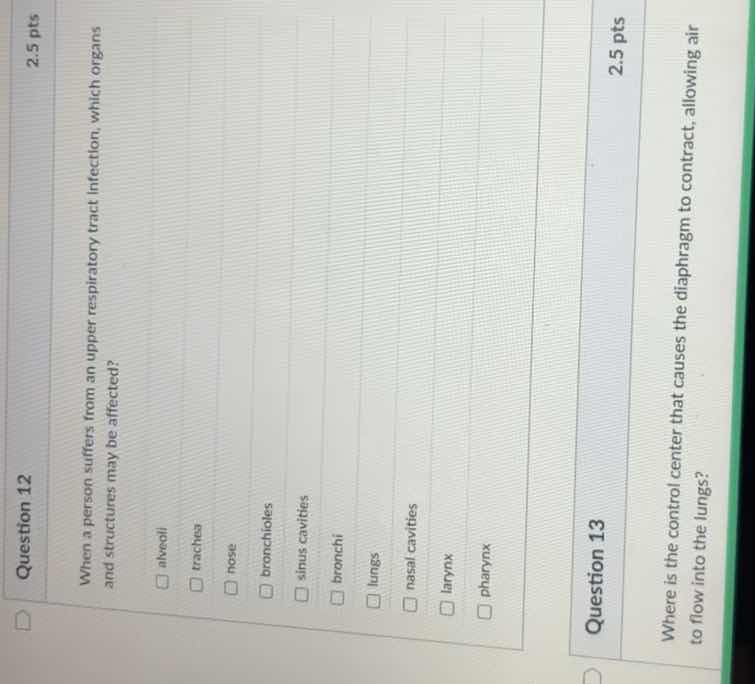
question 12 2.5 pts when a person suffers from an upper respiratory tra…

Question

question 12
2.5 pts
when a person suffers from an upper respiratory tract infection, which organs and structures may be affected?
alveoli
trachea
nose
bronchioles
sinus cavities
bronchi
lungs
nasal cavities
larynx
pharynx

question 13
2.5 pts
where is the control center that causes the diaphragm to contract, allowing air to flow into the lungs?

Explanation:

Response

<pre_analysis>
{
"quality": "clear",
"question_count": 2,
"skills_matched": [
"direct_cot",
"explain_then_answer",
"tutor"
],
"needs_drawing": false,
"concepts_used": [],
"new_concepts": [
"Respiratory Anatomy",
"Upper Respiratory Tract",
"Respiratory Control Center"
],
"current_concepts": [
"Respiratory Anatomy",
"Upper Respiratory Tract",
"Respiratory Control Center"
]
}
</pre_analysis>

<reasoning>

Identify upper respiratory structures

The upper respiratory tract consists of structures outside the thorax. These include the nose, nasal cavities, sinus cavities, pharynx, and larynx. The trachea, bronchi, bronchioles, alveoli, and lungs are part of the lower respiratory tract.

Locate the respiratory control center

The primary control center that regulates breathing and sends signals to the diaphragm to contract is located in the brainstem, specifically within the medulla oblongata and the pons.

Select correct options for Question 12

Based on anatomical definitions, the affected upper respiratory structures are:

  • nose
  • sinus cavities
  • nasal cavities
  • larynx
  • pharynx

Formulate answer for Question 13

The control center that regulates breathing by stimulating the diaphragm is located in the medulla oblongata (and the pons) of the brainstem.
</reasoning>

<answer>

Question 12

The structures affected by an upper respiratory tract infection are:

  • nose
  • sinus cavities
  • nasal cavities
  • larynx
  • pharynx

Question 13

The control center is located in the medulla oblongata (and the pons) within the brainstem.
</answer>

<post_analysis>
{
"subject": "Natural Science",
"question_type": "Multi-part",
"knowledge_point": [
"Natural Science",
"Biology",
"Human Anatomy and Physiology"
]
}
</post_analysis>

Answer:

<pre_analysis>
{
"quality": "clear",
"question_count": 2,
"skills_matched": [
"direct_cot",
"explain_then_answer",
"tutor"
],
"needs_drawing": false,
"concepts_used": [],
"new_concepts": [
"Respiratory Anatomy",
"Upper Respiratory Tract",
"Respiratory Control Center"
],
"current_concepts": [
"Respiratory Anatomy",
"Upper Respiratory Tract",
"Respiratory Control Center"
]
}
</pre_analysis>

<reasoning>

Identify upper respiratory structures

The upper respiratory tract consists of structures outside the thorax. These include the nose, nasal cavities, sinus cavities, pharynx, and larynx. The trachea, bronchi, bronchioles, alveoli, and lungs are part of the lower respiratory tract.

Locate the respiratory control center

The primary control center that regulates breathing and sends signals to the diaphragm to contract is located in the brainstem, specifically within the medulla oblongata and the pons.

Select correct options for Question 12

Based on anatomical definitions, the affected upper respiratory structures are:

  • nose
  • sinus cavities
  • nasal cavities
  • larynx
  • pharynx

Formulate answer for Question 13

The control center that regulates breathing by stimulating the diaphragm is located in the medulla oblongata (and the pons) of the brainstem.
</reasoning>

<answer>

Question 12

The structures affected by an upper respiratory tract infection are:

  • nose
  • sinus cavities
  • nasal cavities
  • larynx
  • pharynx

Question 13

The control center is located in the medulla oblongata (and the pons) within the brainstem.
</answer>

<post_analysis>
{
"subject": "Natural Science",
"question_type": "Multi-part",
"knowledge_point": [
"Natural Science",
"Biology",
"Human Anatomy and Physiology"
]
}
</post_analysis>