QUESTION IMAGE
Question
question 10
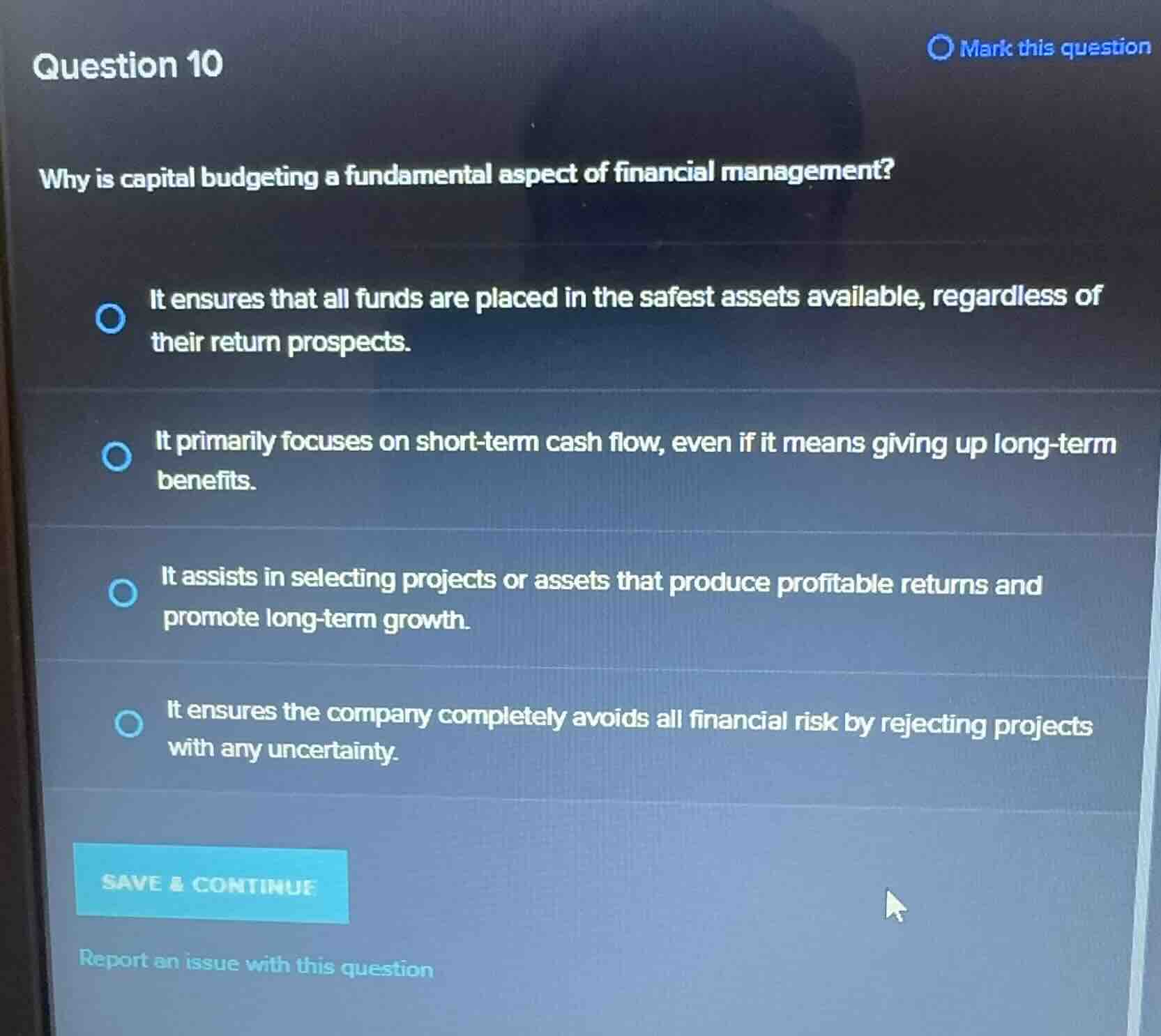
why is capital budgeting a fundamental aspect of financial management?
- it ensures that all funds are placed in the safest assets available, regardless of their return prospects.
- it primarily focuses on short-term cash flow, even if it means giving up long-term benefits.
- it assists in selecting projects or assets that produce profitable returns and promote long-term growth.
- it ensures the company completely avoids all financial risk by rejecting projects with any uncertainty.
Define capital budgeting
Using the Role of Financial Management knowledge point
Capital budgeting is the process a business uses to evaluate, select, and plan major long-term investments or projects. These expenditures involve significant capital outlays, such as purchasing new machinery, building a new facility, or launching a new product line, which impact the company's financial health over multiple years.
Evaluate the options
- Option 1: "It ensures that all funds are placed in the safest assets available, regardless of their return prospects." This is incorrect because financial management balances risk and return; investing solely in low-yield "safe" assets hinders growth.
- Option 2: "It primarily focuses on short-term cash flow, even if it means giving up long-term benefits." This is incorrect because capital budgeting specifically targets long-term strategic investments rather than day-to-day operational cash flows.
- Option 3: "It assists in selecting projects or assets that produce profitable returns and promote long-term growth." This is correct because the core objective of capital budgeting is to allocate resources to high-value, long-term projects that maximize shareholder wealth and drive future growth.
- Option 4: "It ensures the company completely avoids all financial risk by rejecting projects with any uncertainty." This is incorrect because business investments inherently involve risk, and capital budgeting aims to manage and evaluate risk rather than completely avoiding it by rejecting all uncertain projects.

Snap & solve any problem in the app
Get step-by-step solutions on Sovi AI
Photo-based solutions with guided steps
Explore more problems and detailed explanations
- (A) It ensures that all funds are placed in the safest assets available, regardless of their return prospects.
- (B) It primarily focuses on short-term cash flow, even if it means giving up long-term benefits.
- (C) It assists in selecting projects or assets that produce profitable returns and promote long-term growth. (Correct answer)
- (D) It ensures the company completely avoids all financial risk by rejecting projects with any uncertainty.